

Nimbus Therapeutics Secures $1.3B Partnership with Eli Lilly to Advance AI-Driven Oral Weight-Loss Therapy
Nimbus Therapeutics
Small Molecule Drug Developer
Recently, global pharmaceutical giant Eli Lilly made another key move in the field of metabolic diseases. The pharmaceutical giant Eli Lilly and Company and biotechnology company Nimbus Therapeutics announced a research collaboration and licensing agreement valued at up to $1.3 billion. The two parties will jointly develop novel oral small-molecule drugs for the treatment of obesity and other metabolic disorders.
Under the agreement, Nimbus is eligible to receive a total of $55 million in upfront and milestone payments, as well as up to $1.3 billion in development and sales milestone payments and tiered royalties based on net sales. This collaboration builds upon the parties’ previous cooperation in the field of cardiometabolic diseases and aims to leverage Nimbus’s computational chemistry and artificial intelligence-driven drug discovery platform to advance the development of early-stage small-molecule oral weight-loss therapies.
Nimbus Therapeutics, founded in 2009 and headquartered in Boston, Massachusetts, USA, is an innovative enterprise that conducts drug discovery based on structural analysis, leveraging artificial intelligence technologies combined with computational chemistry methods to develop breakthrough small-molecule drugs. Since its predecessor era as Nimbus Discovery, the company has established a clear mission: to target drug targets that are biologically validated but difficult to tackle using traditional approaches.
“A 16-Year Biotech Case Study”—This is how Abbas Kazimi, CEO of Nimbus, positions the company. He stated that after Nimbus was founded, the core question on the founding team’s mind was: How to build a more capital-efficient biotechnology company? Guided by this consideration, Nimbus established three pillars: first, purely computation-driven drug discovery, meaning truly putting existing computational chemistry tools into practice; second, creating a more virtualized organizational structure; and third, its unique business model: building assets, reaching value inflection points, exiting, recycling capital, refinancing, and repeating the cycle.
Nimbus’s core competitiveness lies in building a deep closed-loop R&D engine of “AI + experimentation.”Rather than merely applying algorithms, this platform systematically integrates atomic-resolution protein structures derived from X-ray crystallography and cryo-electron microscopy with physics-based molecular simulations and machine learning predictive models, creating an AI-driven drug discovery toolkit. This enables the team to rationally design small-molecule compounds with both high potency and high selectivity at the atomic level, achieving precise “targeting” of complex targets such as TYK2 and HPK1.
This computation-driven approach, grounded in cutting-edge structural biology, has enabled the continuous advancement of breakthrough molecules targeting “undruggable” targets into clinical stages, thereby consistently attracting strategic bets from global pharmaceutical giants.
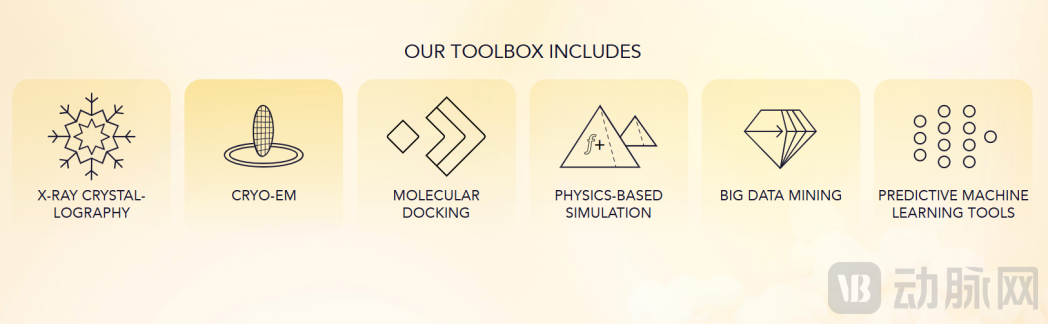
Nimbus’s Toolbox (Image source: Nimbus Therapeutics official website)
Nimbus boasts an interdisciplinary team. Co-founder and Chairman Bruce Booth is a prominent figure in life sciences venture capital, having co-founded or made early investments in numerous biotechnology companies. Among these, Avila Therapeutics and Stromedix were subsequently acquired by major pharmaceutical firms such as Celgene and Biogen. This “build-to-exit” experience has directly shaped Nimbus’s business model. Previously, he served as an executive at the healthcare investment firm Caxton Health Holdings and as an Associate Principal at McKinsey & Company. He is also a Marshall Scholar from the United Kingdom and holds a Ph.D. in Molecular Immunology from the University of Oxford.
Ramy Farid, another co-founder, was formerly an Assistant Professor in the Department of Chemistry at Rutgers University, where his research focused on computational protein design. The innovative docking algorithm he developed became the most-cited article of the year in the Journal of Medicinal Chemistry, laying the technological foundation for Nimbus’s computing platform. Additionally, he holds a Ph.D. in Chemistry from the California Institute of Technology and was previously an NIH Postdoctoral Fellow at the University of Pennsylvania.
CEO Abbas Kazimi holds a master’s degree from Harvard University and has extensive experience in strategic planning, business development, and financing. Since joining Nimbus Therapeutics in 2014, he has helped the company secure over $630 million in equity financing and driven transactions totaling more than $8 billion, including the $6 billion sale of the TYK2 program to Takeda Pharmaceutical and the $1.2 billion sale of the NASH program to Gilead Sciences.
Peter J. Tummino, Ph.D., President of Research and Development, brings over 30 years of experience in drug discovery. Since joining Nimbus Therapeutics as Chief Scientific Officer in 2019, he has led the team in advancing multiple projects into clinical stages. Prior to joining Nimbus, he served as Vice President of Global Drug Discovery at Janssen Pharmaceuticals. During his tenure at GlaxoSmithKline, he drove several epigenetic drugs into clinical trials, including dabrafenib (a BRAF inhibitor) and trametinib (a MEK inhibitor), both approved for oncology treatment. He holds a Ph.D. in Biochemistry from the University of Michigan and has published 85 peer-reviewed academic papers.
Nimbus’s other core members include Dr. Scott Edmondson, Senior Vice President and Head of Chemistry, who has led teams to successfully develop more than ten clinical candidate drugs throughout his career, two of which have been commercialized; Ian Sanderson, Chief Financial Officer, who was named “CFO of the Year for Small Companies” by Boston Business Journal in 2019 and previously served as CFO at Boston Pharmaceuticals and Catabasis Pharmaceuticals; Dr. Anita Scheuber, Senior Vice President and Head of Oncology, who brings over 15 years of oncology clinical development experience in the pharmaceutical industry; and Dan Price, Vice President of Computational Chemistry and Structural Biology, who spent 16 years at GSK and contributed to the discovery of four drugs in clinical development. Together, these cross-disciplinary expertise form Nimbus’s comprehensive capability chain spanning from target selection to clinical advancement.

Key Leaders (Image source: Nimbus Therapeutics official website)
This team, composed of top scientists, drug development experts, and business leaders, is key to Nimbus’s mission of “developing breakthrough medicines through precision small-molecule design.”
Nimbus Therapeutics’ R&D pipeline spans the fields of oncology, immunology, and metabolic diseases.
In the field of oncology, its lead candidate, NDI-219216, is a non-covalent WRN helicase inhibitor targeting microsatellite instability-high (MSI-H) tumors. WRN is a helicase involved in DNA replication and repair, serving as an effective synthetic lethal target in MSI-H tumors, which are commonly found in colorectal, gastric, and endometrial cancers. Preclinical data demonstrate that NDI-219216 induces a DNA damage response in MSI-H tumor cells, thereby inhibiting cell survival and promoting cancer cell death. The dose-escalation phase of the Phase 1/2 clinical trial for this drug has been completed, with data showing favorable safety profiles and target inhibition characteristics.
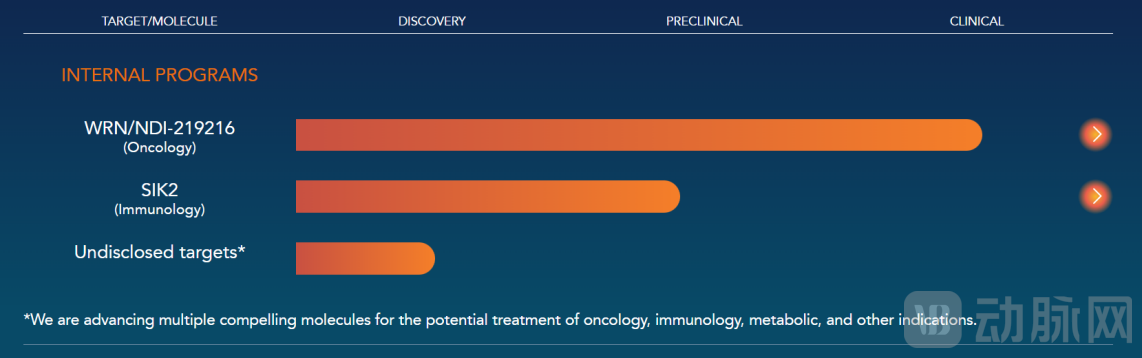
Pipeline Overview (Image source: Nimbus Therapeutics official website)
In the field of immunology, Nimbus has a SIK2 inhibitor program in clinical development. Members of the SIK family belong to salt-inducible kinases, which are involved in regulating transcriptional programs that drive pathological processes such as inflammatory responses and suppress the body’s repair mechanisms. Therefore, SIK inhibitors hold promise for correcting this imbalance by blocking these pathological pathways and promoting tissue repair.
In the field of metabolic diseases, in addition to the new collaborative project with Eli Lilly on an oral weight-loss drug, Nimbus had previously partnered with Eli Lilly on an AMPK activator program.AMPK is a key kinase that senses energy status and maintains metabolic homeostasis. By integrating structural biology with computational chemistry, Nimbus Therapeutics is dedicated to discovering small-molecule activators capable of selectively activating specific isoforms of the AMPK heterotrimer, for the treatment of metabolic disorders such as diabetes, diabetic nephropathy, and metabolic dysfunction-associated steatohepatitis (MASH).
In addition, Nimbus has multiple undisclosed preclinical programs in development.
The value of Nimbus has been validated by a series of major commercial successes.
In 2016, its liver ACC inhibitor project NDI-010976Acquired by Gilead for an upfront payment of $400 million and a total deal value of $1.2 billion, the drug is currently undergoing Phase II clinical trials for the treatment of metabolic dysfunction-associated steatohepatitis.
In 2022, Takeda Pharmaceutical acquired the selective TYK2 inhibitor Zasocitinib (formerly NDI-034858) in a deal with a total value of up to $6 billion. Nimbus received a $4 billion upfront payment and is eligible for up to $2 billion in subsequent milestone payments. The drug is currently undergoing multiple Phase II/III clinical trials. In the same year, Nimbus entered into a research collaboration and licensing agreement with Eli Lilly regarding small-molecule AMPK activators.
In terms of equity financing, Nimbus Therapeutics has completed multiple rounds of funding since its inception, raising a cumulative total of over $637 million. Investors include institutions such as Atlas Venture, Bain Capital Life Sciences, RA Capital, Lilly Ventures, and Pfizer. In addition, Nimbus has also collaborated withGenentech, CelgeneReached multiple licensing agreements with a total value exceeding $1.5 billion.
Global AI-driven pharmaceutical companies are exploring computational physics-driven pathways for drug discovery, but few, like Nimbus Therapeutics, frequently complete landmark deals and advance multiple in-house pipelines into clinical trials.The Rise of Nimbus Therapeutics Demonstrates That the Ultimate Value of AI and Computing in Drug Development Must Be Realized Through Molecules Capable of Addressing Genuine Clinical Needs, While Withstanding Rigorous Clinical Validation and Commercial Translation.
In China, the wave of AI-driven drug discovery is also gaining momentum, with a surge of innovative enterprises emerging. Chinese companies have demonstrated significant vitality in AI algorithm efficiency, automated laboratory construction, and early-stage compound generation, with some companies’ pipelines already entering clinical stages.
Overall, Nimbus’s differentiation is primarily reflected in two aspects: first, its capability for source-level, disruptive design of “undruggable” targets with profound biological foundations, which requires a deeper and more sustained integration of computational models and experimental biology; second, the frequency and scale at which its outputs have garnered “votes” from top-tier global pharmaceutical companies through multi-billion-dollar deals, representing the highest recognition from the global industry of its scientific innovation quality and potential, thereby establishing a sustainable “R&D + validation” closed loop.