MoleculeMind Launches MMDesign Platform, Achieving Over 90% Target Hit Rate in De Novo Nanobody Design

MoleculeMind
AI Protein Design Platform Developer

EstimatedReadReading time: 5 minutes
01
Reshaping the Paradigm of Antibody Discovery
Ultra-Low-Throughput Dry-Wet Closed Loop
Target Hit Rate Exceeds 90%
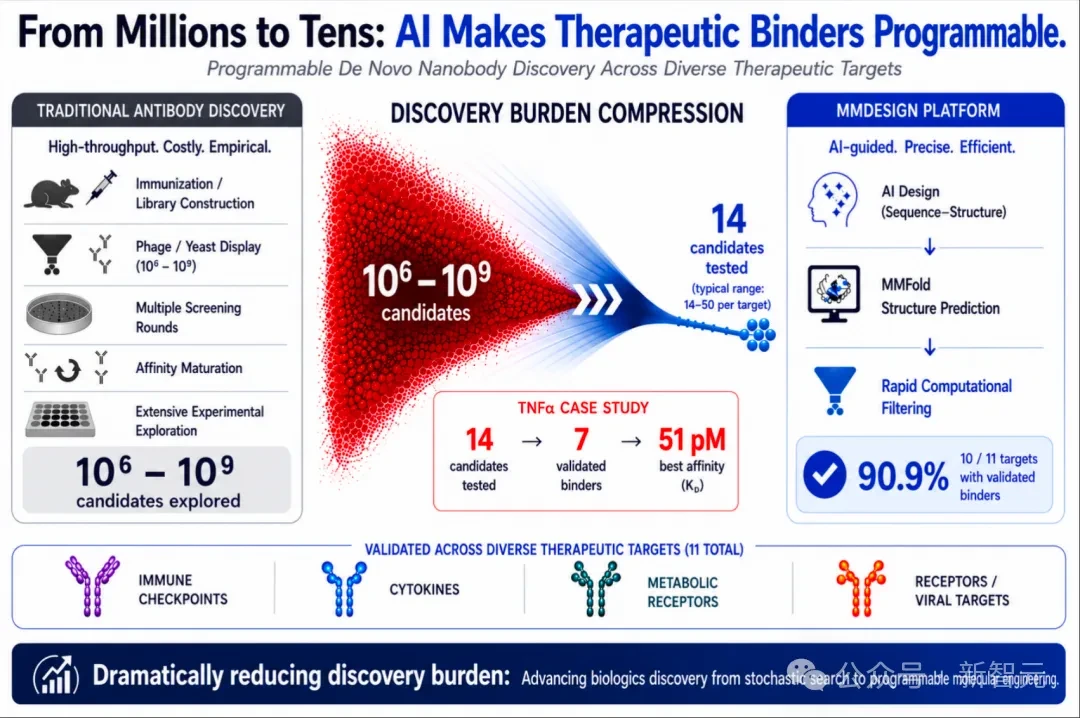
Traditional antibody discovery relies heavily on animal immunization or large-scale library screening, often requiring blind-box experimental validation of millions to billions of candidate molecules, with very limited controllability over binding epitopes and molecular druggability properties.
MoleculeMind has completely reshaped this discovery paradigm.
MMDesign adopts a "generate-and-filter" strategy.
Users need only input the target protein and specified epitope residues, and MMDesign will leverage MoleculeMind’s proprietary protein foundation large model alongside its structure prediction model, MMFold, for collaborative optimization. This process generates tens of thousands of candidate molecules in a single run, which are then subjected to a multi-layered intelligent evaluation system—including structural reliability, sequence naturalness, and physics-based interface assessment—drastically compressing the vast candidate pool to just dozens of molecules per target for wet-lab validation.
In a systematic evaluation of 12 high-value therapeutic targets, including cytokines, immune checkpoints, receptor proteins, and multi-pass transmembrane proteins, MMDesign submitted only 14 to 50 molecules per target for wet-lab validation. Specific binding was successfully confirmed for 11 of these targets, achieving a target success rate of over 90% and demonstrating robust target universality.
Meanwhile, MMDesign has consistently generated a large number of high-activity, practical-grade nanobodies with affinities reaching the nanomolar (nM) or even picomolar (pM) range.
Taking PD-L1 as an example, the hit rate of candidate molecules for this target reached 86.7%, with the optimal molecule exhibiting a high affinity (KD) as low as 7.2 nM.
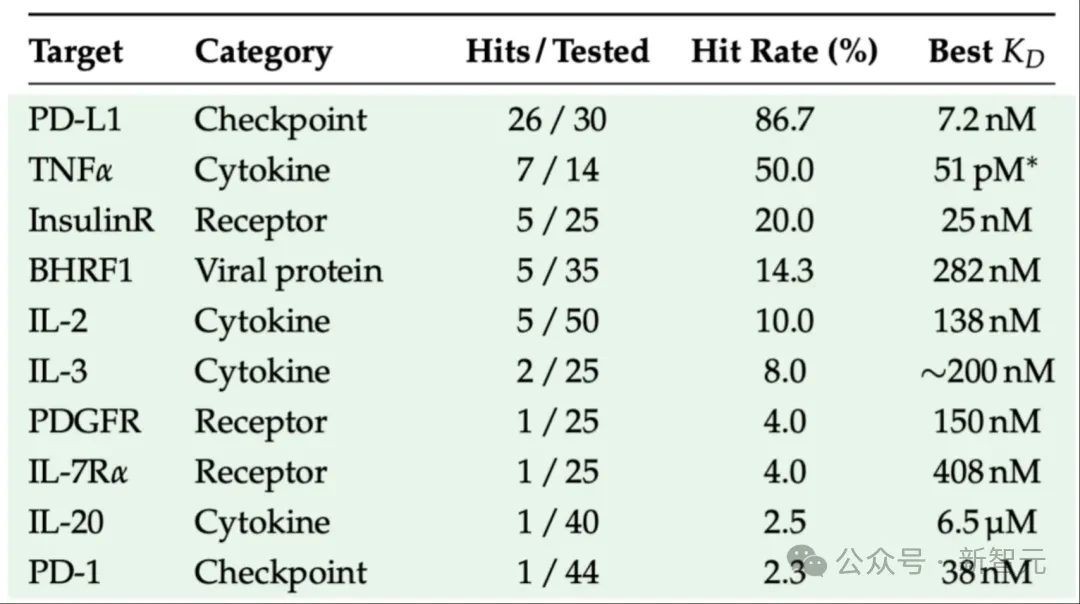
(Experimental Validation Results for Selected Targets)
From an industrial value perspective, these highly active molecules demonstrate exceptional source novelty, successfully pioneering a novel conformational space for binding and establishing a robust patent moat.
This series of data suggests that the traditional, costly "drug screening" process, which typically takes years, is poised to be disrupted by a new paradigm of "AI-driven precise design + ultra-small-scale experimental validation."
02
Breaking the Boundaries of Undruggable Targets
Overcoming Multiple High-Difficulty Targets with Inherent Druggability
In addition to conventional targets, MMDesign has achieved milestone progress in tackling two industry-recognized challenging targets: the shallow trimeric target TNFα and the highly difficult transmembrane protein GPCR.
TNFα is a homotrimeric cytokine whose binding surface is shallow and highly solvent-exposed, making it one of the most challenging target classes for low-throughput de novo design.
In previously published studies of the same kind, no team has achieved success under similar low-flux conditions.
MMDesign achieved a hit rate of up to 50% by testing only 14 candidate molecules, with the highest affinity reaching an impressive 51 pM.
G protein-coupled receptors (GPCRs) constitute the largest family of drug targets in the pharmaceutical industry, yet their extremely complex conformations have long made them a “deep-water zone” that is difficult to target with antibody design.
Among the 29 de novo designed nanobodies by MMDesign, 22 candidate molecules achieved specific binding, with purity levels ranging from 90% to 99% and transient expression yields all exceeding 0.5 g/L.
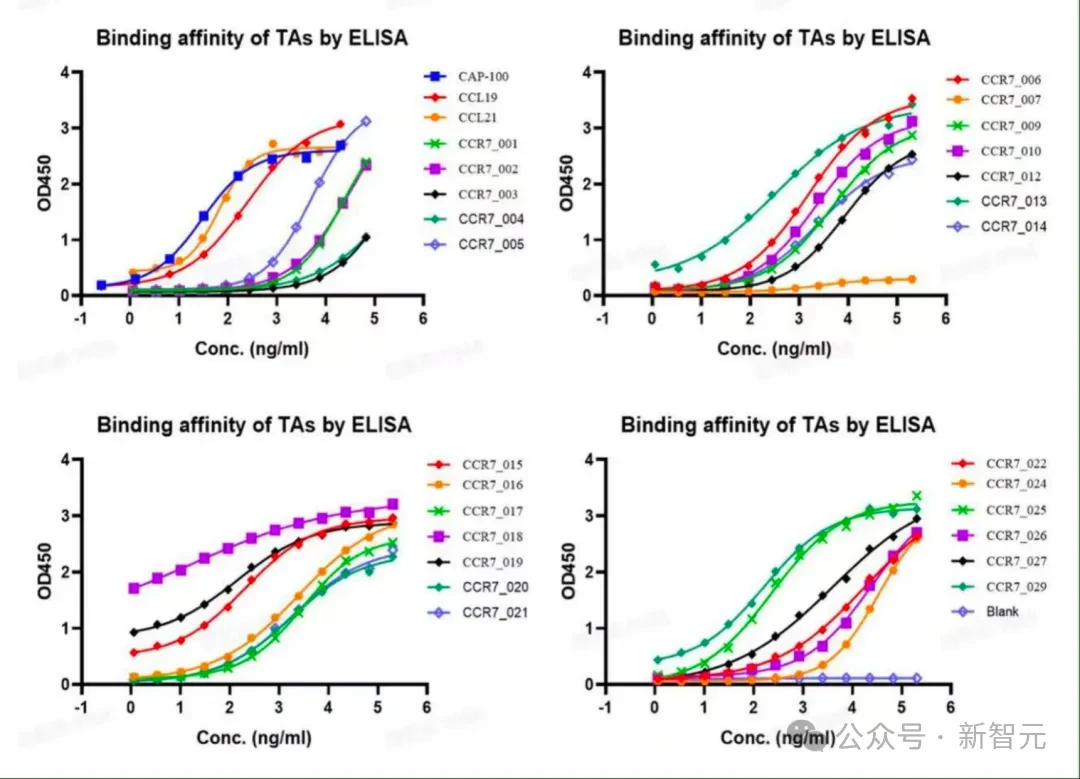
This result indicates that MMDesign incorporates drug-like properties such as “solubility and low aggregation propensity” as intrinsic optimization objectives from the very early stages of de novo antibody design, rather than relying on post-hoc screening.
This capability to significantly front-load and mitigate late-stage CMC risks can greatly enhance the certainty of advancing innovative drugs into the clinical stage.
03
From “Structure Prediction” to “De Novo Design”
Application-Driven Continuous Innovation in Underlying Algorithms
MMDesign achieves high hit rates and high activity for multiple targets at an extremely small scale, stemming from MoleculeMind’s long-term dedication to protein research and applications.
Professor Xu Jinbo, founder of MoleculeMind, is one of the pioneers in the field of protein structure prediction, and his early work laid an important methodological foundation for subsequent breakthrough achievements such as AlphaFold.
MMDesign and its core engine—the all-atom structure prediction model MMFold—also carry forward the innovative legacy of MoleculeMind.
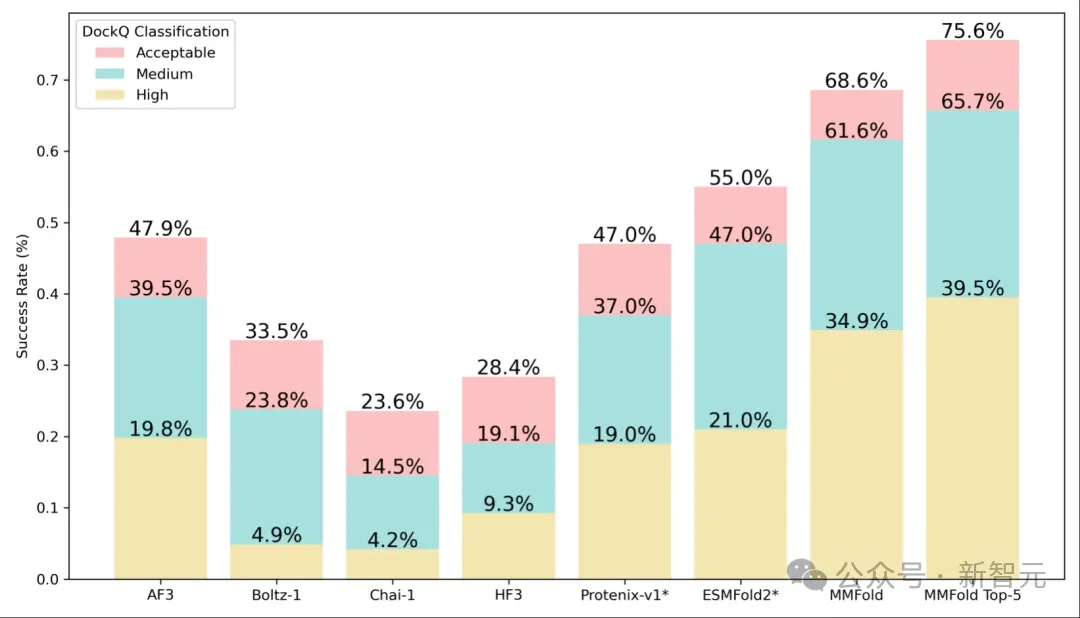
On the authoritative FoldBench benchmark (based on 172 antibody–antigen interfaces), MMFold achieved a Top-1 prediction success rate of 68.6%, significantly outperforming other state-of-the-art models such as AlphaFold 3.
In the highly challenging and industry-prioritized task of high-precision structure prediction, MMFold achieved a success rate that doubled that of other models.
Precise characterization of underlying structural predictions enables MMDesign to “see more accurately,” thereby allowing it to pinpoint target molecules with greater precision within the vast computational space.
“We are building not just a technical tool, but an entirely new infrastructure that redefines R&D paradigms and breaks the ‘Rule of Ten-Ten,’” said Xu Jinbo.
Thus, a clear industrial trajectory is gradually emerging: AI-driven programmable molecular engineering is significantly reducing the burden on biological laboratories, enabling more efficient and higher-success-rate epitope-targeted drug design.
For pharmaceutical companies, this means lower early discovery costs, higher target coverage, faster pipeline advancement, and greater success rates.
Looking ahead, MoleculeMind will leverage its MMDesign platform to further expand into frontier areas such as multispecific biologics, collaborating with global pharmaceutical partners to translate the boundless potential of AI computing into next-generation innovative therapies that tangibly benefit humanity.