

First Stock of HSV-2! This Wuhan Pharmaceutical Company Charges for Hong Kong IPO with the World's Only Phase III Therapy

BINHUI BIOPHARM
Oncolytic Virus Drug Developer
On April 2, 2026, an unusual document appeared in the Hong Kong Stock Exchange's filing system.
This is an IPO application that records a "life-and-death gamble" of BINHUI BIOPHARM, a biotechnology company, regarding its 16-year technological route decision. BINHUI BIOPHARM chose the HSV-2 virus, which was hardly favored by anyone in the global oncolytic virus field, and forcibly broke through the encirclement dominated by the mainstream HSV-1.
Outside the window, the global oncolytic virus market is expanding at a staggering compound annual growth rate of 110.4%. Inside, the prospectus of this Wuhan-based company lies open, each page seemingly answering a crucial question: How can a company that has chosen a non-mainstream technical route carve out a survival space in fierce competition?
1The Gamble Begins: Abandoning Mainstream HSV-1, Betting Solely on the Forgotten HSV-2
The time was fixed in 2010, when founder Dr. Liu Binlei and his team stood at a crossroads.
At that time, the global oncolytic virus field was betting on a clear answer: HSV-1 (Herpes Simplex Virus Type 1). The world's only approved oncolytic virus drug, T-VEC, is based on this backbone. Major pharmaceutical companies and top laboratories alike had their eyes fixed on this "star virus."
But the team of Binhui Biopharm, led by Liu Binlei with an international background, saw something others didn’t.
They chose HSV-2 – an option that was almost forgotten by the industry at the time. This was not a spur-of-the-moment decision but a bold gamble based on scientific intuition.
From a technical perspective, this choice is indeed well-founded: compared to HSV-1, HSV-2 possesses stronger innate oncolytic potency, a richer array of anti-tumor signaling pathways, and, more importantly, greater resistance to human neutralizing antibodies. This means that once the drug enters clinical use, the patient's immune system won't easily "eliminate" it.
The core chip of the gamble is a product named BS001 (OH2 injection), which has become the world's first HSV-2-based oncolytic virus therapy to enter Phase III clinical trials.
The technical details of BS001 read like a precise "surgical operation": the team adopted a dual knockout strategy, accurately knocking out the neurotoxic ICP34.5 – this is akin to equipping the virus with a "tumor navigation system," allowing it to replicate only within cancer cells while avoiding normal cells. Meanwhile, they removed the immune-suppressing ICP47, equivalent to dismantling the disguise tumors use to "hide," enabling the immune system to recognize and attack cancer cells once again.
A more ingenious step is that the team inserted human granulocyte-macrophage colony-stimulating factor (hGM-CSF) into the virus. This is equivalent to launching a "reinforcement flare" on the battlefield. Once the virus lyses inside the tumor, it releases signals to recruit and activate more immune cells to come to the rescue.
BINHUI BIOPHARM's technical logic is not about simply modifying viruses but designing a complete tumor immune attack system. Every component of this system is aimed at enabling the virus to target, attack, and persist in fighting tumors with greater precision, efficiency, and longevity.
2Data Sword: Melanoma OS 46.6 Months, ORR Reaches 42.1% in PD-1 Resistant Patients
The first round of verification in the gamble comes from those numbers in the clinical trial laboratory.
As of 2023, the data from the Phase Ia/Ib trial of BS001 has been gradually released. In patients with advanced melanoma, the median overall survival was 46.6 months, with an objective response rate (ORR) of 34.48% — already an impressive result. The real highlight, however, comes from another figure: in the group of patients who developed resistance to PD-1 therapy, the ORR reached a remarkable 42.1%.
FDA's Fast Track Designation (FTD) Arrives as Scheduled. In June 2023 and August 2025, BS001, developed by BINHUI BIOPHARM, was granted FTD by the FDA for OH2 Injection for two indications: treating unresectable stage III or IV melanoma resistant or progressed after anti-PD-1 therapy, and in combination with PD-1 antibody therapy for microsatellite-stable (pMMR/MSS) colorectal cancer liver metastases that have progressed after at least three lines of treatment.
This designation has put the development of BS001 into the "fast lane." This means that the future review time will be significantly shortened, allowing patients to access this drug much earlier.
Approvals from the regulatory level are coming in like snowflakes.
The breakthrough therapy designation by the National Medical Products Administration (NMPA) has made BS001 the "top seed" in China's oncolytic virus field. Even more remarkably, the FDA has also granted BS001 orphan drug designation for the treatment of Stage III to IV melanoma and malignant glioma.
The label "orphan drug" is backed by a set of harsh figures: In 2024, there will be approximately 351,600 new cases of melanoma worldwide, and this number is expected to increase to 376,600 by 2030, with an extremely low survival rate for patients in the advanced stage. Moreover, malignant glioma is known as the "king of brain cancers," with a five-year survival rate of less than 10%. The FDA's designation means that BS001 has already obtained "priority review rights" for these two indications.
"That seemingly official statement in the prospectus now carries a different meaning when read today: 'These designations for specific indications or subtypes reflect the FDA’s recognition of unmet medical needs or orphan drug status for certain indications within our broad clinical development program.'"
In plain language, it means: The FDA acknowledges that patients in these disease areas have waited too long.
3Strategic Positioning: Global Oncolytic Virus CAGR 110.4%, Only Phase III Trials Worldwide for Two Major Indications
By choosing to file in April 2026, BINHUI BIOPHARM is betting on another dimension: time.
Opening the market analysis report in the appendix of the prospectus, a set of figures stands out: it is projected that from 2024 to 2030, the global oncolytic virus market size will reach 7.6 billion US dollars, with a compound annual growth rate (CAGR) of 110.4%.
At present, BINHUI BIOPHARM is positioned at the intersection of several key tracks.
In the melanoma sector, the global annual incidence exceeds 350,000 people. Currently, the only oncolytic virus drug, T-VEC (based on HSV-1), is already on the market. BS001 is the only Phase III candidate drug in China, which means that once approved, it will directly face a proven market.
In the colorectal cancer field, the global annual incidence exceeds 2.1 million, and currently, no oncolytic virus drugs have been approved. BS001 is the world's only Phase III candidate drug, which is equivalent to planting the first flag in an uncharted territory.
Glioma, soft tissue sarcoma, biliary tract cancer... Each indication listed in the prospectus represents a large patient population and a treatment gap that urgently needs to be filled.
"Our current clinical work mainly focuses on later-line treatment, but as clinical evidence accumulates, we intend to advance towards earlier lines of treatment." This sentence appears plain at first glance, but upon closer reflection, it holds hidden implications.
What does later-line treatment mean? It means that the patient has exhausted all existing therapies and is in a desperate situation. At this point, any effective drug, even if it only extends life by a few months, is invaluable.
And what does "pushing to the front line" mean? It means that once the data is good enough, BS001 may change from "the last hope" to "the preferred choice." This leap implies an exponential increase in market scale commercially.
4R&D Ledger: Accumulated R&D Expenditure Exceeds 187 Million from 2024-2025, Valuation at 3.22 Billion after 7 Rounds of Financing
Flipping open the financial statements reveals a typical "report card" for a biotech company, with the characteristics of "high R&D, high losses, and high financing" still prominent. In 2024, R&D expenditure was 102.8 million yuan, with a net loss of 113 million yuan. In 2025, R&D expenditure reached 84.3 million yuan, with a net loss of 121 million yuan. By the end of 2025, the company had 126 million yuan in cash on hand.
In traditional industries, continuous losses are a danger signal. But in the biotech field, this is almost a "standard feature." The key is, where has all the money been spent?
BINHUI BIOPHARM's funds have mainly been spent in two areas: clinical trials and talent. The former is the only way to validate the technology pathway, while the latter is the core guarantee for maintaining a technological edge.
In terms of financing history, BINHUI BIOPHARM has followed a typical "Chinese innovative drug" path: 7 rounds of financing, from angel round to B+ round, with familiar names such as Longpan Investment, Lepu Biotechnology, Fenxiang Zeshan, and Yangtze River Pharmaceutical appearing on the list of investors.
In December 2023, the company's post-investment valuation reached 3.22 billion yuan. Behind this figure lies the collective vote of confidence from the capital market in the HSV-2 technical route.
An interesting episode is: In October 2025, BINHUI BIOPHARM provided a convertible loan of 10 million yuan to Puling Biomedical. Six months later, this loan was converted into 2.43% equity in Puling Biomedical.
This is not a simple financial investment, but a strategic layout – Puling Biopharmaceutical has deep accumulation in another细分领域, and this investment allows BINHUI BIOPHARM to broaden its technical vision while maintaining focus.
5Ecosystem Upgrade: From Single Drug to Three Major Technology Platforms, Deepening Vertically and Expanding Horizontally
In the 16th year of the gamble, BINHUI BIOPHARM begins to play an even bigger game: shifting from betting on a single product to betting on an entire platform.
Opening the product pipeline chart, what you see is not a single product but a complete "technology matrix": three strategic series, including oncolytic viruses, nucleic acid therapies, and protein biologics.
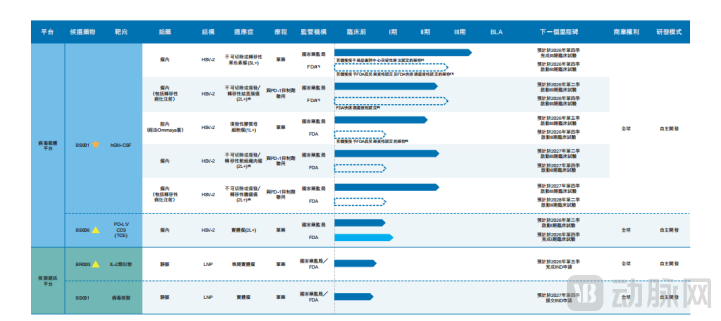
Source: BINHUI BIOPHARM Prospectus
BS006, a new generation oncolytic virus candidate drug based on the HSV-2 platform, integrates three synergistic anti-tumor mechanisms. It is expected to obtain the IND approval in August 2025 and initiate Phase I clinical trials in the second quarter of 2026, representing a deep exploration of the HSV-2 platform.
BR003, an LNP-encapsulated IL-2 analog nucleic acid therapy, is expected to complete its IND application by the third quarter of 2026.
BS051, Virus-like Nucleic Acid Particles, IND Application Expected in Q4 2027: A Horizontal Expansion into the Nucleic Acid Therapeutics Field.
6IPO Blueprint: Raising Funds for Clinical and Commercialization, Aiming at Cutting-edge Therapies to Build Technical Barriers
The funds raised from the IPO will mainly flow into two directions: clinical trials and the commercialization team.
The Phase III clinical trial of BS001 requires significant funding, and the global multi-center trial is even more of a financial burden. The development of other pipeline products such as BS006 also demands continuous investment.
The commercialization layout is even more complex. In the Chinese market, it is necessary to build one's own sales team; in overseas markets, it may be necessary to seek partners. "Strategic cooperation and building an internal team simultaneously" – these twelve words are easy to write but difficult to execute.
At the technical level, the company plans to invest in cutting-edge technologies such as oncolytic nanoparticle therapy. This is not a distraction, but rather a construction of a technological moat. "Creating industry entry barriers," in the field of innovative drugs, technological leadership is the best barrier.
The road to BINHUI BIOPHARM's listing has been a twisting story in itself. In 2021, the company considered an H-share listing, then shifted towards an A-share listing, and ultimately returned to the Hong Kong stock market. These three shifts reflect the changing environment of China’s capital market, as well as the varying choices of a technology company at different stages.
7Track Sample: Validate HSV-2 Route Value, Reshape China's Oncolytic Virus Innovation Landscape
BINHUI BIOPHARM's IPO is not just a bet on the future of a company, but also on the potential of a technological pathway.
Technically, this is a validation of the "non-mainstream." If the HSV-2 route ultimately succeeds, it will open a new door for the entire oncolytic virus field, providing an alternative to HSV-1.
At the market level, this is an impact on "major indications." Melanoma, colorectal cancer, glioma... each one is a tough challenge in the treatment of solid tumors. If BS001 can gain a foothold in these areas, it will prove that oncolytic virus therapy is not only suitable for treating rare diseases but can also enter the mainstream market.
At the capital level, this is a test for "Chinese innovation." The Hong Kong Stock Exchange's Chapter 18A has opened the door to listing for dozens of Chinese biotech companies, but only a few have truly passed the tests of technology, market, and commercial validation. The choices, data, and story of BINHUI BIOPHARM will become yet another sample within this group.
Sixteen years ago, BINHUI BIOPHARM might not have anticipated that this gamble would last so long. Sixteen years later, as the prospectus was submitted to the Hong Kong Stock Exchange system, this gamble entered a new phase.
The outcome of the gamble will be determined by the data from Phase III clinical trials, by the review of regulatory authorities, by market acceptance, and ultimately, by the patients awaiting new drugs.