

Novo Nordisk Announces R&D Restructuring and Layoffs in China and Denmark
Novo Nordisk
Insulin Developer and Manufacturer
On September 18, Novo Nordisk’s official website released the “Plan to Transform R&D Approach,” announcing the layoff of 400 employees in China and Denmark as part of the restructuring of its research and development department.
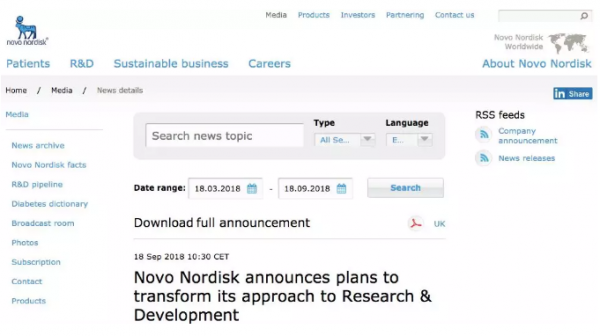
Novo Nordisk Announces Another Round of Layoffs
In fact, this is not the first time Novo Nordisk has laid off employees.
Three months ago, in June this year, media reports indicated that Novo Nordisk was considering implementing a cost-cutting plan that could involve laying off approximately 3,000 employees.
In 2016, to address the increasingly fierce competition in the insulin business market, Novo Nordisk planned to lay off 1,000 employees to help cut costs. The layoffs covered R&D, sales, and administrative departments, with approximately half of the affected employees being from Denmark.
Earlier, in November 2015, Novo Nordisk disbanded its nationwide team of education specialists, along with other sales support, education manager, and finance positions, affecting approximately 100 to 200 employees.
The biggest difference between this round of layoffs and the previous two is that cost reduction was no longer cited as the reason; instead, it was attributed to the restructuring of the R&D department.
It is reported that this layoff and restructuring aims to “accelerate the expansion and diversification of its pipeline for serious chronic diseases,” increasing investment in transformative biological and technological innovations in core therapeutic areas and new treatment fields. Novo Nordisk hopes to successfully develop a series of chronic disease drugs by streamlining its team and focusing its efforts, thereby sharing and alleviating the market pressure faced by its core diabetes business.
Furthermore, Novo Nordisk stated that it expects to establish four “translational research units” focused on discovering new therapies and technologies by the end of 2018. Meanwhile, the company will increase its investments in automation, machine learning, and artificial intelligence, and integrate laboratory infrastructure with information technology systems to enhance the efficiency of its R&D organization.
Mads Krogsgaard Thomsen, Executive Vice President and Chief Scientific Officer at Novo Nordisk, stated, “To demonstrate a higher level of innovation across a broader and more diverse range of chronic diseases, we must establish an optimal foundation of future-ready skills and allocate resources to priority areas. Regrettably, this means that many valued colleagues will lose their jobs, ensuring we have sufficient innovative research capacity to support our long-term development goals.”
IncreasinglyPharmaceutical Company, with a focus on artificial intelligence
Besides Novo Nordisk, many pharmaceutical companies are now realizing that they have redundant manpower and lack competitiveness in areas such as big data and artificial intelligence, prompting them to invest heavily in these fields.
Recently, at the World Internet of Things Expo held in Wuxi, AstraZeneca unveiled new healthcare IoT innovation solutions and announced the latest progress of its “China Commercial Innovation Center” after one year of operation.
It is reported that AstraZeneca has signed agreements with multiple internet companies in one go, continuously increasing its investment in the application of big data and artificial intelligence across various disease areas. This includes signing a strategic cooperation memorandum with Tencent, joining forces with iFlytek Healthcare to support long-term disease management for patients with chronic conditions, and collaborating with Alibaba Health to create an intelligent patient platform based on traceability codes.
Regarding investment and advancement, Wang Lei, AstraZeneca’s Global Executive Vice President, President of International Business and China, stated to the media, “We have over 10,000 employees, with nearly 10% engaged in the industrial implementation of innovations related to the Internet of Medical Things (IoMT). Labor itself represents a significant cost.”
It is evident that numerous multinational pharmaceutical companies have begun to prioritize the application of big data and artificial intelligence across the spectrum from research and development to patient services, and further to comprehensive disease management solutions.
This primarily impacts multinational pharmaceutical companies through adjustments in their R&D and marketing departments.
In terms of R&D, we will vigorously develop more promising new fields and consolidate legacy areas with shrinking markets. In terms of marketing, we will adjust our product promotion models and key product lines in response to policy changes and market developments.
As a result, there will be changes and adjustments in related positions. For example, the R&D team for certain products will be downsized, and the number of sales representatives will be reduced, while staffing levels for key products will be increased.