

Novartis' Promacta Receives FDA Approval as First-Line Treatment for Severe Aplastic Anemia, First New Therapy in Over a Decade
Nov 19, 2018 14:30
CST Updated
14:30

Novartis
Drug Development and Manufacturing
November 19, 2018/Bio ValleyBIOON/--Swiss pharmaceutical giantNovartis(Novartis) recently announced that the U.S. Food and Drug Administration (FDA) has approved the expanded indication label for the immunosuppressive drug Promacta (eltrombopag), in combination with standard immunosuppressive therapy (IST), for children aged 2 years and older and adults with severe aplastic anemia.Anemiafirst-line treatment for (SAA). This approval makes Promacta the first new drug approved in the U.S. market in over a decade for newly diagnosed SAA patients.Previously,FDAPromacta has been granted Breakthrough Therapy designation for the first-line treatment of SAA. Currently, the indication for Promacta as a first-line treatment for SAA is also under review by the European Medicines Agency (EMA), with a final decision expected in 2019.
This approval is based onNovartisAnalysis of data from a clinical study sponsored by the National Heart, Lung, and Blood Institute (NHLBI) and conducted under a Cooperative Research and Development Agreement (CRADA). The analysis results showed that in patients with severe aplastic anemia (SAA) who were treatment-naïve to immunosuppressive therapy (IST), 79% of patients achieved a response (95% CI: 69–87) after 6 months of Promacta combined with standard first-line IST, with a complete response rate of 44%, which is 27 percentage points higher than the historical complete response rate for standard IST alone. Furthermore, the analysis indicated that among patients who continued cyclosporine (CsA) maintenance therapy after 6 months of treatment with Promacta in combination with horse anti-thymocyte globulin (h-ATG) and CsA, the median duration of response was 24.3 months. In this study, the most commonly reportedAdverse Reactions(Incidence ≥5%) includes abnormal liver function, rash, and skin discoloration (including hyperpigmentation).
NovartisTumorLiz Barrett, CEO of the Society for Aplastic Anemia, stated that severe aplastic anemia (SAA) can be fatal if not treated promptly, but many patients do not respond to current first-line treatment regimens. TodayFDAThe approval represents a significant advancement for the patient population with severe aplastic anemia (SAA), enabling physicians to incorporate Promacta into standard immunosuppressive therapy (IST) regimens. This combination therapy has been demonstrated to significantly improve overall response rates and complete response rates, thereby reducing the number of patients who fail to respond to initial treatment.
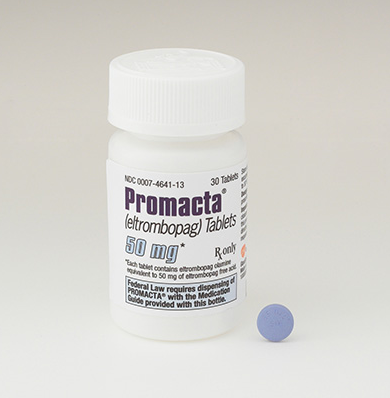
eltrombopagIt is a once-daily oral thrombopoietin (TPO) receptor agonist that increases platelet levels in the blood by inducing the proliferation and differentiation of bone marrow stem cells.As of now, eltrombopagMultiple indications have been approved: (1) for the treatment of thrombocytopenia in adult patients with chronic immune (idiopathic) thrombocytopenic purpura (ITP) who have had an insufficient response to or are intolerant of other treatments; (2) for patients with severe aplastic anemia (SAA) who are refractory to other therapies; (3) for the treatment of thrombocytopenia in patients with chronic hepatitis C (CHC) to enable the initiation and maintenance of interferon-based standard therapy for liver disease; (4) for the treatment of thrombocytopenia in pediatric patients aged 1 year and older with ITP who have had an insufficient response to corticosteroids, immunoglobulins, or splenectomy. The drug is marketed under the brand name Promacta in the United States and as Revolade in Europe and other countries and regions, with indications varying by country and region.
Eltrombopag was developed by the British pharmaceutical giant GlaxoSmithKline. In 2015, Novartis and GlaxoSmithKline completed a $22 billion asset swap transaction, in which Novartis acquired GlaxoSmithKline’s oncology business for $16 billion, with eltrombopag being part of that portfolio.
In 2017, global sales of Promacta/Revolade reached $867 million. In 2018, the drug continued to demonstrate strong growth. According to Novartis’s released Q3 2018 performance report, sales of the drug in the third quarter of that year amounted to $295 million, representing a 32% year-over-year increase, primarily driven by rising demand for thrombopoietin receptor agonists among patients with immune thrombocytopenia (ITP). In the U.S. market, the patent for Promacta was originally set to expire in October, butNovartisThe acquired pediatric indication has successfully extended the patent protection period for Promacta by an additional 6 months.(Bioon.com)