Corheart Medical: How Far Is the Artificial Heart from Replacing Heart Transplantation?

BrioHealth Solutions
Ventricular Assist Device Developer and Manufacturer
Not long ago, many people likely paid attention to the news about artificial hearts: "Medtronic acquired HeartWare for $1.1 billion to strengthen and fill its gap in this field." HeartWare is the world's second-largest artificial heart company. Prior to this, Thoratec, the world's largest artificial heart company, had already been acquired by St. Jude Medical for $3.4 billion in July 2015. This series of mergers has made artificial hearts a hot topic in medical investment. In China, there is also an artificial heart research and development enterprise.——Suzhou BrioHealth Solutions Medical Device Co., Ltd. The artificial heart developed by BrioHealth Solutions is even superior to foreign products, as the company has been continuously exploring the possibility of using artificial hearts as an alternative to heart transplantation. On this topic, Chen Chen, Chairman of BrioHealth Solutions, provided in-depth insights, which also drew significant interest from VCBeat (WeChat ID: vcbeat).
Every year, the world faces a shortage of millions of transplantable organs, leaving most patients in anxious wait, with some even dying while waiting. Heart failure is one of many dreaded conditions; 50% of heart failure patients die within five years, and those with Stage III and IV heart failure have even shorter survival periods. Currently, there is no medical treatment that can reverse this condition; internal medicine treatments only provide relief, making heart transplantation the only effective solution. Data shows that 50% of patients survive for nine years after undergoing heart transplantation. However, taking the United States as an example, nearly 100,000 people require heart transplants annually, yet fewer than 3,000 donor hearts are available. How can such a significant gap be bridged? Artificial hearts have emerged as a viable alternative.
Some people mistakenly believe that a cardiac pacemaker is an artificial heart. In fact, a cardiac pacemaker treats cardiac dysfunction caused by certain arrhythmias by delivering battery-powered electrical pulses from a pulse generator through lead electrodes to stimulate the myocardium in contact with the electrodes, thereby inducing cardiac excitation and contraction. An artificial heart, on the other hand, addresses mechanical function, acting similarly to a mechanical pump. By miniaturizing the pump to a size small enough to be implanted at the heart's location, an artificial heart is created.
Artificial hearts are categorized into two types: one involves removing the native heart and replacing it with a mechanical device, known as a Total Artificial Heart (TAH); the other is an assistive artificial heart, which retains the original heart and places a second “heart” alongside it to work in concert with the native organ. Assistive artificial hearts include left ventricular assist, right ventricular assist, and biventricular assist devices. These represent ingeniously designed products with significant commercial potential. The artificial hearts developed by HeartWare and BrioHealth Solutions both refer to this category of Ventricular Assist Devices (VADs).
In the working principle of ventricular assist devices (VADs), the patient’s heart continues to beat but is unable to provide the total blood flow required by the body. Blood flows through the pump of the VAD, working in conjunction with the heart to supplement the portion of cardiac output that the native heart cannot deliver. (Note: All references to “artificial hearts” in this article refer to ventricular assist devices [VADs].)
Given the pulsatile nature of the heart, the first generation of artificial hearts was the pulsatile-flow artificial heart. It operates via a device that simulates cardiac motion and is implanted in the abdominal cavity. The system includes a sac approximately the size of a cardiac ventricle, which is mechanically compressed and relaxed from above and below to mimic the systolic and diastolic movements of the heart.
Pulsatile-flow artificial hearts demonstrated impressive performance over two decades ago. Clinical data from that period showed that patients receiving optimal medical therapy all died within approximately two years. After implantation with a pulsatile-flow artificial heart, the one-year survival rate reached 52%, double the 25% observed with medical therapy alone; the two-year survival rate was 23%, compared to only 8% with medical therapy. These clinical outcomes significantly boosted confidence and even highlighted the commercial potential of artificial hearts. The HeartMate I, manufactured by Thoratec Corporation, received U.S. FDA approval in 2003 for permanent replacement therapy.
However, the initial success was short-lived. As clinical practice accumulated, it became evident that heart transplantation maintained a survival rate of over 70% at 30 months. In contrast, both medical therapy and pulsatile-flow artificial hearts demonstrated very low survival rates beyond two years. At this point, the advantage of pulsatile-flow artificial hearts over medical therapy disappeared. Coupled with drawbacks such as bulky size, insufficient durability, and poor blood compatibility, internists remained reluctant to refer patients to surgeons for artificial heart implantation, despite FDA approval.
Although pulsatile-flow artificial hearts did not achieve success, this did not hinder the advancement of artificial heart technology. Inspired by fluid dynamics principles from the aerospace industry, continuous-flow artificial hearts based on "pump" mechanisms emerged. Unlike pulsatile-flow artificial hearts, which simulate cardiac motion, continuous-flow artificial hearts generate cardiac function through principles similar to industrial pumps, providing mechanical circulatory support by pumping blood from low pressure to high pressure.
Based on the chronological development of continuous-flow artificial hearts, the principles of hemodynamic support, and the inherent characteristics of the devices, three types have emerged to date: mechanical bearing, hydrodynamic levitation, and fully magnetic levitation.
Mechanical bearing-based artificial hearts function as axial-flow pumps, transporting blood from one end to the other during high-speed rotation. At this point, a traditional Chinese medicine practitioner checking the pulse would be surprised, as the patient no longer has a pulse yet remains alive. The large-scale clinical application of axial-flow pumps has significantly accelerated the rapid development of artificial hearts. In 2010, the FDA approved Thoratec’s HeartMate II for clinical use as destination therapy, marking its transition from bridge-to-transplant therapy to destination therapy.
Although mechanical-bearing artificial hearts represent a qualitative leap forward compared to first-generation pulsatile-flow artificial hearts, their bearings are immersed in blood, making the mechanical components prone to wear and causing significant blood trauma. The prolonged crushing of blood cells by the bearings leads to a considerably high incidence of thrombosis in patients and impairs coagulation mechanisms, rendering these devices unsuitable for long-term operation.
In light of the side effects associated with mechanical bearings, attention has shifted back to suspension-based blood pumps, leading to the development of hydrodynamically levitated artificial hearts. HeartWare’s HVAD is a representative product in this category. The HVAD pump is more compact than its mechanically bearing-supported counterparts. It is positioned adjacent to the heart, drawing blood out and employing hydrodynamic levitation to suspend the rotor. At sufficiently high rotational speeds, the rotor lifts off from the pump housing, achieving full levitation. As the HVAD lacks bearings, it operates without wear, offering high reliability. Moreover, animal studies revealed minimal internal contamination, suggesting an effective resolution of thrombus formation. However, in reality, the extremely thin fluid film within the HVAD generates high shear stress during rotation, causing blood damage and leading to the formation of microthrombi in the vasculature. Consequently, in the pivotal clinical trials, 28.7% of patients experienced one or more strokes within two years.
To date, challenges persist regarding blood compatibility, invasiveness of implantation, infections caused by percutaneous cables, and reliability. Fully magnetically levitated artificial hearts have emerged as a novel solution, presenting significant challenges for research and development. Thus far, only three products worldwide have entered clinical trials. The first product, Terumo’s DuraHeart, completed 68 clinical cases in Europe but was deemed a failure. The second product, WorldHeart’s Levacor, underwent six clinical cases in the United States and also failed to achieve success. Only the third product, Thoratec’s HeartMate 3, has been considered successful, having undergone more than 100 clinical cases in Europe and the United States.
Clinical trials have demonstrated that full magnetic levitation significantly enhances blood compatibility. So why did it still fail? The primary issue was the device’s excessive size, which restricted placement to the abdominal cavity during implantation. This posed substantial surgical challenges, leading to higher risks of infection and perioperative mortality, thereby resulting in low clinical acceptance. The success of HeartMate 3 stems from its pioneering miniaturized magnetic levitation design, enabling intrathoracic implantation—a significant advancement.
Consider this: its U.S. clinical trials, which began in 2014, have already enrolled more than 100 patients to date—an achievement that was previously unimaginable. In July 2015, Thoratec was acquired by St. Jude Medical for approximately $3.4 billion, a move driven in part by the product technology and market potential of HeartMate 3.
Compared to Thoratec and HeartWare in the United States, China’s BrioHealth Solutions is less well-known. Nevertheless, BrioHealth Solutions has been far from low-profile: it is the first high-tech company in China to develop internationally leading artificial hearts and related technologies. Its Chairman, Chen Chen, was selected for the sixth batch of the “Thousand Talents Plan” by the Organization Department of the CPC Central Committee. As a primary inventor of the Levacor artificial heart developed by World Heart in the United States, he brings over 20 years of experience in artificial heart research and development.
Since its establishment in 2008, BrioHealth Solutions has been dedicated to the research and development of its artificial heart product, the CH-VAD. During the product’s development, hemocompatibility was identified as the most critical performance metric for all artificial heart devices. Drawing on his experience, Chen Chen recognized that the CH-VAD must not incorporate bearings, as they would damage blood cells; likewise, a thin hydrodynamic levitation film was deemed unsuitable due to its potential to cause hemolysis. Furthermore, the CH-VAD’s blood pump was designed to be compact, minimize infection risk, and ensure high reliability, while also aiming to keep costs low—including both manufacturing expenses and medical costs associated with adverse effects.
Faced with numerous technical challenges, CH-VAD achieved key structural design in 2011, successfully reduced product size by 2013, completed electronic system integration in 2014, and has already conducted animal trials. Based on currently disclosed specifications, CH-VAD may even surpass the HeartMate 3 to become the most advanced artificial heart in the world.
This perspective is primarily inferred from three aspects:
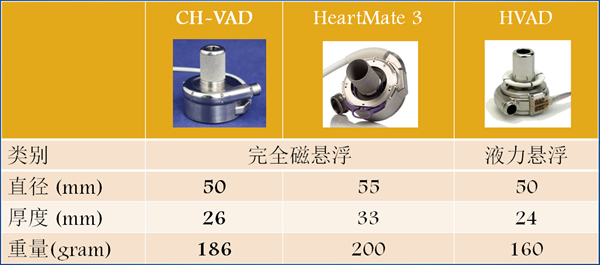
1. Both CH-VAD and HeartMate 3 are fully magnetically levitated artificial hearts. CH-VAD possesses comprehensive independent intellectual property rights, and furthermore, it is smaller in size than the HeartMate 3, resulting in less invasive implantation.
2. The risk of infection in patients with artificial hearts primarily depends on the thickness and flexibility of the percutaneous cable, while damage to the wires and connectors within the cable represents the most critical reliability issue for artificial heart systems. The CH-VAD features four internal wires within its percutaneous cable, which has a diameter of 3.4 mm. This design has been patented in the United States, making it the artificial heart with the fewest and thinnest percutaneous cable wires globally.
3. Compared with the HeartMate 3, the CH-VAD generates lower shear stress and shorter shear exposure time. In preclinical studies involving nearly 30 animals, no thrombus formation was observed, suggesting superior hemocompatibility.
Based on data from the previous decade, the market for artificial hearts is promising. Thoratec’s HeartMate II and HeartWare’s HVAD have achieved high clinical acceptance, with cumulative clinical experience exceeding 30,000 cases. By 2014, sales of these two products reached $700 million. In comparison, the total global output value of the heart valve industry was only $2 billion. The fact that artificial hearts generated $700 million through just two companies’ products underscores their remarkable market potential.
In the treatment of heart failure, both pharmacological therapy and heart transplantation have significant drawbacks: the former offers limited efficacy, while the latter is constrained by a shortage of donor organs. Meanwhile, newer stem cell therapies for heart failure currently face substantial hurdles in obtaining approval from the U.S. Food and Drug Administration (FDA). Consequently, artificial hearts have emerged as the most viable option for improving outcomes in heart failure patients.
Of course, it faces significant market challenges as well. In the United States, artificial hearts serve tens of thousands of patients and generate substantial revenue, not only due to a robust reimbursement system but also because of effective market education. In China, however, while cancer patients may spend hundreds of thousands of yuan to extend their lives, heart failure patients are less likely to do so. With no institutions investing in market education, companies like BrioHealth Solutions lack the resources for such promotional efforts.
The acquisition of Thoratec by St. Jude Medical last year and the acquisition of HeartWare by Medtronic this year are both exciting developments. It is possible that BrioHealth Solutions, among others, may also face acquisition once its product technology matures, as dictated by market forces. The entry of large corporations is essential to drive rapid advancements in the development of artificial hearts.
Finally, returning to the core question: How far are artificial hearts from replacing heart transplantation? Over a ten-year timeframe, nearly 50% of heart transplant recipients survive, whereas among patients using current artificial hearts with mechanical bearings or hydraulic suspension, 50% achieve a survival period of four years, with multiple patients surviving for more than eight years. Industry predictions suggest that artificial hearts employing fully magnetically levitated bearings will further significantly extend patient lifespan and improve quality of life. Chen Chen stated that the CH-VAD is designed for a service life of 10 years. Although the development cycle for artificial heart products is lengthy, he believes that truly viable alternatives to heart transplantation will emerge within his lifetime.
Lenovo Star, established in 2008, currently manages two funds with a total capital of approximately RMB 1.5 billion dedicated to angel investments. In 2015, it was ranked among the top three best angel investment institutions in China by Zero2IPO Group and China Venture. As the early-stage investment and incubation arm of Lenovo Holdings, Lenovo Star leverages over 30 years of entrepreneurial experience and resource accumulation from Lenovo to provide entrepreneurs with distinctive services combining angel investment and in-depth incubation, serving as a "Super Angel" alongside entrepreneurs.
This article is primarily intended for the guest speakers of the MED TED themed speech event, which was part of the sub-forum at the Legend Stars WILL Conference – Xiangyihui Session II.