

Daheng Puxin Ophthalmology Alliance: Enabling Tiered Diagnosis and Treatment through AI-Powered Medical Solutions

Daheng Prust Medical
Ophthalmology Information Service Provider
In late May 2016, four ministries and commissions, including the National Development and Reform Commission and the Ministry of Science and Technology, jointly issued the “Three-Year Action Plan for ‘Internet Plus’ Artificial Intelligence,” marking the first inclusion of “artificial intelligence” in the Chinese Government Work Report.
On July 20, 2017, the State Council issued the “Development Plan for Next-Generation Artificial Intelligence,” which outlined the guiding principles, strategic objectives, key tasks, and safeguard measures for the development of China’s next-generation artificial intelligence toward 2030. The plan called for the promotion and application of new AI-driven models and methods in treatment, and for the establishment of a rapid and precise intelligent healthcare system.
CICC’s report, “120 Charts Outline the Complete Landscape of the Global AI Industry,” also expresses high expectations for “AI + Healthcare.” Breakthroughs in key technologies such as image recognition, deep learning, and neural networks are driving a new wave of significant development in AI-enabled healthcare.
Connecting doctors, patients, hospitals, and equipment through the ophthalmology medical consortium service platform
AI is powerful, but to make models more accurate, artificial intelligence must first establish key medical data and high-quality patient data, and also have a clear understanding of statistical analysis and image processing.
Fortunately, Beijing Daheng Prust Medical Technology Co., Ltd. (hereinafter referred to as “Daheng Prust”) assembled a team of top-tier ophthalmologists and fundus image processing experts in China more than a decade ago. Deeply rooted in the field of ophthalmology, the company has pioneered the exploration of intelligent fundus image analysis technology across various scenarios, including electronic medical records, imaging diagnosis, assisted diagnosis and treatment, big data analytics for personal health, and precision medicine.
Three years ago, in collaboration with Tsinghua University and Beijing Tongren Hospital, among others, we secured a National Key Technology R&D Program project under the 12th Five-Year Plan of the Ministry of Science and Technology, titled “Research on Key Technologies and Application Demonstration of Third-Party Specialized Imaging Services.” As the lead institution, we embarked on the exploration of innovative healthcare models, including internet-based medical services and ophthalmology medical consortia.
After three years of dedicated effort, the research project was successfully completed, and China’s first “Ophthalmology Medical Consortium Service Platform” was launched. With Beijing Tongren Hospital serving as the pilot site, China’s first Ophthalmology Medical Consortium Service Center was established. The network has extended to more than 160 grassroots hospitals nationwide, accumulating data from over 3 million patients and more than 10 million historical medical records. To date, the platform has facilitated over 400,000 remote consultations. Leveraging the “Ophthalmology Medical Consortium Service Platform” and the accumulated dataset of tens of millions of fundus images, and relying on the R&D team of the Chinese Academy of Sciences, Daheng Prust Medical successfully developed the “Huiyan AI” intelligent image analysis software after years of effort. Focused on ophthalmology, this software utilizes advanced image processing technologies and robust big-data algorithms to assist ophthalmologists in rapidly diagnosing fundus-related diseases, thereby reducing misdiagnoses and missed diagnoses.
Leveraging AI to Facilitate the Implementation of Tiered Diagnosis and Treatment for Diabetic Retinopathy
China faces severe population aging, with the proportion of individuals aged 65 and above projected to reach 20% by 2020. Diabetes is one of the most prevalent chronic diseases worldwide. Diabetic retinopathy (DR) is the most common complication of diabetes and the leading cause of irreversible blindness among eye diseases.
Diabetic retinopathy often presents no obvious symptoms in its early stages. Even when mild symptoms do appear, the optimal window for treatment is frequently missed due to patients’ lack of awareness regarding eye care, ultimately leading to irreversible blindness. According to a report by the World Health Organization (WHO), approximately 500 million adults in China are in a pre-diabetic state, with around 110 million diagnosed with diabetes. Among them, roughly 27 million suffer from diabetic retinopathy, one-third of whom (approximately 9 million) are at risk of blindness.
China has approximately 114 million patients with diabetes, yet there are fewer than 40,000 ophthalmologists, resulting in a patient-to-doctor ratio exceeding 3,166:1. This places a heavy burden on hospitals and ophthalmologists, leading to strained doctor-patient relationships. Consequently, the time and energy of ophthalmologists have become scarce resources. To address the shortage of medical resources in large hospitals, the Chinese government has been vigorously promoting "tiered diagnosis and treatment" to promote the equalization of basic medical and health services. However, how can patients in third- and fourth-tier cities, or even in remote mountainous areas, access high-quality ophthalmic care? How can the work efficiency of ophthalmologists be improved? How can limited ophthalmic medical resources be balanced? These are the primary objectives that Daheng Prust Medical aims to achieve through its deployment of diabetic retinopathy screening and artificial intelligence (AI) solutions.
The AI-powered intelligent auxiliary diagnostic system developed by Daheng Prust Medical is primarily applied in core healthcare scenarios to address the shortage of high-quality ophthalmic medical resources. By leveraging machine assistance to perform repetitive screening tasks, the system offers a more economical and efficient solution. It helps ophthalmologists at large hospitals further enhance productivity, enables primary-care ophthalmologists to achieve intermediate-level diagnostic and treatment capabilities, and allows ophthalmologists to devote more energy to higher-value clinical work.
Since 2008, Daheng Prust Medical has been conducting free screenings for diabetic retinopathy (“DR”) in rural towns and villages across Beijing. By adopting a three-tier diagnostic and treatment model characterized by “screening at the community level, diagnosis and treatment at secondary hospitals, and referral of complex cases to central hospitals,” the company has decentralized fundus screening to grassroots community hospitals. Motivated secondary hospitals are assigned to centrally diagnose patient data and fundus images uploaded by their affiliated grassroots hospitals. Meanwhile, central hospitals with strong ophthalmic capabilities are organized to provide consultations or accept referrals for complex cases that exceed the diagnostic and treatment capacities of secondary and grassroots hospitals. This approach has established an eye disease prevention and blindness control system tailored to the characteristics of Chinese hospitals, covering nearly 10 million rural residents, including over one million individuals aged 55–85 who are the target population for DR screening.
To date, Daheng Prust Medical’s ophthalmic disease screening services have rapidly expanded across China, including in Beijing, Shanghai, Tianjin, Inner Mongolia, and Henan Province. The company has established deep collaborative partnerships with local Health and Family Planning Commissions, blindness prevention offices, and major tertiary Grade A ophthalmic hospitals. Furthermore, beyond diabetic retinopathy screening, it has pioneered innovative screening models for other ocular conditions, achieving notable outcomes and accumulating extensive experience in ophthalmic disease screening.
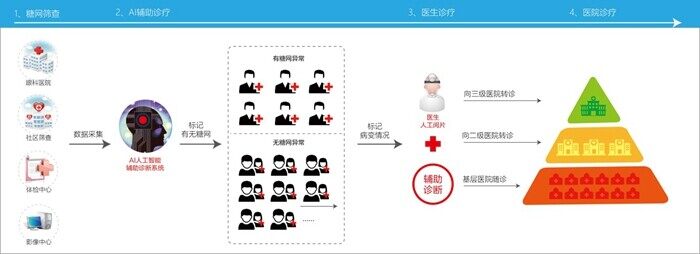
Leveraging the extensive experience and vast medical data accumulated through existing ophthalmology medical consortium platforms and screening systems, Daheng Prust Medical utilizes its domestically leading artificial intelligence (AI) diagnostic technology. Following the completion of screenings, the company pioneered the use of its AI diagnostic system, “Huiyan,” for automated image analysis. This system automatically classifies fundus images of diabetic retinopathy (DR), efficiently identifying and flagging the majority of normal cases without DR and the minority of abnormal cases with DR. For abnormal fundus photographs, the system marks pathological features such as hemorrhages and exudates and provides staging recommendations for DR diagnosis. This allows ophthalmologists to focus their efforts primarily on patients with DR lesions, reducing repetitive workload in image review. Consequently, mild cases can be managed at primary care levels while severe cases are referred to higher-level hospitals, significantly improving the work efficiency of screening physicians.
Extend high-quality medical resources and services from tertiary hospitals beyond their walls, enabling hospitals at all levels to fully leverage their respective medical resources, improve the operational efficiency of the entire healthcare system, address the shortage of ophthalmologists in China, lower the threshold and cost of diabetic retinopathy screening, empower primary care physicians to fulfill their role as the nerve endings of health protection, thereby enhancing the overall prevention of diabetic retinopathy.
Currently, Daheng Prust Medical has collaborated with several renowned ophthalmic research institutions, including Beijing Tongren Hospital, Peking Union Medical College Hospital, and the Shanghai Eye Disease Prevention and Treatment Center, on AI-assisted screening and diagnosis of diabetic retinopathy. Significant progress has been made in intelligent analysis of eye diseases, such as the recognition of diabetic retinopathy and cataracts, particularly in the screening of diabetic retinopathy. The company has sequentially launched image processing systems tailored to different conditions. These solutions have demonstrated favorable application outcomes in practical scenarios, including primary-level ophthalmic screening, hospital outpatient services, intelligent diagnosis, and remote image review and consultation.
In the future, Daheng Prust Medical will actively explore the integrated applications of AI-assisted diagnosis and treatment with ophthalmic precision medicine, big data analytics for personal health, and family doctor contracting services.