

AiCure Files IPO Prospectus: AI-Powered Medication Adherence Platform Backed by NIH and Global Pharma Giants
AiCure
AI Medical Service Provider
For clinical drug researchers, 90% of patient behaviors are unpredictable, and whether patients take their medication on time has a significant impact on study outcomes. For patients, taking medication on schedule can accelerate the disease treatment process. However, various factors may lead to poor medication adherence (not taking medication or not taking it on time), such as patients' unhealthy lifestyle habits, mood, infrequent contact with doctors, and environmental and climatic influences.
Improving Patient Medication Adherence Through Technological Means
Eight years ago, healthcare expert Adam Hanina and his colleagues identified a critical issue in clinical trials: because many patients failed to adhere to the prescribed dosing schedules and amounts set by researchers, it was impossible to accurately assess the efficacy of drugs in clinical trials. This compromised the outcomes of clinical studies, directly contributing to the failure of 20% to 30% of clinical trials annually, resulting billions of dollars in financial losses. Each year, millions of high-risk patients are hospitalized due to poor medication adherence, adding approximately $290 billion in treatment costs.

To address this issue, Adam Hanina partnered with Laura Shafner, who has a background in finance, to co-found the mobile SaaS (Software as a Service) platform AiCure in New York in 2010.The company uses image and facial recognition algorithms to verify patients' medication ingestion behavior, thereby improving medication adherence.
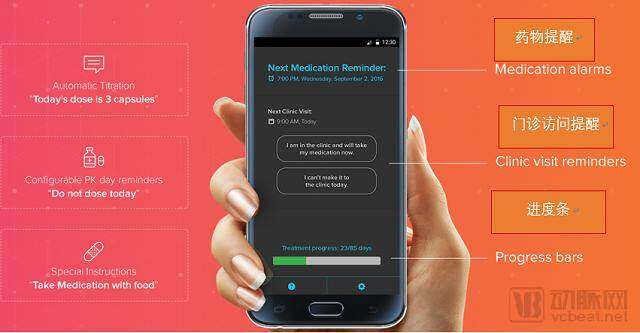
AiCure’s primary product is a mobile application that can be used on any camera-enabled mobile device, leveraging the device’s camera to verify whether patients have taken their medications as scheduled.
Mobile App User Interface
App Recognition Process:
(1) Acquire patient data through mobile technology and facial recognition technology;
(2) Use algorithms to automatically identify whether patients have prepared the correct medication and whether they are taking it at the appropriate time;
(3) Record the patient's condition after medication administration;
(4) and transmit the encrypted and de-identified record data to a cloud-based dashboard via a HIPAA-compliant secure network;
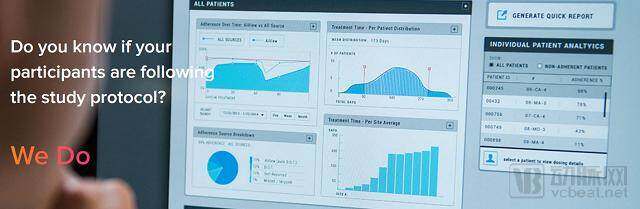
(5) Researchers or healthcare providers can monitor users’ medication adherence in real time and address potential issues. Researchers can also communicate with patients through the dashboard to provide immediate assistance.
Additionally, the application provides interactive guidance, reminders, and recommendations to further enhance patient adherence.
AiCure's AI-Powered Work Platform:

Adam Hanina, CEO of AiCure, stated, “AiCure is the only scalable, clinically validated platform capable of medication ingestion recognition on mobile devices. It not only transforms patient behavior but also ensures accurate dosing, fully streamlining the clinical trial process and avoiding costly hospitalizations.”
AiCureThe company’s technical team likens it to a personal trainer at a gym. It can send medication reminders and dosage instructions to patients, monitor multiple routes of administration for various drugs—such as oral, sublingual, inhalers, and injection pens—and supports multiple language modes. Additionally, equipped with machine learning capabilities, the system continuously optimizes monitoring and treatment plans as data accumulates. When abnormal medication-taking behavior is detected, the system can also issue alerts.。
Although there have been methods available on the market to assess adherence, such as medication counters used for recording and tracking management, these devices cannot determine actual intake. Direct observation of patients is somewhat intrusive, and the resulting reports on patient medication-taking behavior are not sufficiently precise or reliable.
Laura believes: “Most existing medication adherence monitoring methods are designed for either clinical research or clinical practice, but not both. Our technology aims to fill this gap by first providing a standardized approach and then measuring data in a standardized manner across all domains.。”
Clinical Trial: AI Can Improve Stroke Patient Rehabilitation
Did your patient take their medication on time?
In the United States, stroke is the fifth leading cause of death, claiming nearly 129,000 lives annually. Globally, the number of deaths attributed to stroke exceeds 33 million. Anticoagulants can prevent stroke, making their use essential for patients.
However, due to many uncertainties, many stroke patients are unable to manage their condition effectively, often forgetting or even refusing to take anticoagulants, which increases the risk of stroke and bleeding. If stroke patients use an artificial intelligence platform on their smartphones to remind them to take their medication, the likelihood of adhering to anticoagulant therapy will significantly increase.
Results from a 12-week controlled trial published by the American Heart Association showed that all stroke patients using AiCure’s artificial intelligence tools adhered to their anticoagulant regimen (which helps prevent stroke), whereas only 50% of the 12 patients in the control group did. The study demonstrates the significant potential of artificial intelligence in enhancing stroke treatment processes and reducing clinical care costs.

Enhance Statistical Data Capabilities and Reduce Clinical Trial Costs
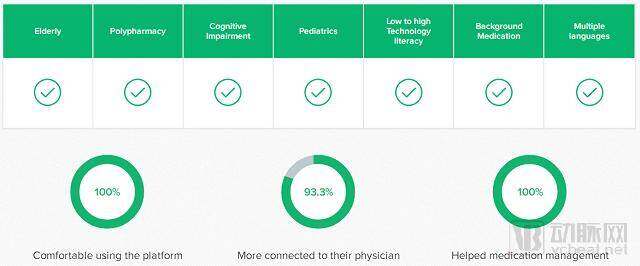
AiCure's application facilitates clinical practice across multiple hospital departments, including Cognitive Disorders, Geriatrics, and Pediatrics, and has received consistent acclaim for its user experience.
AiCure will develop an advanced mobile technology platform by leveraging deep learning, computer vision, machine learning, and predictive analytics, integrated with the latest advancements in artificial intelligence. This platform will provide continuous medical care to patients worldwide and lead researchers into a new era of visual diagnostics.
Awards & Honors
CB Insights’ newly released list of the Top 100 Most Promising AI Startups globally evaluated and screened over 2,000 startups across more than 25 sectors worldwide, including healthcare and cybersecurity, ultimately selecting the 100 most promising AI companies. Despite a selection rate of less than 5%, AiCure secured a spot on the list thanks to its exceptional strength.
AiCure received the 2016 Scrip Award in the category of “Best Technological Development in Clinical Trials,” in recognition of its significant contributions to enhancing the efficiency of clinical trials and research. The Scrip Awards, presented by SCRIP—a globally leading authoritative pharmaceutical journal—honor leading pharmaceutical companies that have achieved remarkable success and made outstanding contributions in fields such as pharmaceuticals, clinical development, financing, medicine, ophthalmology, and biotechnology.
In addition, AiCure was also named a Gartner Cool Vendor in 2016 andThe AIconics awardsTwo Major Awards.
$12.25 million Series A financing
AiCure has been steadily advancing its technological development. At the company’s inception, with funding from the Small Business Innovation Research (SBIR) program provided by the U.S. National Institutes of Health (NIH), the AiCure team hired an artificial intelligence engineer to develop this recognition-capable application.
During only the first phase of the company’s establishment, the AiCure team successfully demonstrated the technical feasibility of the platform—namely, its ability to verify whether patients have ingested their medication.
Building on this success, AiCure secured SBIR funding from the NIH again in 2013 during its second phase to support the development of a platform for drug research and clinical treatment.
The $7 million in funding provided by the NIH enabled AiCure to conduct technology research and development. After meeting the app’s predefined basic requirements, the team proceeded to use the app to analyze drug levels in the blood, thereby enhancing medication adherence among patients with schizophrenia and stroke.
In 2016, the company completed a $12.25 million Series A financing round, led by New Leaf Venture Partners, with participation from Pritzker Group Venture Capital, Tribeca Venture Partners, and Biomatics Capital, to continue developing its application and therapeutic monitoring technologies.
Hanina stated, “The initial two SBIR grant awards were instrumental in our company’s development. Support from the National Institutes of Health (NIH) enabled us to attract venture capital investors and secure an additional $12.25 million in financing.”
Furthermore, AiCure has contracted with five of the top 12 pharmaceutical companies globally to leverage its app for adherence monitoring in clinical drug trials. Among them, Takeda Pharmaceutical Company, a U.S.-based firm, is conducting clinical trial research on patients with mental disorders.
Atul R. Mahableshwarkar, Director at Takeda Pharmaceutical Company, stated, “Patient non-adherence to prescribed medication regimens is a significant challenge in clinical trials. The AiCure platform can help enhance our ability to assess drug efficacy and simultaneously reduce the number of patients required for studies.”
In addition to their collaborations with pharmaceutical companies, the AiCure team also partners with academic institutions and investors across multiple fields to continuously test its application. The app will later be utilized in National Institutes of Health (NIH) research on substance abuse, while the team collaborates with government organizations and insurance companies on population health issues related to infectious diseases and cardiovascular diseases.
. AiCure hopes to popularize this technology globally to help high-risk patients address their health risks (for high-risk patients, missing the correct medication timing can lead to extremely serious consequences, such as hospitalization or even death).
AiCure has also joined the “Tuberculosis Control Program” of the Los Angeles County Department of Public Health, which leverages artificial intelligence to monitor medication adherence among tuberculosis patients and individuals with latent tuberculosis infection.