

Anobiomed Files IPO Prospectus: Pioneering China's Indigenous CAR-T Therapy with Over 90% Remission Rates

Annuobode
Developer of Immuno-Oncology Antibody and Gene Therapeutics
In the film “Dying to Survive,” the domestic price of “Glenin,” a medication for treating chronic myeloid leukemia, is 25,000 yuan per bottle. Patients need to take one bottle per month for life, which undoubtedly forces them to “pay to prolong their lives.”
“Gleevec” took Novartis nearly half a century to develop, with an investment of $5 billion, yet the patent protection period stipulated by law is only twenty years. For pharmaceutical companies, given such substantial investments, new drugs must be priced high to achieve a return on investment. If these new anti-cancer drugs were introduced into China, adding various costs such as labor, transportation, and value-added tax on medicines, the final domestic price would be unaffordable for ordinary people.
In the field of cancer immunotherapy, CAR-T therapy has achieved remarkable success in treating B-cell malignant hematologic tumors, with approximately 90% of patients with B-cell leukemia achieving complete remission after receiving CAR-T treatment. Currently, Novartis and Kite Pharma have gained approval for their new CAR-T therapies, Kymriah (CTL-019) and Yescarta (KTE-C19), priced at $475,000 and $373,000 respectively. When these drugs are marketed in China, they will become the next "Gleevec."
How exactly can the predicament depicted in "Dying to Survive" be resolved?
From a macro-policy perspective, the state has employed measures such as medical insurance coverage, reduced drug tariffs, and streamlined distribution channels to exert some control over drug prices. Nevertheless, most patients still find these treatments unaffordable. The root cause lies in China’s weak R&D capabilities, which have long relied on following and imitating foreign innovations. Only when we can independently develop and produce these “miracle cures,” thereby securing pricing power for Chinese stakeholders, can the predicament depicted in the film *Dying to Survive* be truly resolved. Therefore, in the new frontier of CAR-T therapy, we must adhere to complete independent innovation, accelerate the end-to-end R&D and validation of CAR-T technologies, and reduce costs, ensuring that the plight portrayed in *Dying to Survive* does not continue.
The New Battlefield in Cancer Treatment: CAR-T Therapy
Immunotherapy is currently the most highly sought-after cancer treatment modality, encompassing adoptive cell therapy, immune checkpoint inhibitors, non-specific immune stimulation, tumor vaccines, and oncolytic viruses. Among these, CAR-T therapy, a form of adoptive cell therapy, has garnered significant industry favor and has become a critical clinical intervention for hematologic malignancies.
CAR-T Therapy: Chimeric Antigen Receptor T-Cell ImmunotherapyIn simple terms, this therapy involves isolating immune T cells from the human body and equipping them with a "new radar"—a chimeric antibody capable of recognizing tumor-specific antigens—thereby generating CAR-T cells. These engineered CAR-T cells are then infused back into the patient’s body to identify and destroy tumor cells.
CAR-T therapy is no longer a traditional pharmaceutical treatment but a living "cellular drug," akin to humans personally "training" T cells to recognize and eliminate tumor cells, thereby achieving a curative effect on cancer.
In 2017, the dispute between Feng Zhang’s team and the University of California, Berkeley over who would secure the CRISPR/Cas9 patent rights caused a stir in the industry; the patent battle was both a defense of rights and a contention for profits.
Currently, there are dozens of CAR-T technology R&D companies in China, but some are still imitating foreign R&D processes and applying overseas research achievements to clinical trials. After spending substantial funds, they can only verify the efficacy of foreign technologies.
Gary Jing, founder of Ningbo Annuobode Biological Pharmaceutical Technology Co., Ltd., told reporters that international pharmaceutical giants have set their sights on China’s CAR-T market, with Sino-foreign joint ventures such as WuXi Jienuo and Fosun Kite already conducting clinical trials in the country. Once these companies’ products receive marketing approval, they will inevitably engage in fierce market competition with domestic enterprises. At that point, intellectual property (IP) will become a “Sword of Damocles” hanging over local firms. Should IP litigation arise, domestic companies lacking independent IP rights will face significant challenges when confronting foreign pharmaceutical corporations directly. Therefore, only by persisting in independent research and development and securing proprietary IP rights for CAR-T technologies can Chinese companies avoid being exploited by foreign entities entering the Chinese market.
Gary Jing: “The development goal of Annuobode is to develop CAR-T technology with independent intellectual property rights in China.”
Ningbo Annuobode Biological Pharmaceutical Technology Co., Ltd. (hereinafter referred to as “Annuobode”) is an emerging player in the field of antibody drug development. Established in November 2017, the company was founded by Gary Jing, who previously served as a Research Assistant at the University of Oklahoma Health Sciences Center in the United States. He has long been engaged in fundamental immunological research and the screening and development of antibody drugs, and has published multiple research papers in international academic journals in related fields. After returning to China in 2012, Gary Jing served as a Senior Scientist at GenScript, where he led his team in conducting research in areas such as antibody drug screening, gene editing, and recombinant lentiviral vector packaging.
Through the joint efforts of its partners, Annuobode has attracted a large pool of top-tier talent in the biotechnology sector, rapidly assembling a professional team with capabilities in technological innovation, clinical validation and translation, and market development and operations. Currently, Annuobode has established comprehensive platforms for monoclonal antibody screening, antibody engineering, phage display, and cell and gene editing. Building on this foundation, the company is prioritizing breakthroughs in humanized/fully human CAR-T technology and innovative antibody drug research and development.
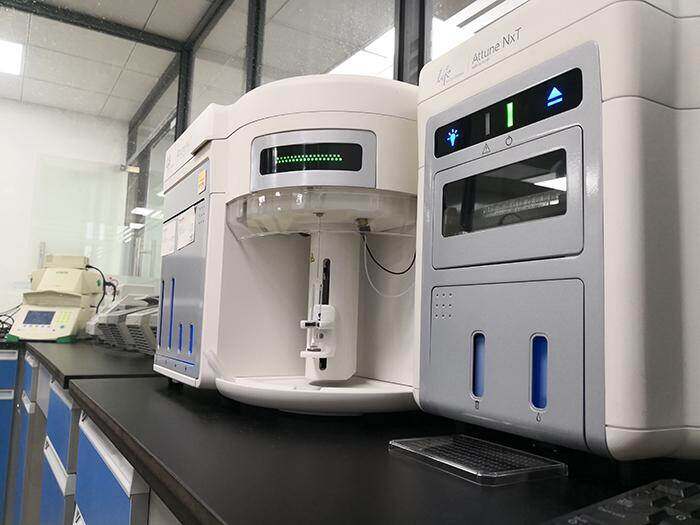
Annuobode Laboratory Instruments (Image provided by the company)
Gary Jing stated that the inevitable development trend of CAR-T technology is the progression from murine antibodies to humanized antibodies, and finally to fully human antibodies.
Currently, the CAR-T novel drugs Kymriah (CTL-019) and Yescarta (KTE-C19), which have been approved for marketing abroad, still utilize murine-derived antibody sequences. However, murine protein structures differ from human protein sequences after all. Early clinical trials of antibody drugs demonstrated that the dosage of murine monoclonal antibodies required escalation with repeated administration. This phenomenon occurs because the human immune system gradually mounts an immune response against murine antibodies upon exposure, generating anti-murine antibodies that neutralize the therapeutic murine monoclonal antibodies (known as the HAMA response).
Similarly, CAR-T cells prepared using murine monoclonal antibodies are recognized by the immune system upon entering the human body, triggering corresponding immune responses and gradually being cleared by the immune system. As CAR-T cells are lost, patients may experience disease relapse.
To address this issue, Annuobode is committed to developing humanized CAR-T therapies with independent intellectual property rights. This involves engineering over 90% of the murine antibody sequences into human sequences, retaining only the tumor-recognizing regions. Since the engineered humanized antibodies consist almost entirely of human protein sequences, the immune response against them is significantly reduced. This leads to prolonged persistence of CAR-T cells in vivo, thereby extending the duration of patient remission.
Currently, Annuobode has achieved significant progress in its two R&D projects. One is the humanized anti-CD19 CAR-T therapy currently undergoing clinical trials. To date, 30 patients with acute B-cell lymphoblastic leukemia have received the infusion, achieving a complete response rate of over 92%, with some patients maintaining remission for as long as 2.5 years. The other project is a clinical trial targeting multiple myeloma, which has also demonstrated a complete response rate exceeding 90%. The longest duration of remission observed has surpassed one year, with patients remaining in complete remission.
It is reported that Ningbo Annuobode Biological Pharmaceutical Technology Co., Ltd. is about to initiate clinical trials for fully humanized anti-CD19 CAR-T therapy. In this approach, the antigen-recognition domain of the CAR is composed entirely of human antibody sequences, thereby minimizing the risk of human anti-mouse antibody (HAMA) responses following CAR-T cell infusion.
Although Annuobode has been officially established for less than a year, it has already collaborated with numerous medical institutions both domestically and internationally. The company has launched collaborations on CAR-T clinical trials with the Affiliated Hospital of Xuzhou Medical University, Zhejiang Provincial People's Hospital, the Affiliated Hospital of Jiangsu University, and the First Affiliated Hospital of Nanchang University, among others.
Meanwhile, Ningbo Annuobode has partnered with Malaysia’s VOYA Therapeutics to establish an international multicenter CAR-T clinical trial, which has currently achieved satisfactory response rates. The company is also collaborating with Malaysia’s Hygieia Therapeutics to jointly develop gene therapies for the treatment of thalassemia.
To date, Annuobode has filed four invention patents, namely “An Immune-Enhancing Reagent,” “An AAV Virus Capable of Efficiently Infecting Immune Cells and Its Preparation Method and Applications,” “A Preparation Method for Chimeric Antigen Receptor T Cells,” and “A Chimeric Antigen Cell Receptor and Its Applications.” It is expected that the company will file three additional major invention patents by December 2018.
Against this backdrop, in April 2018, Annuobode completed a Series A financing round worth tens of millions of RMB, with Xie Li Investment, a firm specializing in the biotechnology sector, as its partner. The company will accelerate the research and development of fully human CAR-T therapies, striving to identify more novel targets and develop indications for a broader range of conditions. Annuobode has already initiated the development of universal CAR-T technologies and CAR-T therapies for solid tumors.
It was revealed that the company is currently planning and preparing for its Series B financing round.
The development history of CAR-T therapy dates back to the 1980s and 1990s, but it was primarily international pharmaceutical companies such as Novartis from Switzerland, Kite Pharma and Juno Therapeutics from the United States that successfully commercialized CAR-T products.
Among them, Novartis’s Kymriah (CTL-019) is the first CAR-T therapy approved by the FDA for marketing, indicated for the treatment of acute B-lymphoblastic leukemia (Acute Lymphocytic Leukemia, ALL). Kite’s Yescarta (KTE-C19) followed closely behind, becoming the second CAR-T therapy approved by the FDA for marketing.
To date, no domestically developed CAR-T therapies have been approved for market launch in China. With the introduction of multiple regulatory guidelines in 2017, the CAR-T industry has gradually entered a period of robust growth. Although enterprises have sprung up like mushrooms after rain, few possess independent innovative R&D capabilities. If this trend continues, Chinese patients may ultimately face not a domestically produced “Gleevec,” but rather patent wars and drug price monopolies imposed by foreign pharmaceutical companies—resulting in a situation where effective treatments are available but remain unaffordable.
“Only by committing to original innovation can Chinese pharmaceutical R&D enterprises stand tall, enabling patients and the market to break free from dependence on foreign pharmaceutical companies at an earlier date!”