

Behind the Halved Stock Price: A Deep Dive into Ping An Good Doctor's Business Model (Part 1) – Introduction and Product Overview

Juventas
Innovative Cell Therapy Drug Developer
Editor’s Note: This article is reprinted from “Notes on Learning for Wealth” (ID: Think_Big_Long_Deep), authored by Jiang Tianjiao. VCBeat has republished it with authorization.
On December 19, 2018, Ping An Good Doctor marked exactly six months since its IPO, with its share price having halved from the listing high of HK$57. Three years to list, half a year to halve—this milestone moment warrants a careful examination of Ping An Good Doctor’s business model. As follows:
The significance of Ping An Good Doctor’s IPO is immense. Prior to this, various research analyses on internet healthcare were confined to examinations of products, users, and business models. Financial metrics—such as revenue, profit or loss, and gross margin—that are commonplace in corporate analysis seemed perpetually irrelevant to the internet healthcare industry. Practitioners have finally been able to observe, through Ping An Good Doctor’s prospectus, how the internet healthcare business model performs when underpinned by financial data.
It is necessary to provide a brief overview of Ping An Good Doctor. As a representative enterprise in the internet healthcare industry, Ping An Good Doctor launched its mobile app for the first time in April 2015 (nearly four years later than Chunyu Doctor, the pioneer of mobile healthcare). Its main offerings include online medical and health services (such as family doctor consultations via online channels and appointment registration), consumer-oriented medical services (including offline services such as physical examinations, genetic testing, dental care, and medical aesthetics), a health mall (an e-commerce model for health-related physical goods, comprising both self-operated and platform-based businesses), and health management and interaction services (targeting end-users with customized information and reminders, generating revenue through advertising). From 2015 to 2017, the average daily number of consultations on Ping An Good Doctor reached 40,000, 180,000, and 370,000, respectively. According to publicly available information, apart from Chunyu Doctor, which once stated that its daily consultation volume could reach 100,000, no other company has achieved this scale.
Ping An Good Doctor’s business model is not as clear and straightforward as one might imagine. Its 575-page prospectus is exceedingly dense, with overlapping data presentations and noticeable descriptive and computational errors—all of which can significantly hinder readers’ analysis of the business model. Therefore, this book adopts a three-part layered approach to examine Ping An Good Doctor’s business model: Part One provides an overview based on basic financial data, offering a broad perspective and intuitive impression (which, however, can often be misleading when interpreting the business model); Part Two conducts an in-depth, root-cause analysis and discussion of its core profitability model, including revenue sources, gross margin analysis, and identification of the true drivers of revenue; Part Three highlights and discusses the genuine strengths of Ping An Good Doctor’s business model that have gained recognition within the industry.
Products and Services: Rich, comprehensive, and steady
Before analyzing Ping An Good Doctor, let us review the product forms that have emerged in internet healthcare since 2011, covering the pre-consultation, during-consultation, and post-consultation stages. These include health science popularization content, online consultations, online registration, specialist appointments (including surgeries), medical escort services (strictly speaking, the service is offline, while the booking process is online), pharmaceutical e-commerce (including the O2O model), and online health management (including chronic disease management). Looking back at Ping An Good Doctor’s products, we find that they offer a comprehensive suite of all these services.
In fact, the differentiation in the quality of internet healthcare products often lies not in ordinary internet aspects such as UI (User Interface) and UE (User Experience), but in whether they can achieve their ultimate objectives—a distinction that yields markedly different experiences in “casual trial” versus “real-world scenario” contexts. Whether these objectives are met—such as obtaining clear online consultations for diseases or health issues, successfully booking appointments with desired physicians, and purchasing needed medications affordably and efficiently—ultimately depends on the abundance of medical resources and the ability to integrate industry chain resources. These factors are beyond the reach of internet product managers.
For Ping An, the industry’s “resource dependency threshold” has instead enabled it to thrive in the internet healthcare sector. By the end of 2017, Ping An Good Doctor had partnered with 3,100 hospitals, including over 1,000 Grade A tertiary hospitals, as well as 1,100 health examination centers, 500 dental clinics, and 7,500 pharmacies. It also provided access to 2,100 chief physicians from Grade A tertiary hospitals for its “Find a Top Specialist” service. While these figures may not appear as exaggerated as the hundreds of thousands of registered doctors claimed by other platforms during the same period, they are closely aligned with actual business operations and have secured Ping An Good Doctor a strong position in high-end medical resources. The quality of internet healthcare products often hinges on resource availability and integration capabilities, rather than on interaction design and user experience alone. (Users do not engage with internet healthcare apps for entertainment as they would with mobile games or short-video platforms like Douyin; moreover, the user experience of tool-oriented apps tends to become homogeneous over time due to iterative updates and imitation.) In this regard, Ping An holds a distinct advantage.
User Count: A Surge Driven by Strong Promotion.
Ping An Good Doctor launched its app in April 2015. Over the next three years—2015, 2016, and 2017—its registered user base reached 30.3 million, 132 million, and 193 million, respectively. In other words, within just one year, Ping An surpassed Chunyu Yisheng, which was founded in 2011, to claim the top position in the industry. Well-versed in internet valuation logic, Ping An Good Doctor recognized that growth in registered users alone was far from sufficient, as similar metrics could be artificially inflated through tactics such as app store ranking manipulation or direct user acquisition purchases. Therefore, Ping An spared no effort in driving active user engagement through operational strategies. Its monthly active users (MAUs) reached 5.6 million, 21.8 million, and 32.9 million in 2015, 2016, and 2017, respectively—an impressively high performance for a healthcare app, a sector typically characterized by low-frequency user demand.
Certainly, Ping An also incurred significant costs in this endeavor. Its promotional marketing and advertising expenses amounted to RMB 130 million, RMB 590 million, and RMB 470 million in 2015, 2016, and 2017, respectively. This spending helped spawn “Step by Step to Gold,” a campaign centered on the theme of earning money by walking, which became a representative marketing case. Furthermore, the user acquisition and activation efforts of Ping An Good Doctor greatly benefited from the Ping An Group’s broader product promotion initiatives (with clear profit-sharing arrangements within the group).
Revenue and Profit Performance: Explosive Revenue Growth Amidst Staggering Losses
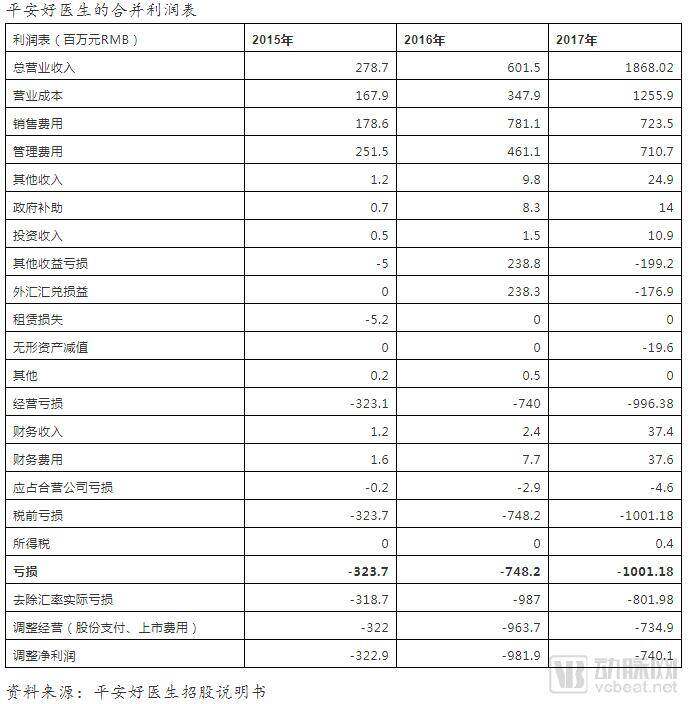
In terms of revenue scale, Ping An Good Doctor’s performance has been quite outstanding. From 2015 to 2017, the company achieved operating revenues of RMB 279 million, RMB 602 million, and RMB 1.868 billion, respectively. The revenue growth rates for 2016 and 2017 reached 116% and 211%, respectively, and this momentum in revenue growth is expected to continue for some time.
However, from a profitability perspective, the situation presents a stark contrast. Fortunately, under the “Internet” label, Ping An Good Doctor’s substantial losses appear somewhat more acceptable. Excluding non-recurring items such as foreign exchange gains and losses, Ping An Good Doctor reported net losses of RMB 323 million, RMB 982 million, and RMB 740 million in 2015, 2016, and 2017, respectively, accumulating to over RMB 2 billion in losses over the three-year period.
In the second part, which dissects the profit model, we will focus on exploring what has led to Ping An Good Doctor’s simultaneous surge in revenue and massive losses.
A Review of Ping An Good Doctor: The largest internet healthcare enterprise in China, featuring a rich and comprehensive product portfolio and significant advantages in resource accumulation. It amassed nearly 200 million registered users within three years, with 32.9 million monthly active users. In 2017, its revenue reached RMB 1.868 billion, while it incurred a loss of RMB 740 million.
From the perspective of the business models of general internet companies, regardless of their front-end delivery formats (such as search engines, video platforms, or various tool-based service apps and websites), the only three models that have been widely validated and can directly generate revenue are advertising, e-commerce, and gaming.
As an “internet healthcare” enterprise, Ping An Good Doctor naturally operates within this framework. The overly entertainment-oriented format of “gamification” always somewhat challenges user expectations when paired with the theme of medical and health services, but it is not entirely implausible. Ping An Good Doctor has extensively experimented with various product formats, including live streaming; however, its primary revenue streams are likely advertising and e-commerce. Is this inference accurate? Let us examine the revenue structure in detail.
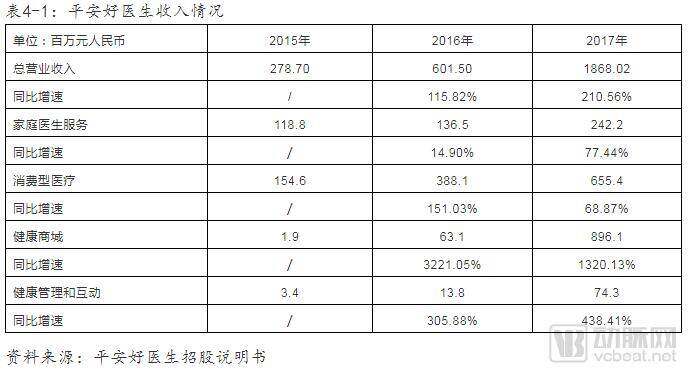
Ping An Good Doctor’s primary revenue streams are divided into four business segments: family doctor services, consumer healthcare, the health mall, and health management and engagement. Specifically, family doctor services primarily refer to the online consultation services provided by Ping An Good Doctor (a model quite similar to that of Chunyu Yisheng, etc.). Consumer healthcare mainly involves the sale of products such as medical check-up services, medical aesthetics services, and dental care services. The health mall can be understood as a platform for selling all health-related products (though it also sells other items). Lastly, health management and engagement, while appearing to be a service-oriented product, does not generate revenue through service sales but rather through advertising, displaying over 4,300 feed ads daily.
In 2015, when the product was first launched, its primary revenue streams came from family doctor services and consumer healthcare, reaching approximately RMB 120 million and RMB 150 million, respectively. It is important to note that this was merely the initial stage of the product’s first year on the market. For most internet healthcare companies, generating revenue is not a consideration during the first year of product launch, nor do they typically have the capacity to focus on monetization; achieving user growth alone is considered a success. Even Chunyu Doctor, a pioneer in online lightweight consultations, has never generated revenue of such magnitude from its online consultation services. Clearly, the differences at the product level between these entities are insufficient to account for such a significant disparity in revenue.
In 2016, the situation underwent a significant shift. Compared to the impressive performance in 2015, when only nine months of operation generated RMB 120 million in revenue, the total revenue for the entire year of 2016 was merely RMB 137 million. Looking at user metrics, the number of registered users in 2016 reached 132 million, more than four times the 30.3 million registered in 2015. The average monthly active users (MAU) in 2016 stood at 21.8 million, nearly four times the 5.6 million MAU recorded in 2015. Furthermore, the average daily consultation volume increased from 40,000 in 2015 to 180,000 in 2016, also representing a more than fourfold growth. Given that the number of registered users, monthly active users, and consultation volumes all achieved fourfold increases, why did revenue decline instead? Why were user growth and monthly active users not driving revenue growth?
This is completely counterintuitive for internet industry professionals. The phenomenon of a surge in user base coupled with a decline in revenue is virtually impossible in internet products, as the ARPU (Average Revenue Per User) should not experience a drastic drop. It was only after the public release of Ping An Good Doctor’s 575-page prospectus that we were able to trace the clues and uncover the answer: The number of users is not the primary driver of Ping An Good Doctor’s revenue. This business does not rely on online internet sales; instead, Ping An Group directly procures services from Ping An Good Doctor by paying fixed fees, and then drives members to use the Ping An Good Doctor APP for consultations and services. These users are all recorded as paying users.
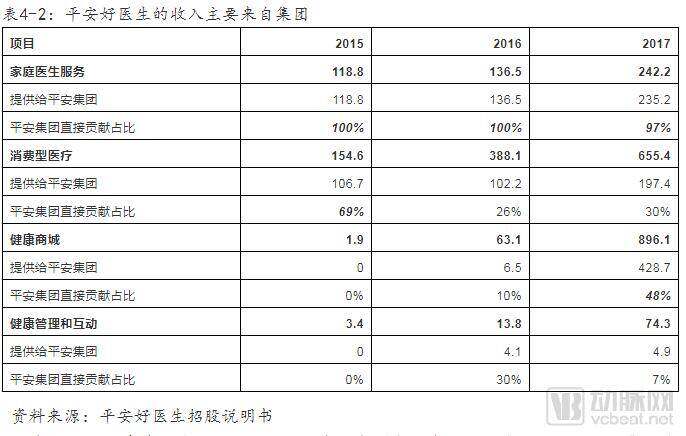
It is evident that the so-called family doctor services (online consultations) were almost entirely procured by Ping An Group. The “success” of Ping An Good Doctor has made all online consultation companies more acutely aware that pursuing B2C sales through customer operations is not a viable path. Zhang Rui, founder of Chunyu Doctor, which is known for its lightweight consultation model, deeply understands this challenge. In 2015, he publicly expressed similar views. At that time, Zhang Rui was searching for a sustainable profitability model and once believed the answer lay in a “membership system,” drawing confidence from the fact that “92% of respondents in telephone interviews with 400 samples indicated their willingness to pay.”
In early 2014, he vigorously promoted an online membership service priced at 8 yuan per month (equating to a maximum annual ARPU of 96 yuan), which allowed users to consult with doctors at secondary and tertiary hospitals without any limits on the number of consultations. As a result, within one month, the volume of inquiries on the platform plummeted from 30,000 per day to just 3,000, representing a 90% drop. Zhang Rui has always maintained that “overestimating users’ willingness to pay” was the most foolish mistake he ever made. In fact, Zhang Rui’s error was not cognitive; the “membership model” is indeed a proven viable revenue model for online medical consultations. The critical issue lay in the choice between serving individual consumers (B2C) versus businesses (B2B).
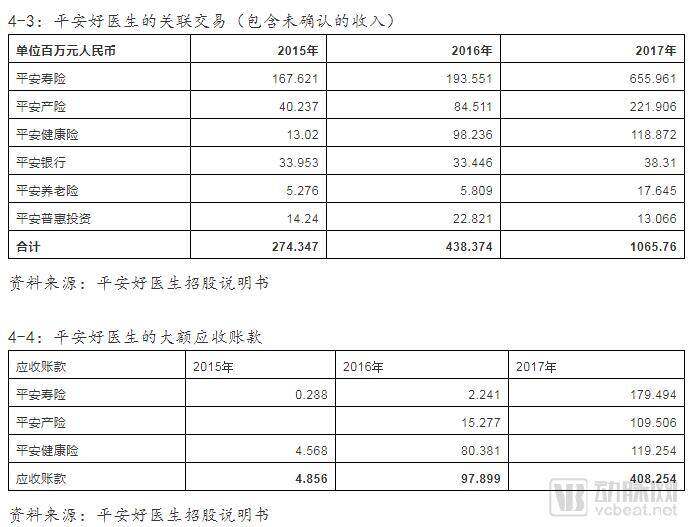
Returning to the case of Ping An Good Doctor, we can further observe that the contributions of Ping An-affiliated enterprises to Ping An Good Doctor extended beyond what has been previously discussed. The table below presents statistics on related-party transaction amounts. Some figures include unconfirmed revenue (as service-based products may not meet accounting recognition criteria in certain cases). Nevertheless, it is evident that purchases of goods exceeding RMB 10 million through related-party transactions reached RMB 275 million, RMB 438 million, and RMB 1.066 billion in 2015, 2016, and 2017, respectively. This clearly demonstrates the Group’s strategy of continuously supporting Ping An Good Doctor via related-party procurement. Furthermore, in 2017, related-party transactions involved substantial accounts receivable amounting to RMB 409 million. This was part of the final push toward Ping An’s listing; although revenue was recognized, actual cash inflows were not necessarily fully realized. In contrast, the Group’s support for Ping An Good Doctor in terms of cash flow during 2015 and 2016 was “more tangible,” with no accounts receivable exceeding RMB 100 million recorded in those years.
In summary, Ping An Good Doctor’s rapid growth has been heavily reliant on support from the Ping An Group. In the first two years, this support even played an absolutely dominant role. Specifically, revenue from family doctor services was not driven by the app’s own operations or user fees, but rather came 100% from B2B procurement within the Ping An Group ecosystem. As a result, user growth was not correlated with revenue; indeed, from a narrow financial perspective, lower user engagement could potentially reduce Ping An Good Doctor’s operating costs. However, viewed from a broader strategic standpoint, expanding the user base and enhancing user activity can not only drive conversions in other business segments but also elevate the company’s valuation.
- In May 2016, Ping An Good Doctor initiated its first round of financing, raising $500 million. This round simultaneously set two records: “the largest single financing round for a mobile health startup globally” and “the highest valuation for a Series A round,” with a post-money valuation reaching $3 billion.
- Meanwhile, in 2016, the consumer healthcare segment of Ping An Good Doctor achieved a growth rate of 151%, reaching RMB 388 million, making it the most standout growth segment that year;
- In 2016, Ping An Good Doctor's annual revenue reached RMB 602 million, dominating the internet healthcare sector;
- In 2017, Ping An Good Doctor's health e-commerce platform entered its harvest period, with revenue reaching RMB 896 million. Whether the profitability driven by this revenue is equally robust remains to be analyzed in subsequent sections; however, it indeed surpassed the total revenue generated by all business segments throughout the entire year of 2016.
- In 2017, Ping An Good Doctor achieved 192 million registered users, a 45% increase; monthly active users reached 32.9 million, up 51%; daily average consultations totaled 370,000, surging by 105%; and revenue from family doctor services grew by 77%, reaching RMB 242 million.
In that year, Ping An Good Doctor achieved a total revenue of RMB 1.868 billion—standing alone at the summit of internet healthcare.
(To be continued...)