

Six Strategic Insights on the Productization of Medical Artificial Intelligence: From Core Value to Market Readiness

Xishi Yigou Medical
Medical Artificial Intelligence Technology R&D, Equipment Manufacturer
As artificial intelligence begins to venture into the healthcare sector and gradually gains understanding and acceptance among physicians, hospitals, and patients, its commercialization pathway remains shrouded in uncertainty.
Enterprises at different stages often face distinct pathways for advancement. Currently, the commercialization of medical AI is stalled in a vacuum period between "submission of applications" and "approval of applications," prompting startups to embark on their respective journeys to find viable paths for survival.
While action is indeed urgent, we must engage in deep reflection on the fundamental issues of healthcare, using these insights as a guiding compass to ensure that our development remains aligned with core values.
At the “2018 Top 100 Future Healthcare” forum held in late 2018, Song Jie, founder of Xishi Yigou Medical, presented six reflections on medical artificial intelligence based on the current landscape, as compiled by VCBeat reporters below:
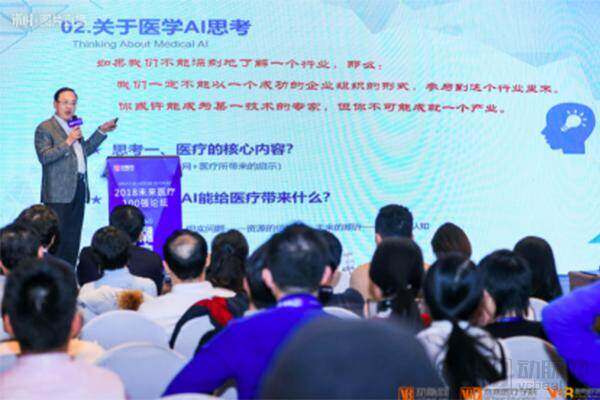
Song Jie Delivers Keynote on “Medical Imaging AI: From R&D to Commercial Implementation”
"Diagnosis and treatment constitute the essence of healthcare and represent the core value chain of the medical industry; gaining access to this segment means being able to share in the substantial returns of the healthcare sector."
“The core agents of medical activities are physicians. The manifestations of the clinical capabilities they deliver include medical proficiency, efficiency, physical stamina, and cognitive capacity—these are the scarcest resources in the healthcare sector. Those who can master, replicate, or multiply these scarce elements will be positioned to enter the core value chain of healthcare and thereby reap substantial rewards.”
Taking internet healthcare as an example, this sector has seen substantial investment over the past decade but yielded minimal returns. The reason is singular: it failed to penetrate the core value zone, merely “lingering on the periphery.” Fundamentally, it did not impact the “core scarce elements” of healthcare.
This means that the development of AI must be guided by the following objectives: mastering core medical elements, penetrating into high-value segments of healthcare, and achieving substantial returns. In other words, only by developing technologies that can replicate and amplify physicians’ capabilities, and creating products that integrate into diagnostic and therapeutic workflows, can greater benefits be realized.
The development trajectory of medical AI is inevitably geared toward addressing the shortage of core resources by directly targeting the critical domains of diagnosis and treatment. R&D institutions in the field of medical AI must clearly recognize this imperative.
With a clear understanding of the core elements of healthcare, objectives and direction become well-defined; AI in healthcare addresses the challenge of “multiplying physicians’ capabilities.”
Medical AI encompasses a wide range of applications. The current concentration of enterprises on medical imaging does not imply that medical AI is limited to image processing; rather, it reflects the fact that imaging data is relatively straightforward, with fewer confounding variables, thereby facilitating breakthroughs.
AI in medical imaging is merely the first step. The true potential value of artificial intelligence in healthcare lies in enabling physicians to integrate factors such as a patient’s medical history, genetics, and physical condition, thereby making precise predictions about their future health and using these insights to guide current treatment decisions.
As of 2019, the number of companies in China conducting medical AI research had surpassed that in the United States. Many enterprises have recruited top-tier overseas AI talent, aiming both to acquire cutting-edge AI technologies and to expand into international markets.
Frankly speaking, China holds no advantage over the United States in fundamental AI research; however, it may lead in applied research within specific niche fields.
In the R&D of medical AI, the so-called data advantage is largely superficial. Our two true core advantages are, first, a lenient legal environment, and second, national policy guidance. These two advantages will inevitably disappear in the future, and whether the company can continue to survive after their disappearance is a question we must seriously consider.
In general, enterprises should leverage momentum for development and plan ahead. The current lenient legal environment does not mean that present issues will not be addressed at some point in the future. There are many topics worthy of consideration, such as: What are the sources of corporate data? What are the models of collaboration? Are the profit models reasonable and compliant with the law?
Many companies claim to have established partnerships with hundreds of hospitals, yet the specific nature of these collaborations remains unclear. For AI, as an emerging technology, it is advisable that all existing corporate partnerships and data sources comply with current laws and regulations. If the legitimacy and authenticity of these arrangements are in question, attention must be paid to intellectual property rights to avoid future disputes over IP ownership down the line.
Technology and products share a reciprocal causal relationship; however, from the perspective of commercial entities, AI is invariably a product. Many enterprises collaborate with physicians at tertiary hospitals on the premise of mutual assistance: companies help doctors produce high-quality academic papers, while doctors ensure the companies’ products are adopted by the hospitals. In such arrangements, the actual clinical utilization of the products falls outside the physicians’ scope of consideration. This type of collaboration is unreasonable, as the resulting products may not necessarily align with the hospitals’ needs.
Regarding the registration of Class III medical devices in China, no company has yet obtained approval, nor has any submitted tentative application materials. This is because, for existing AI products, in the absence of clear standards, companies have not yet completed the process of self-demonstrating "safety" and "efficacy," or have not identified methods and pathways to do so.
In fact, we should not demand perfection from a new technology. However, healthcare allows for no negligence, and regulations offer little "flexibility."
“Regulatory approval” is a necessary step for product commercialization. Consequently, companies employ various strategies to secure it. For experienced organizations, obtaining approval is not an insurmountable challenge; however, it does not guarantee market success. As the saying goes, “Experts see the substance, while novices see only the surface.”
Xishi Yigou Medical’s multi-domain products are all manifested as hardware-based AI medical devices, while also providing cloud-based diagnostic services. These products cover multiple fields, including digestive endoscopy, CT, and ultrasound, and are expected to officially enter the market in 2019. In the view of Xishi Yigou Medical, obtaining a “market access permit” is not the ultimate goal; rather, it is valuable only when such permission is granted for a product with genuine market potential.
Thus, it is evident that regulatory approval is a critical step in the commercialization of medical devices; however, the integration of upstream and downstream processes is equally important. Obtaining approval does not equate to absolute success for a company in this market.
From the current perspective, pulmonary nodules and fundus imaging continue to dominate core R&D directions. This indicates that the ease or difficulty of data acquisition largely determines the trajectory of medical AI development.
Medical data is diverse, and R&D must not be about “gimmicks”; its true value lies in the ability of R&D outcomes to address clinical issues. Therefore, Xishi Yigou Medical places greater emphasis on clinical applicability:
1. For a specific field, disease coverage should be comprehensive.
Applied R&D differs from academic research; without breadth, there is no practical application. Taking endoscopic AI products as an example, comprehensive coverage of most endoscopically diagnosable diseases is a prerequisite for clinical application. When a physician inserts an endoscope into a patient’s gastrointestinal tract, they need to assess the overall condition comprehensively, rather than stating, “I can only tell you whether a specific disease is present or absent; we have no insight into other conditions.” For the foreseeable future, AI’s diagnostic accuracy for any single disease is unlikely to surpass the limits of human medical understanding. While AI may outperform humans in efficiency and potentially exceed the capabilities of general practitioners and even some specialists, it will not transcend the boundaries of human medical knowledge.
2. Real-World Application Scenarios
One cannot fabricate hypothetical scenarios; medical practice follows established pathways and conventions. Practitioners lacking in-depth understanding of this field are prone to errors. For instance, applications in endoscopy and ultrasound must be real-time, as physicians need to detect diseases during the dynamic examination process. The scenario where a physician identifies a disease, archives data, and then relies on AI for diagnosis is a false premise. Therefore, in many areas, the hardware integration, device embodiment, and real-time performance of AI products are critical. Distinguishing genuine application scenarios requires profound industry insight and understanding—this domain demands true experts to navigate it effectively.
3. The product form is easy to accept.
The product should be in a form acceptable to physicians—easy to use.
The product should be in a form acceptable to sales—facilitating profitability.
The product should be self-explanatory—clearly demonstrating its return potential.
Having clarified the core components of healthcare, the value of artificial intelligence, and the advantages of domestic enterprises, what R&D outcomes can be successfully implemented?
Song Jie believes that developers should determine whether their R&D direction is academic research or technological application. The AI landscape today is no longer what it was two years ago; people no longer cheer for every new breakthrough, but instead first consider whether this “new discovery” holds genuine clinical value. Therefore, products at the current stage must achieve three key points:
First, medical products must be authentic and practical, offering direct value. This means that companies should first establish a broad scope (“surface”) before focusing on specific areas (“points”). No physician would perform a gastroscopy on a patient solely to locate a single lesion; therefore, products targeting only a single disease lack clinical value. Only when developers can encompass the majority of diseases within the system’s recognition capabilities can the product be considered suitable for clinical application. Thus, given the current R&D capabilities of AI enterprises, an AI product may not achieve exhaustive depth in specific areas, but it must still maintain broad coverage. Otherwise, such AI cannot qualify as a viable product.
Second, medical products must be independent and reliable, designed to simplify workflows rather than add burdens. Taking fundus imaging products as an example, family physicians in the United States typically do not interpret fundus photographs for patients. Marketing AI-based fundus analysis tools to these primary care providers would impose additional unpaid labor on them, which contradicts user-centric logic.
Third, when designing products, developers must clearly determine whether the enterprise will develop standalone software or rely on GPS manufacturers in the future. In this regard, Xishi Yigou Medical has adopted a dual-pronged approach but leans more toward creating a product that can be controlled by the enterprise itself.
In summary, when developing AI products, enterprises should prioritize comprehensive disease coverage over single-disease focus, practicality over scientific research, and strategic direction over product design. Unlike academic research, commercial ventures require managers to adopt the perspective of end-users and understand their actual preferences to create top-tier AI products. Only such products will possess genuine clinical value and be readily accepted by the market.
About Xishi Yigou Medical
Xishi Medical Technology (Beijing) Co., Ltd. was established in Beijing in 2015 and is one of the earliest enterprises in China to engage in the research and development of medical artificial intelligence technologies. The company’s core business focuses on the R&D and application of AI-based medical imaging technologies, covering areas such as gastrointestinal endoscopy, medical imaging (CT, MRI), ultrasound imaging, dermatology, and electrocardiography (ECG).
Since its inception, the company has been joined by the team of Dr. Wu Ren, a renowned international artificial intelligence scientist (Novumind), thereby gaining access to first-class AI development technologies, AI supercomputing center technologies, and application-side AI chip support.
In early 2017, driven by the company’s research breakthroughs across multiple fields and attracted by policies in Sichuan Province, the company established its presence in Chengdu and was renamed Sichuan Xishi Yigou Medical Technology Co., Ltd. Subsequently, it jointly established the “Huaxi-Xishi Medical Artificial Intelligence R&D Center” with West China Hospital to conduct multidisciplinary AI technology research and development.
Over the past four years of researching AI-powered digestive endoscopy products, Xishi Yigou Medical has analyzed clinical data from more than one million patients. Its full-gastrointestinal-tract disease portfolio now covers 90% of common gastrointestinal conditions. To ensure regulatory compliance, Xishi Yigou Medical has executed clear collaboration agreements with top-tier medical institutions in all its partnerships.
In addition to digestive endoscopy, Xishi Yigou Medical has recently been actively conducting research in the field of CT. The core aspects of this technology include: during CT image reconstruction, using software to segment images of diseased areas into thinner slices to enhance image quality; or pre-adjusting CT scanner parameters to better highlight pathological lesions.
While Xishi Yigou Medical is integrating its relevant AI technologies into hardware devices, it is simultaneously developing cloud-based application products. For primary healthcare institutions and physical examination centers, these solutions offer low usage costs and are well-suited for diagnostic examinations that do not require high real-time performance.
Currently, Xishi Yigou Medical is collaborating with multiple top-tier hospitals to establish quality control systems in various fields, including digestive endoscopy, ultrasound, and CT, to help primary care hospitals improve their diagnostic capabilities and increase business revenue.