

Lilly's $3.2 Billion GLP-1 Blockbuster Dulaglutide (Trulicity) Enters China, Leading Among Six Domestic GLP-1 Therapies
Eli Lilly
Global Pharmaceutical R&D and Production Company
Highlights
On February 26, Eli Lilly announced that its GLP-1 receptor agonist antidiabetic drug dulaglutide (brand name Trulicity) had been approved by the National Medical Products Administration for entry into the Chinese market. In 2018, global sales of dulaglutide reached $3.2 billion, making it Eli Lilly’s top-selling product. According to data from Menet, eight GLP-1 receptor agonist antidiabetic drugs have been approved for marketing worldwide, six of which have entered the domestic market. How have these products performed in the Chinese market?
Annual Sales of $3.2 Billion! A Simple and Potent New Glucose-Lowering Drug Enters China
GLP-1 is an “incretin” naturally secreted by the gastrointestinal mucosa in humans. GLP-1 receptor agonist hypoglycemic agents are currently among the best-selling antidiabetic drugs. Their advantages include a significantly lower incidence of hypoglycemic events compared with insulin, reduced food intake, delayed gastric emptying (which facilitates weight control), and protection of pancreatic β-cell function.
On February 26, Eli Lilly announced that its once-weekly GLP-1 receptor agonist dulaglutide (brand name Trulicity) had received approval from the National Medical Products Administration for entry into the Chinese market. It is indicated for glycemic control in adults with type 2 diabetes, including as monotherapy and in patients who have not achieved adequate glycemic control with metformin and/or sulfonylureas. The approval of Trulicity provides a potent, convenient, and reassuring new option for blood glucose management in patients with type 2 diabetes in China.
Professor Ji Linong, President of the Western Pacific Region of the International Diabetes Federation and Director of the Department of Endocrinology at Peking University People’s Hospital, commented: “In two recently completed clinical trials predominantly involving Chinese patients with type 2 diabetes, dulaglutide demonstrated superior glycemic-lowering efficacy compared to sulfonylureas (glimepiride) and insulin glargine, which are widely recognized for their potent glucose-lowering effects. Additionally, it led to significant improvements in body weight and avoided the hypoglycemia associated with these comparator therapies. The studies also showed that Trulicity has a favorable safety profile and offers the convenience of once-weekly administration.”
Eli Lilly’s dulaglutide was first approved by the FDA in 2014 under the brand name Trulicity. It has since been successfully launched in more than 70 countries across the Americas, Europe, and Asia. Widely recognized by patients for its potent glucose-lowering efficacy, ease of use, and favorable safety profile, it has become the market leader in the long-acting GLP-1 receptor agonist (GLP-1RA) segment in the United States, Japan, South Korea, and Germany.
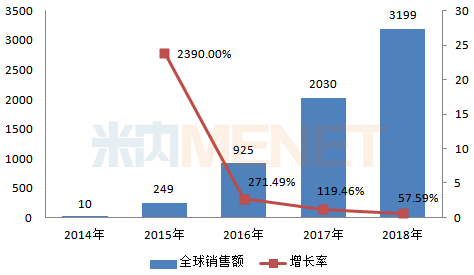
Figure 1: Global Sales of Eli Lilly’s Dulaglutide, 2014–2018 (in million USD)
(Source: Menet Network Multinational Company Performance Database)
According to the multinational company performance database of Menet, Eli Lilly’s dulaglutide saw its sales “skyrocket” following approval and market launch. In 2017, its annual sales first surpassed the $2 billion mark, representing a year-on-year increase of 119.46%. On February 6, Eli Lilly announced its 2018 financial results: the company’s total revenue for the year reached $24.556 billion, a 7% year-on-year increase. Dulaglutide contributed $3.199 billion in sales revenue, a 57.59% year-on-year growth, making it Eli Lilly’s top-selling product in 2018.
Of the 8 GLP-1 receptor agonists available globally, only one is domestically produced in China.
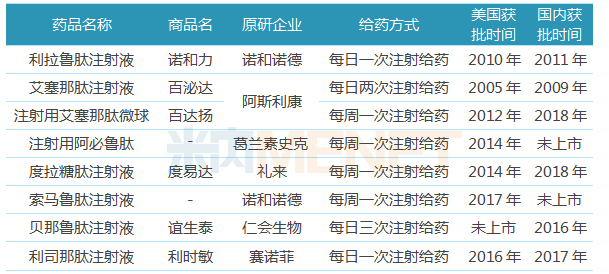
Table 1: Globally Marketed GLP-1 Receptor Agonist Antidiabetic Drugs
(Source: Menet Database)
According to Menet’s Global Drug R&D Database, there are currently eight GLP-1 receptor agonist hypoglycemic agents approved for marketing worldwide, including Novo Nordisk’s liraglutide injection and semaglutide injection, AstraZeneca’s exenatide injection and exenatide microspheres for injection, GlaxoSmithKline’s albiglutide for injection, Sanofi’s lixisenatide injection, Shanghai Renhui Biotechnology’s benaglutide injection, and Eli Lilly’s dulaglutide.
Among the eight GLP-1 receptor agonist antidiabetic drugs, four are long-acting GLP-1 receptor agonists requiring only once-weekly administration, resulting in relatively higher patient adherence; six have entered the Chinese market, with Shanghai ReaGene Bioscience’s benaglutide injection being the only domestically produced product.
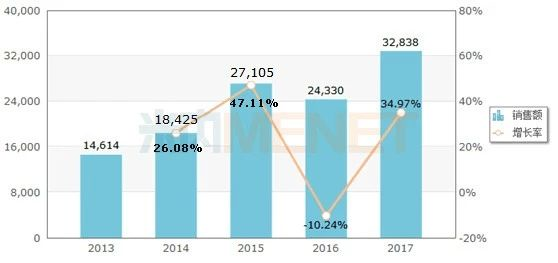
Figure 2: Sales of Liraglutide at Public Medical Institution Terminals in China, 2013–2017 (Unit: RMB 10,000)
(Source: Competitive Landscape of China’s Public Medical Institutions Terminal, Menet)
Novo Nordisk’s liraglutide entered the Chinese market in 2011. According to Novo Nordisk’s 2018 annual report, global sales of liraglutide (for the indication of diabetes) amounted to DKK 24.333 billion in 2018, representing a 9% year-on-year increase. Revenue from China reached DKK 521 million, a 73% year-on-year increase, accounting for 2.14% of its global revenue.
Due to pricing factors, the sales of liraglutide in public medical institutions in China have fluctuated in recent years. In 2017, among the top 20 brands of non-insulin hypoglycemic agents in public medical institutions in China, Novo Nordisk’s liraglutide injection ranked tenth with a market share of 1.54%. Following the inclusion of liraglutide in the National Reimbursement Drug List in 2017, the product experienced significant volume growth in the Chinese market.
Novo Nordisk’s other long-acting GLP-1 receptor agonist, semaglutide injection, has not yet been launched in China. The product was approved for marketing in the United States at the end of 2017 and has since gained approval in 11 countries across North America and Europe. In 2018, it generated global revenue of DKK 1.796 billion, marking a strong start. Furthermore, Novo Nordisk plans to submit a marketing application for oral semaglutide to the U.S. Food and Drug Administration (FDA) in 2019.
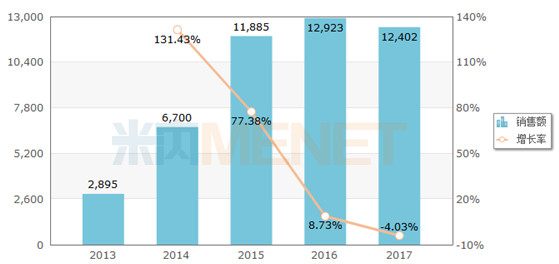
Figure 3: Sales of Exenatide at Public Medical Institution Terminals in China, 2013–2017 (Unit: 10,000 RMB)
(Source: Menet’s Competitive Landscape of China’s Public Medical Institutions Terminal)
Exenatide injection (brand name Byetta), which requires twice-daily subcutaneous administration, was approved by the U.S. FDA in 2005 and entered the Chinese market in 2009. According to AstraZeneca’s 2018 annual report, global sales of exenatide amounted to USD 126 million in 2018, representing a 28% year-on-year decline. In the domestic market, sales of exenatide injection at public medical institutions in China also decreased in 2017 compared with the previous year.
However, AstraZeneca subsequently developed exenatide microspheres for injection, administered once weekly via injection. The product was launched in the United States in 2012 and achieved global sales of $584 million in 2018. In 2018, it received approval from the National Medical Products Administration (NMPA) for marketing in China, becoming the first long-acting GLP-1 receptor agonist approved in the country. Revenue from exenatide in the Chinese market was expected to increase in 2018.
Source: Menet Database, financial reports of multinational corporations, etc.