

Novo Nordisk Submits Regulatory Applications to FDA and EMA for Fiasp as Mealtime Insulin in Children and Adolescents with Type 1 Diabetes
Mar 04, 2019 19:05
CST Updated
19:05

Novo Nordisk
Insulin Developer and Manufacturer

FDA
U.S. Food and Drug Administration

European Medicines Agency
The European Medicines Agency (EMA) is a decentralized agency of the European Union (EU), located in London. It began operations in 1995. The agency is responsible for the scientific evaluation, supervision, and safety monitoring of medicines developed by pharmaceutical companies for use in the EU. By ensuring that all medicines available on the EU market are safe, effective, and of high quality, the EMA protects public and animal health in the 28 EU Member States and countries of the European Economic Area.

March 4, 2019 /Bio ValleyBIOON/ ---DiabetesPharmaceutical giant Novo Nordisk recently announced that it has submitted an application to the U.S. Food and Drug Administration (FDA) and the European Medicines Agency (EMA) for a label update of Fiasp (insulin aspart, faster-acting insulin aspart), seeking approval for Fiasp as a new mealtime insulin for type 1Diabetes(T1D) pediatric and adolescent patients.
Administer around mealtimesDiabetesIt may be difficult because type 1DiabetesParents of toddlers reported that this was one of the most problematic areas. Additionally, adolescents’ refusal to eat meals and their consumption of snacks also posed challenges to diabetes management.
Mads Krogsgaard Thomsen, Executive Vice President and Chief Science Officer at Novo Nordisk, stated, “Clinical experience has shown that to achieve optimal efficacy with conventional rapid-acting insulin, administration before meals is required, which often involves considerable guesswork. Compared with traditional insulin aspart, Fiasp has a faster onset of action and can be administered at the start of a meal, thereby helping to reduce uncertainty around mealtime dosing. We believe that Fiasp can help younger patients with diabetes better manage their condition.”
This application is based on the results of the Phase IIIa clinical study ONSET-7, which investigated the efficacy and safety of Fiasp versus conventional insulin aspart in pediatric and adolescent patients with type 1 diabetes. The results demonstrated that, when used as part of a multiple daily injection regimen (also known as a basal-bolus regimen), Fiasp provided better glycemic control compared to conventional insulin aspart.
ONSET-7 was a 26-week, partially double-blind, basal-bolus, treat-to-target study that enrolled 777 children and adolescents (aged 1 to <18 years) with type 1 diabetes. The study investigated Fiasp administered at mealtimes (0–2 minutes before meal initiation) and 20 minutes after meal initiation, compared with conventional insulin aspart administered at mealtimes (0–2 minutes before meal initiation). All patients concurrently received basal insulin Tresiba (insulin degludec).
Data show that when administered at mealtimes, Fiasp achieved a greater reduction in overall glycemic levels (HbA1c) compared with the conventional insulin aspart treatment group (estimated treatment difference [ETD]: −0.17%). Furthermore, Fiasp also significantly reduced postprandial glucose levels (1 hour after meals) compared with conventional insulin aspart.
Furthermore, data from another group showed that patients who injected Fiasp 20 minutes after starting a meal achieved similar overall glycemic levels compared to those who injected conventional insulin aspart at mealtime (non-significant estimated treatment difference [ETD]: 0.13%, favoring conventional insulin aspart). This result confirms the non-inferiority of Fiasp when administered 20 minutes after meal initiation compared to conventional insulin aspart injected at mealtime.
In this study, regarding safety, Fiasp showed no significant difference compared with conventional insulin aspart in the overall incidence of severe or blood glucose-confirmed hypoglycemic episodes, as well as in the overall incidence of other adverse events such as nausea or injection site reactions.
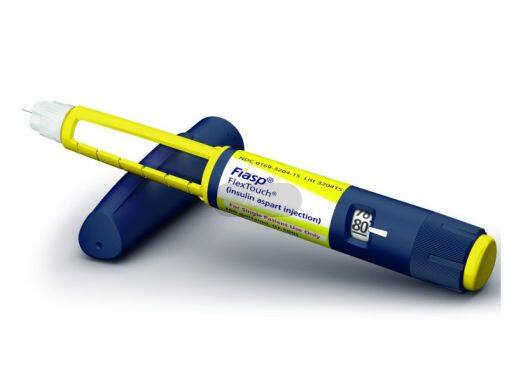
Fiasp is currently the only approved next-generation, ultra-rapid-acting mealtime insulin. It is a new formulation of insulin aspart (NovoRapid, brand name: NovoRapid) with two new excipients (vitamin B3 and L-arginine) added to ensure more timely, rapid, and improved absorption, thereby enabling faster onset of action.
Compared with insulin aspart, Fiasp more closely mimics the endogenous insulin response to meals, which is also the optimal approach for achieving HbA1c targets. To date, Fiasp has been approved in the United States, the European Union, Canada, Australia, Switzerland, and several other markets for improving glycemic control in adult patients with type 1 and type 2 diabetes. (Bioon.com)