

Bayer Submits Regulatory Applications for Darolutamide in Non-Metastatic Castration-Resistant Prostate Cancer Across the U.S., Japan, and Europe
Mar 11, 2019 15:10
CST Updated
15:10

Bayer
Pharmaceutical Product R&D Developer

European Medicines Agency
The European Medicines Agency (EMA) is a decentralized agency of the European Union (EU), located in London. It began operations in 1995. The agency is responsible for the scientific evaluation, supervision, and safety monitoring of medicines developed by pharmaceutical companies for use in the EU. By ensuring that all medicines available on the EU market are safe, effective, and of high quality, the EMA protects public and animal health in the 28 EU Member States and countries of the European Economic Area.

March 11, 2019/BioValleyBIOON/--German pharmaceutical giantBayer(Bayer) recently announced that it has submitted a Marketing Authorization Application (MAA) to the European Medicines Agency (EMA), seeking approval for darolutamide for the treatment of patients with non-metastatic castration-resistant prostate cancer (nmCRPC). In late February this year, Bayer completed its submission to the U.S.FDARolling submission of the New Drug Application (NDA) for darolutamide in the treatment of nmCRPC was conducted, with the NDA submitted to the Japanese Ministry of Health, Labour and Welfare (MHLW) completed in early March. Currently, Bayer is also discussing the submission of darolutamide application documents with regulatory authorities in other countries.
This application is based on data from the pivotal Phase III ARAMIS clinical study of darolutamide for the treatment of non-metastatic castration-resistant prostate cancer (nmCRPC). The results demonstrated that, in patients with nmCRPC, the darolutamide plus androgen deprivation therapy (ADT) regimen significantly reduced the risk of metastasis or death by 59% compared with placebo plus ADT. Furthermore, the darolutamide plus ADT regimen exhibited a favorable safety profile compared with placebo plus ADT in this study.
Darolutamide was co-developed by Bayer and the Finnish pharmaceutical company Orion. In addition to nmCRPC, the two parties are also advancing another Phase III clinical trial, ARASENS, to evaluate the efficacy and safety of darolutamide in the treatment of metastatic hormone-sensitive prostate cancer (mHSPC).
Darolutamide is an oral non-steroidal androgen receptor antagonist with a unique chemical structure, high binding affinity to the receptor, and potent antagonistic activity, thereby inhibiting receptor function and the growth of prostate cancer cells.
Senior Vice President of Bayer Pharmaceuticals Division andTumorScott Z. Fields, Head of Development, stated, “In the early stages of prostate cancer, patients are typically asymptomatic. Therefore, it is crucial to provide patients with treatment options that significantly delay metastatic progression while limiting treatment-related side effects, enabling them to continue their daily lives. With this submission, we are one step closer to providing a potential new treatment option for nmCRPC to patients and physicians in Europe.”
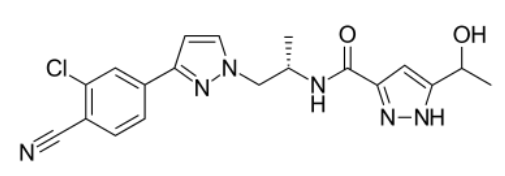
Molecular structure of darolutamide (Image source: Wikipedia)
ARAMIS was a randomized, multicenter, double-blind, placebo-controlled study that enrolled 1,509 patients who were receiving androgen deprivation therapy (ADT) as standard of care but were at high risk for metastatic disease. In the study, patients were randomized in a 2:1 ratio to receive either darolutamide (600 mg twice daily) or placebo, in addition to ADT. The primary endpoint was metastasis-free survival (MFS), defined as the time from randomization to evidence of metastasis or death. Secondary endpoints included overall survival (OS), time to pain progression, time to initiation of first cytotoxic chemotherapy, time to first symptomatic skeletal event (SSE), and the safety and tolerability profile of darolutamide.
The study results showed that, compared with the placebo + ADT group, the darolutamide + ADT group achieved a statistically significant improvement in MFS (HR=0.41, 95% CI: 0.34–0.50, p < 0.001), indicating a 59% reduction in the risk of metastasis or death, thereby meeting the primary endpoint of the study. The median MFS was 18.4 months in the placebo + ADT group versus 40.4 months in the darolutamide + ADT group, representing an overall extension of median MFS by 22 months.
Regarding overall survival (OS), the darolutamide + ADT regimen demonstrated a favorable trend compared with the placebo + ADT group, with a 29% reduction in the risk of death (HR=0.71, 95% CI: 0.50–0.99, p=0.045). In terms of progression-free survival (PFS), the darolutamide + ADT regimen significantly prolonged PFS compared with the placebo + ADT group (median PFS: 36.8 months vs. 14.8 months; HR=0.38, 95% CI: 0.32–0.45, p<0.001), reducing the risk of local progression, distant metastasis, or death by 62%.
Furthermore, all other secondary endpoints favored darolutamide, including time to pain progression (40.3 months vs. 25.4 months; HR=0.65, 95% CI: 0.53–0.79, p<0.001) and time to cytotoxic chemotherapy (not reached vs. 38.2 months; HR=0.43, 95% CI: 0.31–0.60, p<0.001). Another secondary endpoint, time to first symptomatic skeletal event (SSE), also favored darolutamide.
Importantly, the incidence of treatment-emergent adverse events (AEs) with an occurrence rate ≥5% or Grade 3–5 was comparable between the two treatment groups; only fatigue occurred in more than 10% of patients (12.1% in the darolutamide + ADT group vs. 8.7% in the placebo + ADT group), and quality-of-life outcomes were similar between the two treatment groups.
These data were presented in mid-February this year at the American Society of Clinical Oncology Genitourinary Cancers Symposium held in San Francisco, USA.Tumorpresented at the ASCO GU Symposium and simultaneously published in The New England Journal of Medicine (NEJM). (Bioon.com)