

FDA Approves First Immune Therapy for Triple-Negative Breast Cancer: Roche’s Tecentriq in Combination with Nab-Paclitaxel

Genentech
Pharmaceutical R&D Manufacturer

Roche
Oncology Drug Research, Development, and Manufacturing
VCBeat (biobeat1) has learned that on March 8, 2019, the U.S. Food and Drug Administration (FDA) approved the combination therapy of Genentech, Inc.’s PD-L1 monoclonal antibody Atezolizumab (TECENTRIQ®) with protein-bound paclitaxel. According to FDA regulations, this treatment is indicated for patients with unresectable locally advanced or metastatic triple-negative breast cancer (TNBC) whose tumors exhibit significant PD-L1 expression.
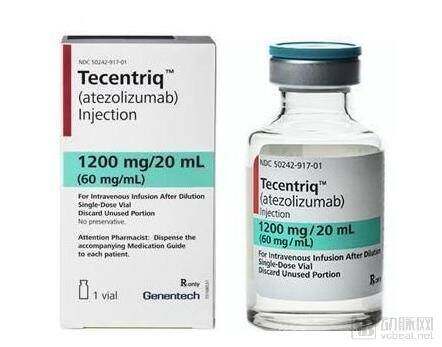
Meanwhile, the FDA also approved the VENTANA PD-L1 (SP142) Assay as a companion diagnostic for Atezolizumab, to identify patients with triple-negative breast cancer who are eligible for this therapy.
This approval is based on IMpassion130 (NCT02425891), a multicenter, international, double-blind, placebo-controlled, randomized trial involving 902 patients with unresectable locally advanced or metastatic triple-negative breast cancer (TNBC) who had not previously received chemotherapy for metastatic disease. Patients were randomized in a 1:1 ratio to receive either atezolizumab (840 mg) or placebo via intravenous infusion on Days 1 and 15 of each 28-day cycle, along with nab-paclitaxel (100 mg/m²) administered intravenously on Day 1.2)。
The PD-L1-positive population was identified by screening tumor specimens using the VENTANA PD-L1 (SP142) assay. The screening results were used to determine the final PD-L1-positive population.
In patients with tumor PD-L1 expression, the median progression-free survival (PFS) was 7.4 months (95% CI: 6.6–9.2) for those receiving atezolizumab in combination with nab-paclitaxel, compared with 4.8 months (95% CI: 3.8–5.5) for those receiving nab-paclitaxel plus placebo. The hazard ratio for PFS was 0.60 (95% CI: 0.48–0.77; p < 0.0001), favoring the atezolizumab plus nab-paclitaxel regimen. The objective response rate (ORR) was 53% in the atezolizumab group versus 33% in the placebo group. Preliminary overall survival data indicated a mortality rate of 43%.
The most common adverse reactions (reported in ≥20% of patients) to atezolizumab monotherapy combined with paclitaxel protein-bound therapy include alopecia, peripheral neuropathy, fatigue, nausea, diarrhea, anemia, constipation, cough, headache, neutropenia, vomiting, and decreased appetite.
This indication was approved under accelerated approval based on progression-free survival in clinical trials. Continued approval for this indication may be contingent upon verification and description of clinical benefit in confirmatory trials.
For patients with triple-negative breast cancer (TNBC) whose tumors express PD-L1, the recommended dose of atezolizumab is 840 mg administered via intravenous infusion over 60 minutes, followed by an injection of 100 mg/m².2Albumin-bound paclitaxel. Administered in 28-day cycles, with atezolizumab given on Days 1 and 15, and albumin-bound paclitaxel given on Days 1, 8, and 15 until disease progression or unacceptable toxicity occurs.
Tecentriq (atezolizumab) is a PD-L1 monoclonal antibody produced by Genentech, a subsidiary of Roche. The approved indication for triple-negative breast cancer marks the third indication for Tecentriq. According to Roche’s 2018 annual report, Tecentriq’s revenue grew by 60%, reaching $789 million in sales.
On October 18, 2016, the FDA approved atezolizumab for the treatment of patients with metastatic non-small cell lung cancer (NSCLC), marking the first indication approved for Tecentriq. On December 6, 2018, the combination therapy of atezolizumab with bevacizumab, paclitaxel, and carboplatin was further approved as a first-line treatment for metastatic non-squamous NSCLC.
On August 16, 2018, the FDA approved Atezolizumab for the treatment of locally advanced or metastatic urothelial carcinoma.
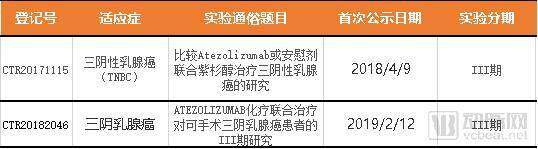
Table: Clinical Studies of Atezolizumab for Triple-Negative Breast Cancer in China
On February 25, 2018, Roche submitted a marketing application for Tecentriq (atezolizumab) to the National Medical Products Administration, with the specific indications remaining undisclosed. Currently, Roche has conducted 19 clinical studies in China on atezolizumab for various indications, including non-small cell lung cancer, muscle-invasive urothelial carcinoma, triple-negative breast cancer, hepatocellular carcinoma, and renal cell carcinoma, with multiple studies having advanced to Phase III clinical trials. There are two clinical studies focused on triple-negative breast cancer, both in Phase III.
Triple-Negative Breast Cancer (TNBC) refers to breast cancer in which immunohistochemical testing of the tumor tissue is negative for estrogen receptor (ER), progesterone receptor (PR), and human epidermal growth factor receptor 2 (HER2). This subtype accounts for 10.0%–20.8% of all breast cancer pathological types, exhibits distinct biological behavior and clinicopathological features, and is associated with a poorer prognosis compared to other subtypes.
Chemotherapy remains the primary treatment for metastatic triple-negative breast cancer (TNBC), a disease associated with a median survival of only 20 months following diagnosis. Atezolizumab is the first immunotherapy approved for the treatment of TNBC.
Tencentriq (Atezolizumab)’s main competitors are Merck & Co.’s Keytruda (Pembrolizumab) and Bristol Myers Squibb’s Opdivo (Nivolumab). According to the 2018 annual reports of Merck & Co. and Bristol Myers Squibb, Keytruda achieved remarkable sales of $7.171 billion in 2018, while BMS’s Opdivo (Nivolumab) recorded $6.735 billion.
In the United States, clinical trials of Keytruda for triple-negative breast cancer have advanced to Phase III and are expected to be completed in 2019. In contrast, clinical studies of Keytruda in China have not yet included triple-negative breast cancer. Clinical development of Opdivo for triple-negative breast cancer has progressed more slowly, remaining at Phase I/II, with no trials currently underway in China.
Based on current clinical research findings, Atezolizumab is expected to maintain its leading position in the treatment of triple-negative breast cancer for the foreseeable future. Coupled with another indication approved in the second half of last year, Tecentriq’s sales are likely to continue their strong upward trajectory this year.
References
1. FDA approves atezolizumab for PD-L1 positive unresectable locally advanced or metastatic triple-negative breast cancer from https://www.fda.gov/Drugs/InformationOnDrugs/ApprovedDrugs/ucm633065.html
2.FDA Action Alert: Regeneron, Celgene and Aerie from https://www.biospace.com/article/fda-action-alert-regeneron-celgene-and-aerie/