

China's First Polymer Innovative Drug Company Lands in Shenzhen: Luofang Bio Opens New Avenues for Chronic Disease Treatment
As innovative drugs continue to evolve along the paths of small molecules, antibodies, nucleic acids, and cell therapies, the mainstream technological systems remain built upon the extension of "natural molecules." However, outside this mature framework, a category of molecular forms based on chemical synthesis and featuring highly controllable structures is gradually entering the research and translation horizon——Synthetic Polymer Drugs。
Unlike antibodies or nucleic acid drugs that rely on biological systems for expression, the core characteristic of polymer drugs lies in "Designability". Its molecular backbone, functional units, in vivo distribution, half-life, and even mode of action can all be precisely controlled through polymer chemistry, allowing new drug development to truly move from 'screening in natural molecules' towardsDesign Functional Molecules Based on Clinical NeedsA brand new stage.
It is under this judgment that Luofang Bio, established in Shenzhen by the end of 2025, has chosen polymer drugs as its core focus and hopes to leverage platform capabilities to drive this technological pathway from scientific research exploration to clinical translation.
When traditional technology tracks become increasingly crowded and homogenized competition intensifies, the choice made by Luofang Bio also raises a core question about the industry's future: Could artificially synthesized polymer drugs potentially become one of the next generation's significant drug forms?
From Global Exploration to Domestic Gaps: Polymer Innovative Drugs Enter Early Window Period
If the preceding text reveals the potential of a new molecular form, then the more critical question is: at the current juncture of innovative drug iteration, why are polymer drugs beginning to attract attention?
From the perspective of the existing drug system,As various technical pathways continue to mature, their boundaries are gradually becoming apparent.——Small molecule drugs have the advantages of oral administration and production, but they have natural limitations in mechanism of action and target expansion; antibody drugs are highly targeted, yet face issues such as complex structure, high cost, and difficulties in regulating in vivo distribution; nucleic acid drugs, while promising, still require breakthroughs in delivery efficiency, stability, and immunogenicity.
As the existing pathways gradually approach their capacity limits, the industry has begun to seek new molecular modalities that can fill the gap. The significance of polymeric drugs lies not only in providing new sources of medication but also in introducing a development logic based on structure—constructing molecules through polymer chemistry to enable on-demand design of structure and function. This allows for higher controllability in pharmacokinetics and mechanisms of action. This characteristic gives polymeric drugs unique potential in scenarios requiring long-term administration and stable efficacy control, such as chronic diseases.
Globally, polymeric drugs are not an entirely new direction. Since entering clinical exploration in the 1980s, the FDA has approved products such as Sevelamer and Colesevelam for marketing, achieving commercialization in chronic disease fields like kidney disease and hyperlipidemia. Meanwhile, fundamental research continues to gain momentum. PubMed data shows that research literature using "polymer therapeutics" as a keyword has been steadily increasing in recent years.
But overall, the field is still in a phase of "active academia, limited translation, and an industrial system yet to take shape." This also means that polymer drugs are at a critical window period — the technical path has been proven feasible, but systematic development capabilities still need to be established.
It is worth noting that China is almost at the starting stage in this direction. Current innovative drug resources are mainly concentrated in small molecules, antibodies, and nucleic acid fields. A complete system from molecular design, synthesis, characterization to drugability evaluation and clinical development for polymer drugs has yet to be truly established.
"This is not a gap in a single technology, but rather the entire development chain has yet to take shape," Luo Zhi pointed out.
At this stage,Luofang Bio Takes the Lead in Building a Technology System for Industrialization, Attempting to Advance Polymer Drugs from Dispersed Scientific Research Exploration to Systematic R&D and Engineering Development。
Anchoring the Platform-Type Biotech Positioning, Entering the Polymer Track with Systematic Capabilities
For Luofang Bio, entering the field of polymer drugs was not accidental but rather a strategic decision based on years of scientific research accumulation.
The team gradually realized in the research of polymer science and drug delivery,Polymers have long been limited to excipients or carriers in the pharmaceutical field, and their potential as "drug APIs" has not been systematically developed.Based on this understanding, the company clearly positioned itself as a platform-based Biotech focused on polymer innovative drugs from the outset.
This positioning also determines its development path: not starting from a single project, but prioritizing the construction of an underlying technological system. The research and development of polymer drugs is highly system-dependent, with each step—from molecular design, controlled synthesis, structural characterization, to drug-likeness evaluation and in vivo studies—being highly coupled, making it difficult to achieve continuous output through a single breakthrough. Only by establishing a complete R&D framework can the steady advancement of candidate molecules toward the translational stage be ensured.
Centering on this goal,The company has built a multidisciplinary team covering areas such as polymer science, medicinal chemistry, biomedical engineering, and clinical development., forming a continuous capability from basic research to clinical translation. Among the R&D team, the proportion of PhDs exceeds 70%, mainly coming from top domestic and international institutions such as Tsinghua University, École Polytechnique Fédérale de Lausanne, and Huazhong University of Science and Technology.
The experience of founder Luo Zhi reflects the continuity of this technical path: He graduated with a bachelor's degree in polymer materials from Tsinghua University, then completed his Ph.D. and postdoctoral research at EPFL and ETH School of Pharmacy in Switzerland. He has long been engaged in the development of innovative drugs and delivery systems, possessing both molecular design and drug translation experience. Previously, he co-founded OBaris AG, a peptide drug delivery company, which was acquired by Johnson & Johnson in 2025, proving his practical foundation for transitioning from scientific research to industrial application.
Under this team structure and path selection, Luofang Bio did not start with a single product but built a platform around the goal of "continuous molecular output," advancing pipeline development on this basis to lay the groundwork for subsequent R&D and industrialization.
Driven by the National Key R&D Program, multi-disciplinary integration builds a closed-loop for R&D
After clarifying the platform pathway, Luofang Bio began transforming the interdisciplinary field of polymers into a sustainable R&D system for producing drug candidates.
This system stems from the technical accumulation of national-level scientific research projects. In 2022, Luo Zhi led the undertaking of the National Key R&D Program's special research on "Advanced Functional and Intelligent Materials." Building on this foundation, the team has continuously engineered the key capabilities formed during the research phase, gradually establishing a closed-loop R&D system covering "design—synthesis—screening—transformation."
The core of this closed loop lies in forming a collaborative operation around key issues: In the design phase, candidate molecules are constructed through computational models and structural analysis, and their properties are predicted based on data to enhance effectiveness from the outset; in the synthesis phase, molecular preparation with controllable structures is achieved through polymer chemistry; in the screening and validation phase, in vitro models and organ-on-a-chip technologies are combined to evaluate functionality and safety under conditions closer to real physiological environments, advancing to preclinical studies.
The accumulation of polymer resources has further enhanced system efficiency. The company has independently built a system containingA polymer drug library with over 2000 candidate molecules, enabling R&D to no longer rely on the linear "design-synthesis" pathway, but instead to screen and optimize based on existing molecules, thusShorten the Early Detection CycleAt the same time, the continuously accumulated data also provides a training basis for algorithm models, forming an iterative relationship of "data-model-design."
On top of this, multidisciplinary capabilities are further integrated into a unified system:Polymer Chemistry, AI Modeling, Large Scientific Facilities, and Organ-on-a-ChipCollaborate on specific R&D issues. By introducing means such as synchrotron radiation and neutron scattering, the team was able to analyze polymer structures under conditions closer to real environments, compensating for the limitations of traditional characterization methods, thereby enhancing the understanding of the relationship between structure and efficacy.
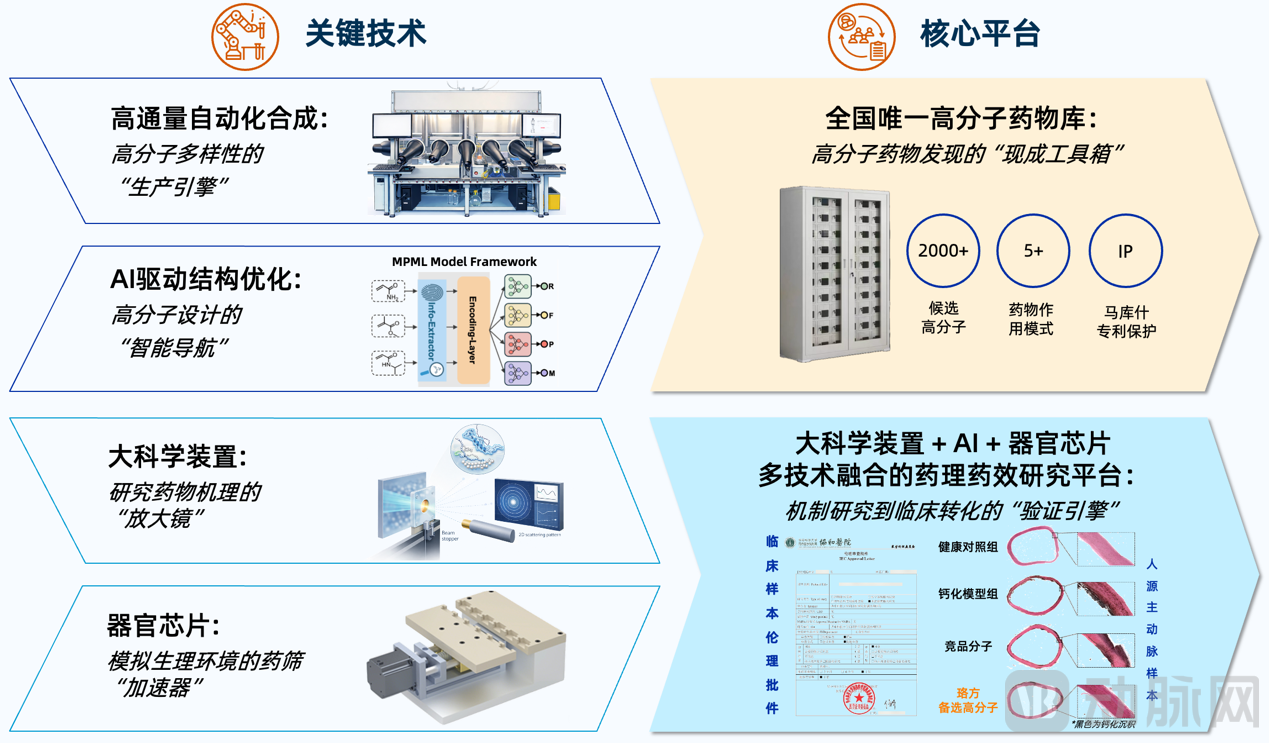
Luofang Bio Core Technology Platform
With the support of this system, Luofang Bio has gained the ability to continuously produce candidate molecules, enabling the development of polymer drugs to transition from single-point exploration to repeatable systematic operation.
Locking in Long-term Management of Chronic Diseases, Building a Pipeline Matrix with the Advantages of Polymer Pharmacological Mechanisms
The value of platform capabilities ultimately needs to be reflected through a high-potential pipeline ecosystem.
In the selection of indications,Luofang Bio systematically focuses on the field of chronic and complex diseases with significant unmet needs.The core treatment needs of such diseases are long-term, safe, stable, and convenient, placing extremely high demands on the safety, tolerability, and dosing frequency of drugs. The in vivo behavior of polymeric drugs can be precisely controlled through structural design, which can extend the half-life and reduce the dosing frequency. More importantly, due to their macromolecular properties, most polymers do not enter cells, resulting in lower systemic toxicity, making them perfectly suited for the clinical scenario of long-term management of chronic diseases.
Leveraging the pharmacological advantages of polymer-based drugs, Luofang has tightly focused on the common characteristic of "homeostatic imbalance" in chronic diseases, achieving a systematic pipeline layout in cardiovascular, allergy, metabolism, and autoimmune directions. All pipelines are driven by the company's self-developed high-throughput and characterization platforms, forming an efficient, synergistic, and rapidly replicable First-in-class chronic disease innovative drug pipeline matrix.
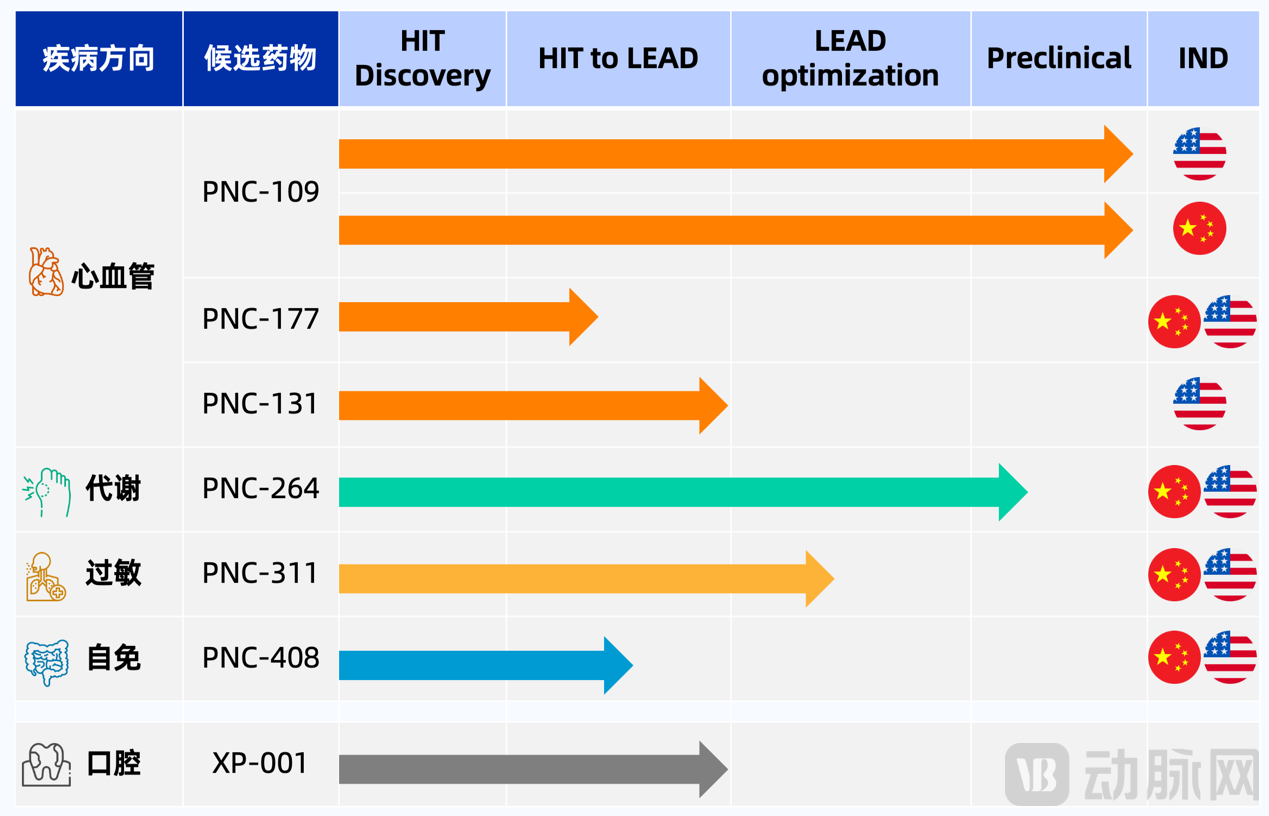
Luofang Bio Chronic Disease Pipeline Layout
Core Original Assets Move Towards the Critical Stage of Clinical Validation
From底层技术 to 管线布局, 珞方生物's core always revolves around platform capabilities. As the 技术体系 becomes increasingly mature, the company has also clarified its value realization path:Focusing on unmet clinical needs, validate the technical value with key clinical data.
In the next 3 to 5 years, Luofang Bio will enter a critical leapfrogging period. On one hand, the platform will continue to iterate, enhancing the efficiency of molecular design and screening; on the other hand, after the first pipeline enters clinical trials, it is expected to gradually release validation signals, moving the technological pathway toward "verifiable."
Placed in a broader coordinate system, polymer drugs are in a stage of continuous expansion, and their industrial boundaries are constantly being explored and defined. In the process where innovative drugs gradually extend from being "target-driven" to "molecular form-driven," the potential value of this pathway is expected to become increasingly evident as clinical and commercial progress advances.
In this process, the role played by enterprises is no longer just a product developer, but also an explorer and promoter of technical pathways. "We are not just making a product; we hope to validate whether a new molecular form can continuously generate clinical value," said Luo Zhi.
From the initiation of national-level scientific research projects, to the establishment of enterprise-based platforms, and then to the advancement of specific pipelines, what LuoFang Bio has practiced is gradually pushing a cutting-edge technology route towards an industrially verifiable and translatable path. For the still-evolving polymer drug track, this kind of systematic exploration centered around platform capabilities is becoming a significant force driving industry evolution.
It is also in this process that the question raised at the beginning starts to receive realistic responses: Could artificially synthesized polymer drugs become one of the significant drug forms of the next generation? The answer may not be fully revealed yet, but true innovation often begins at the margins and eventually merges into the mainstream. Luofang Bio is holding the key to unlocking the door to polymer drugs, bringing new hope to the vast population of chronic disease patients worldwide.