

Chugai Submits New Drug Applications in Japan for Entrectinib, a Precision Oncology Therapy Targeting NTRK and ROS1 Gene Fusions
Mar 19, 2019 08:40
CST Updated
08:40
Roche
Oncology Drug Research, Development, and Manufacturing
Chugai Pharmaceutical
Developer and Manufacturer of Anti-Cancer Drugs
March 19, 2019/BioonBIOON/-- Chugai Pharmaceutical, a Japanese pharmaceutical company controlled by the Swiss pharmaceutical giant Roche, recently announced that it has submitted two New Drug Applications (NDAs) for the ROS1/TRK inhibitor entrectinib in Japan. One NDA seeks approval for entrectinib for the treatment of adult and pediatric patients with neurotrophic tyrosine receptor kinase (NTRK) fusion-positive locally advanced or metastatic solid tumors, including patients whose disease has progressed following prior therapy, and as an initial therapy for patients without acceptable standard treatments. The other NDA seeks approval for entrectinib for patients with metastatic, ROS1-positive non-small cell lung cancer (NSCLC).
Chugai Pharmaceutical Co., Ltd. entered into a licensing agreement with Roche in July 2018, securing exclusive rights for the development and commercialization of entrectinib in the Japanese market. In terms of U.S. regulatory affairs, entrectinib is undergoing priority review by the FDA.FDAThe Prescription Drug User Fee Act (PDUFA) target dates for these two NDAs have been set for August 18, 2019. Previously, entrectinib had been granted Breakthrough Therapy Designation (BTD) in the United States, PRIME designation in the European Union, and SAKIGAKE designation (innovative drug) in Japan.
Entrectinib is an oral, selective tyrosine kinase inhibitor (TKI) for the targeted treatment of locally advanced or metastatic solid tumors harboring NTRK1/2/3 (encoding TRKA/TRKB/TRKC) or ROS1 gene fusions. Entrectinib can cross the blood-brain barrier, blocking the kinase activity of TRKA/B/C and ROS1 proteins, leading to the death of cancer cells with ROS1 or NTRK gene fusions. Entrectinib demonstrates efficacy against both primary and metastatic central nervous system (CNS) diseases, without adverse off-target activity. Currently, Roche is investigating the potential of entrectinib in treating various solid tumors, including non-small cell lung cancer (NSCLC), pancreatic cancer, sarcoma, thyroid cancer, salivary gland cancer, gastrointestinal stromal tumors, and cancers of unknown primary (CUP).
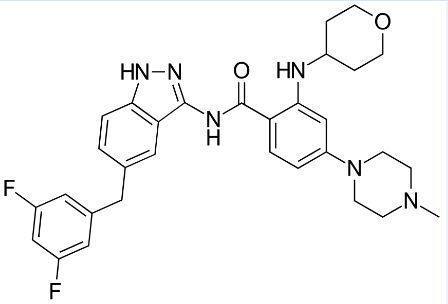
Molecular structure of entrectinib (Image source: Wikipedia)
The NDA for entrectinib is based on integrated analysis data from multiple clinical studies, including the Phase II STARTRK-2 study and three Phase I studies (STARTRK-1, ALKA-372-001, and STARTRK-NG). The data showed that: (1) in patients with NTRK fusion-positive solid tumors, the overall response rate (ORR) was 57.4%, the median duration of response (DoR) was 10.4 months, and the intracranial ORR in patients with baseline CNS metastases was 54.5%; (2) in patients with ROS1-positive non-small cell lung cancer (NSCLC), the ORR was 77.4%, the median DoR was 24.6 months, and the intracranial ORR in patients with baseline CNS metastases was 55.0%.
Entrectinib was developed by Ignyta, which Roche acquired in late 2017 for $1.7 billion. Currently, Roche is leveraging its expertise in developing personalized medicines and advanced diagnostic technologies, together with Foundation Medicine’s expertise in cancer diagnosis and treatment, to develop a next-generation sequencing-based companionDiagnosisKit, to screen for cancer patients most likely to benefit from entrectinib treatment.
It is worth mentioning that in early December 2018,Bayerwith Loxo Oncology's targeted anticancer drug Vitrakvi (larotrectinib) receiving U.S.FDAApproved for pediatric and adult patients with advanced solid tumors harboring NTRK gene fusions. This approval makes Vitrakvi the first oral TRK inhibitor ever, and the first toTumorTumor-agnostic “broad-spectrum” anticancer drugs will usher in a new era of “tumor-agnostic” therapy. In clinical studies, the overall response rate (ORR) for Vitrakvi treatment was 75%, with a complete response rate of 22%. (Bioon.com)
Original Source:Chugai files rare cancer drug for Japan approval