

Medical 3D Printing: Dominated by Series A Companies, Regulatory Hurdles Delay Widespread Clinical Adoption

Excellent
Digital Orthopedic Medical Products and Solutions Service Provider

Shining 3d
Developer of High-Precision 3D Vision Software and Hardware
A 3D-Printed Surgery Trending Online: A Man in Huai'an, Jiangsu Province, Diagnosed with Oral Cancer, Required Mandibulectomy Due to Tumor Invasion of the Entire Mandible; Surgeons Performed Osteotomy and Shaping of the Fibula from the Leg Based on a 3D-Printed Mandibular Model to Complete Mandibular Reconstruction
For 3D printing, the technology originated in 1892, and China's 3D Printing Technology Industry Alliance was established in 2012. However, to this day, applications of 3D printing are still reported as novelties, indicating that the technology has not yet achieved large-scale clinical adoption.
In fact, in 2017, twelve ministries and commissions jointly formulated the “Action Plan for the Development of the Additive Manufacturing Industry (2017–2020)” (hereinafter referred to as the “Plan”).
It lists “3D printing + healthcare” as one of the key priorities. The Plan states: In response to demands in the medical field for personalized medical devices (including non-medical devices used in healthcare settings), rehabilitation equipment, implants, soft tissue repair, and new drug development, efforts will be made to improve policies and regulations concerning the classification, clinical testing, registration, and market access of personalized medical additive manufacturing products. Additionally, standards for service pricing and medical insurance coverage for medical additive manufacturing products and services will be studied and established.
It also highlights the significant deepening of industry applications, driving the large-scale adoption of additive manufacturing in sectors such as aviation, aerospace, shipbuilding, automotive, healthcare, culture, and education.
In VCBeat’s review of the development of 3D printing abroad, we found that in the field of medical applications for 3D printing, products in the nascent stage remain in their early stages, while those in the hype phase have not matured as expected. Furthermore, 3D-printed implants have not entered a hype phase, but rather have developed at a relatively steady pace.
In the previous article, VCBeat (WeChat ID: vcbeat) briefly introduced some of the current applications of 3D printing in the medical field. So, what breakthroughs has the application of 3D printing in the medical field achieved in China over the past two years?
According to statistics from the VCBeat database, there are a total of 78 companies involved in 3D printing both domestically and internationally. Among them, 20 companies specialize in dental 3D printing, 14 focus on orthopedic implants, and 5 are engaged in biological tissues.
Judging from the financing data, excluding undisclosed figures, there were 10 companies at Series A. Most of the companies that went public had already been listed before developing their 3D printing businesses. There were a total of 13 financing rounds in 2018, compared to 18 in 2015.
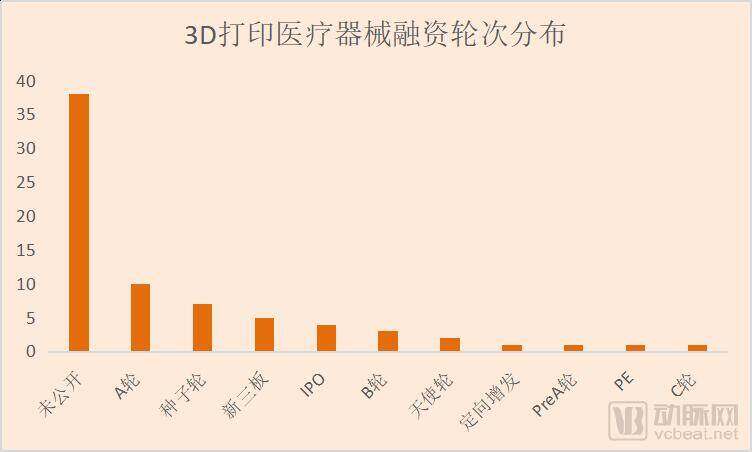
Due to the limited time available for database construction, not all projects could be fully included. The classification of certain companies’ business categories involves a degree of subjectivity and is provided for reference only.
Guo Libing, a partner at Cybernaut Investment Management, told VCBeat: “The overall market for 3D printing applications in healthcare is becoming more rational. Most of the numerous companies that emerged in the early stages have found their niche, with some even achieving self-sustainability.”
As the direction becomes increasingly clear and the market cools down, emerging projects will inevitably combine technological breakthroughs with market demand.
Data from the VCBeat database indicates that orthopedics is a prominent sector among 3D-printed medical applications. The prospects for 3D printing in orthopedics are significant for two main reasons: first, the industry still faces uncertainties, leaving room for breakthroughs, unlike the more mature dental application market or the technically immature field of bioprinting; second, the market size is substantial. However, numerous obstacles remain before large-scale clinical adoption can be achieved.
VCBeat interviewed several researchers, practitioners, and investors in the field of 3D-printed orthopedic implants, aiming to clarify the common barriers hindering industry development and reflect on the achievements made over the years.
In the field of 3D-printed orthopedic implants, products approved by the CFDA include the 3D-printed acetabular cups, 3D-printed artificial vertebral bodies, and 3D-printed spinal interbody fusion cages developed through the collaboration between AK Medical and Peking University Third Hospital.
The application of 3D printing in orthopedics can be divided into two phases: preoperative and intraoperative. Preoperatively, three-dimensional models are reconstructed from CT and MRI data to produce 3D-printed anatomical models and surgical guides. These 3D-printed surgical guides assist surgeons in rapidly determining acetabular positioning, as well as the size, depth, and angle of reaming, along with the entry point, trajectory, and length of acetabular screws, thereby enabling precise surgical execution.
In terms of intraoperative applications, the focus is primarily on personalized orthopedic implants.
Regarding orthopedic implants, there are three existing solutions: autografts, allografts, and metallic implants. Autografts are limited in supply and increase surgical trauma, while allografts, including those derived from bovine and porcine sources, are prone to eliciting immune responses.
3D-printed metal implants can be fabricated with porous structures that mimic human trabecular bone tissue, thereby facilitating greater bone ingrowth. Furthermore, 3D-printed bone implants allow for personalized customization.
“One advantage of 3D-printed constructs is the ability to customize them according to structural shapes. In autologous bone transplantation, for instance, using a fibular graft to reconstruct the mandible involves two anatomically distinct structures. In contrast, allogeneic bone transplantation requires prior inactivation and carries a certain risk of immune rejection,” said Bai Xueling, Associate Researcher and Senior Engineer at the Shenzhen Institutes of Advanced Technology, Chinese Academy of Sciences, in an interview with VCBeat.
Judging from market size and response, orthopedic implants are equally promising. Each year, more than one million people in China require orthopedic implants. For instance, AK Medical and Chunli Medical both generate annual revenues exceeding RMB 100 million and maintain growth rates above 50%. Both companies have also deployed 3D-printed artificial joints; AK Medical has partnered with GE, while Chunli Medical collaborates with HP Healthcare.
AK Medical is known as the first 3D printing stock. However, overall, AK Medical’s primary revenue still comes from conventional knee and hip replacement products. In 2017, conventional products accounted for 87.4% of sales revenue, while 3D-printed hip and spinal replacement products contributed 9%, with revenue reaching RMB 33.4 million.
The 2018 interim report revealed that the growth rate of Aikang Medical’s 3D-printed orthopedic implant business reached 178.6%. In the first half of 2018, sales revenue from 3D-printed products had already reached RMB 27.2 million.
This data, along with the growth rate, sufficiently demonstrates the market potential of 3D printing in orthopedic implants.
However, at present, the common challenge facing the industry lies not in technical hurdles but in the regulatory approval process and the current absence of established standards and specifications.
“Currently, there are many institutions in China conducting research on orthopedic implants, and their products can basically meet clinical needs. However, the approval process may take around three years.”“An industry insider said.”
“We have engaged in basic research for many years, but the approval and certification standards for translating basic research into clinical applications are rather ambiguous and lacking. There is a framework but no detailed implementation rules, making this a very confusing process. Of course, this is inevitably a process where technology and policy complement each other; it is not feasible to have clear policies without technological breakthroughs. We conducted extensive basic research on the quantitative analysis of human skeletal physiological structures, but encountered a lack of standards during the translation process. In 2018, relevant documents were issued, allowing us to immediately enter clinical trials. Therefore, I believe that obtaining certification is one of the more challenging aspects,” Zhao Xiaowen, founder of Excellent, told VCBeat.
However, this long-standing challenge hindering the development of the 3D industry is gradually being addressed. Not long ago, the National Medical Products Administration (NMPA) released a public notice on the establishment of three standardized technical focal units for medical devices, including artificial intelligence, one of which is the proposal for setting up the standardized technical focal unit for medical additive manufacturing technologies. It is believed that relevant standards will be issued soon.
VCBeat compiled statistics on the distribution of 3D printing medical enterprises from its database. Similar to the international landscape, the orthopedics sector has a relatively high concentration of 3D printing companies. However, compared to the FDA, which has already approved more than 30 products for orthopedic implants, the CFDA’s approval process has been slower.
However, as highlighted in the “Plan,” numerous other documents require policy guidance. These include policies and regulations aimed at improving the classification, clinical testing, registration, and market access of personalized medical additive manufacturing products, as well as research to determine fee standards for medical service items related to medical additive manufacturing products and services, along with criteria for medical insurance support.
In addition to guidance from policy standards, another issue that must be considered for the maturation of the orthopedic implant industry is the industrial chain. The industrial chain for additive manufacturing was mentioned in the "Action Plan for the Development of the Additive Manufacturing Industry (2017–2020)" as follows:
The ecosystem has been fundamentally improved. A complete additive manufacturing industry chain has been cultivated, spanning materials, processes, software, core components, and equipment, while an additive manufacturing ecosystem encompassing metrology, standards, testing, and certification has been established. A number of public service platforms have been built, and several industrial clusters have taken shape.
Where is the weakest link in the additive manufacturing supply chain for medical devices? Industry insiders also stated that there has been significant progress in both upstream and downstream sectors of the supply chain over the past two years, particularly in 3D printers.
“Over the past two years, there have been essentially no significant issues with equipment and materials. I recall that in 2014, China had yet to establish standard products for 3D printing, let alone offer personalized printing solutions, whereas dozens of such products were already available abroad. Now, fifteen years later, we have developed standardized 3D-printed medical devices. The range of international products has become quite extensive, with new products receiving FDA approval every year, which demonstrates the promising prospects of this industry,” Zhao Xiaowen told VCBeat.
This also reflects that there is still a certain gap compared to foreign countries. Guo Libing told VCBeat, “In terms of hardware, such as printer nozzles. The nozzle is a key technology, and the requirements for nozzles are very high regardless of whether wax, resin, or metal materials are used. Its speed needs to be extremely fast, and the diameter inside the nozzle must reach the micron level. This is something we cannot produce domestically.”
This absence of core, high-end R&D is also attributable to the fact that a large number of entrepreneurs are vying to develop homogeneous products.
There has been significant attention devoted to devices and materials, yet there is a relative lack of focus on the software aspect, such as how to design implants prior to manufacturing to better meet human physiological needs.
An investor told VCBeat, “Systematically speaking, there is a high degree of homogenization in what companies are developing. When it comes to desktop devices, hundreds of firms seem to be focusing on them, while few are pursuing more advanced solutions, largely due to the significant investment required.”
The 3D printing industry is currently not the most prominent investment hotspot. As reflected by data from the VCBeat database, most companies are still in the early stages of financing. Although some leading enterprises have emerged in the market, this does not indicate a reduction in opportunities. From the current perspective, there is still room for breakthroughs in both hardware and software.
Furthermore, achieving clinical application at the downstream end of the industrial chain will inevitably confront the issue of product costs. Whether 3D-printed orthopedic implants remain within an affordable price range in the future, and the extent of patient accessibility, will likewise constitute barriers to their clinical adoption.
Currently, for patients to receive 3D-printed implantable devices, such as those certified by the CFDA from Aikang Medical, they must be used in conjunction with the Personalized 3D Accurate Construction Technology Solution (“3D ACT Solution”). This solution assists surgeons in simulating and planning surgeries, streamlines surgical procedures, and provides personalized surgical instruments along with pre-selected implants.
Comprehensive solutions can also help enterprises better penetrate hospitals.
From a cost perspective, will the price of 3D-printed implants be significantly higher than that of existing products? Multiple interviewees told reporters that the price of 3D-printed implants is not expected to exceed that of current implants.
An industry insider stated, “The overall cost of 3D-printed products will not be higher than that of existing products, meaning they will not impose a significant financial burden on patients. Given the historically high profit margins associated with traditional orthopedic consumables, the production cost of 3D-printed implants is not a disadvantage.”
3D printing enables a better healthcare experience in a more cost-effective and efficient manner. Regardless of whether it is currently a market hotspot, it will play a significant role in medical applications in the future. Beyond orthopedic implants, 3D-printed biological tissues are being used for clinical trials and clinical simulation of drug efficacy. As a tool, 3D printing also holds considerable promise in certain rehabilitation fields, comparable to that of robotics.