



On March 25, AstraZeneca announced that the European Medicines Agency (EMA) had officially approved its SGLT-2 inhibitor Forxiga (dapagliflozin) as an adjunct to insulin for adults with type 1 diabetes (BMI ≥27) who have inadequate glycemic control with optimal-dose insulin alone.
This marks the first time the EMA has approved an oral drug as an adjunct to insulin for patients with type 1 diabetes, the first AstraZeneca drug approved for the treatment of type 1 diabetes, and the first approval of an SGLT-2 inhibitor for use in patients with type 1 diabetes.
The EMA’s approval was primarily based on the results of the Phase III DEPICT clinical program conducted in patients with type 1 diabetes. The 24-week short-term and 52-week long-term results from the DEPICT-1 study, as well as the 24-week short-term results from the DEPICT-2 study, all demonstrated that once-daily oral Forxiga 5 mg, as an adjunctive therapy to insulin in patients with type 1 diabetes who had inadequate glycemic control with insulin alone, achieved clinically meaningful improvements from baseline in HbA1c levels (primary endpoint), body weight (secondary endpoint), and daily insulin dose (secondary endpoint).
Regarding safety, apart from a slightly higher incidence of ketoacidosis, the adverse reaction data for Forxiga in patients with type 1 diabetes are consistent with those previously observed in patients with type 2 diabetes. Ketoacidosis is a common complication in patients with type 1 diabetes and is more prevalent than in those with type 2 diabetes.
SGLT-2, known in Chinese as sodium-glucose cotransporter-2, is primarily expressed in the kidneys and plays a key role in facilitating renal glucose reabsorption. SGLT-2 inhibitors are a novel class of antidiabetic drugs introduced in recent years. They exert their glucose-lowering effects mainly by reducing renal glucose reabsorption and promoting the excretion of excess glucose through urine. Regarded as a new therapeutic approach distinct from traditional antidiabetic medications, SGLT-2 has become a prominent target in diabetes drug development in recent years.
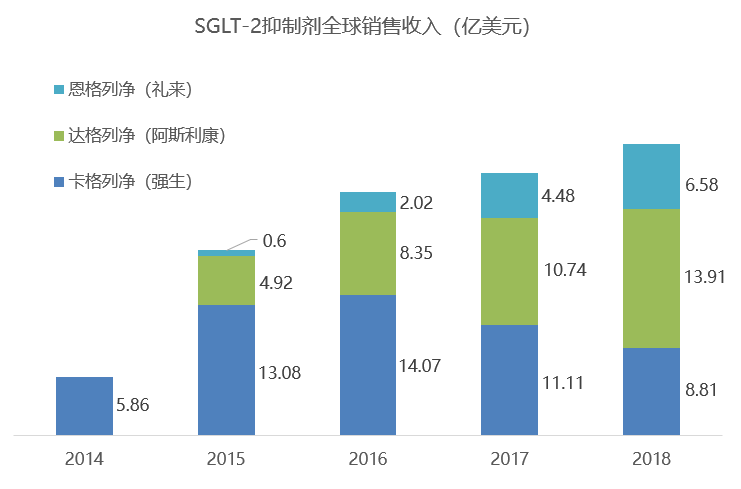
To date, a total of seven SGLT-2 inhibitors have been approved for marketing worldwide, among which tofogliflozin, rugliflozin, and ipragliflozin have been approved only in Japan. An analysis of the three most closely watched SGLT-2 inhibitors (with sales figures for Merck’s ertugliflozin undisclosed) reveals that the market size for SGLT-2 inhibitor drugs has exceeded US$2.9 billion.
In terms of the growth trends of specific agents, canagliflozin, having received the most safety warnings, finally lost its leading position in the SGLT-2 inhibitor class in 2018, with its market share shrinking year by year. Forxiga has been approved in the European Union and the United States as an adjunct to diet and exercise to improve glycemic control in patients with type 2 diabetes mellitus. Clinical studies have confirmed its additional benefits, including weight reduction, blood pressure lowering, and reduced risk of cardiovascular events, resulting in strong sales growth momentum.
Marketing applications for Forxiga as an adjunct to insulin therapy in patients with type 1 diabetes have also been submitted in Japan and the United States, with decisions expected in the first half of 2019 and in 2019, respectively. On March 22, the FDA rejected the marketing application for sotagliflozin, a dual SGLT-1/2 inhibitor co-developed by Sanofi and Lexicon, for the treatment of type 1 diabetes; specific reasons were not disclosed. However, the European Medicines Agency’s Committee for Medicinal Products for Human Use (CHMP) has issued a positive opinion for sotagliflozin for this indication, with the final approval decision anticipated in the second half of this year.