

Takeda Submits MAA to EMA for Subcutaneous Vedolizumab as Maintenance Therapy in Ulcerative Colitis and Crohn’s Disease
Apr 02, 2019 08:02
CST Updated
08:02

Takeda
Biopharmaceutical Manufacturer

European Medicines Agency
The European Medicines Agency (EMA) is a decentralized agency of the European Union (EU), located in London. It began operations in 1995. The agency is responsible for the scientific evaluation, supervision, and safety monitoring of medicines developed by pharmaceutical companies for use in the EU. By ensuring that all medicines available on the EU market are safe, effective, and of high quality, the EMA protects public and animal health in the 28 EU Member States and countries of the European Economic Area.
April 02, 2019 /Bio ValleyBIOON/ -- Japanese pharmaceutical giant Takeda recently announced that the European Medicines Agency (EMA) has accepted the Marketing Authorization Application (MAA) for the subcutaneous formulation of Entyvio (vedolizumab) as a maintenance therapy for adult patients with moderately to severely active ulcerative colitis (UC) and Crohn’s disease (CD). The application includes both pre-filled syringes and autoinjector pens for the subcutaneous formulation of Entyvio. As a gut-selective biologic, Entyvio offers patients additional treatment options through this new route of administration. If approved, Entyvio will become the only maintenance therapy for UC and CD available in both intravenous (IV) and subcutaneous (SC) formulations.
Adam Zaeske, Head of the Gastroenterology Franchise at Takeda’s Europe and Canada Business Unit, stated, “This regulatory submission marks our continued commitment to providing innovative medicines and treatment options to meet the diverse needs of patients with ulcerative colitis (UC) and Crohn’s disease (CD) in Europe. If approved, subcutaneous Entyvio, alongside the currently available intravenous formulation, will offer more choices, enhancing patient experience by aligning with individual treatment preferences and lifestyles.”
This MAA submission is based on the pivotal Phase IIIData from the VISIBLE-1 study. This study was a randomized, double-dummy, double-blind, placebo-controlled trial that included an intravenous (IV) Entyvio control group. The study enrolled a total of 383 patients with moderately to severely active ulcerative colitis (UC) who had previously responded inadequately to, lost response to, or were intolerant of corticosteroids, immunomodulators, orTumorInsufficient response, loss of response, or intolerance to tumor necrosis factor-alpha (TNF-α) antagonists. In the study, patients received two doses of open-label intravenous (IV) Entyvio at Weeks 0 and 2. Patients who achieved clinical remission were randomly assigned at Week 6 to one of three treatment groups: Entyvio subcutaneous (SC) (108 mg) plus IV placebo group (n=106), Entyvio IV (300 mg) plus SC placebo group (n=54), and SC placebo plus IV placebo group (n=56). Subcutaneous injections were administered every 2 weeks, and intravenous infusions were administered every 8 weeks. The primary objective of the study was to evaluate the efficacy and safety of Entyvio SC as maintenance therapy.
Data showed that at Week 52 of treatment, a statistically significantly higher proportion of patients in the Entyvio SC group achieved clinical remission compared with the placebo group (46.2% vs 14.3%, p<0.001; clinical remission was defined as a Mayo score ≤2 with no individual subscore >1), thereby meeting the primary endpoint of the study. A similar clinical remission rate was observed in the Entyvio IV control group (42.6%).
Furthermore, compared with the placebo group, the Entyvio SC treatment group demonstrated statistical superiority in key secondary endpoints, including mucosal healing (56.6% vs 21.4%, p<0.001) and durable clinical remission (64.2% vs 28.6%, p<0.001). The Entyvio SC treatment group also showed higher rates of durable clinical remission (15.1% vs 5.4%, p=0.076) and corticosteroid-free clinical remission (28.9% vs 8.3%, p=0.067) than the placebo group, although these differences were not statistically significant. Similar results were observed in the Entyvio IV treatment group.
Further subgroup analysis indicated that in patients who had not previously received treatment (treatment-naïve) and those who had previously received treatment (pre-treated)TumorIn patients treated with tumor necrosis factor-α (TNFα) inhibitors, the clinical remission rate of Entyvio SC was significantly higher than that of placebo (treatment-naïve subgroup: 53.7% vs. 18.9%, p < 0.001; previously treated subgroup: 33.3% vs. 5.3%, p = 0.023).
Regarding safety, the incidence of adverse events (including serious adverse events and infections) was similar between the Entyvio SC and Entyvio IV treatment groups. Injection site reactions were mild, with an incidence rate of 9.4% in the Entyvio SC group (0% in the placebo group), and no patients discontinued treatment due to these reactions. The detection rates of anti-Entyvio antibodies (AVAs) were similar in the Entyvio SC and IV groups (5.7% and 5.6%, respectively).
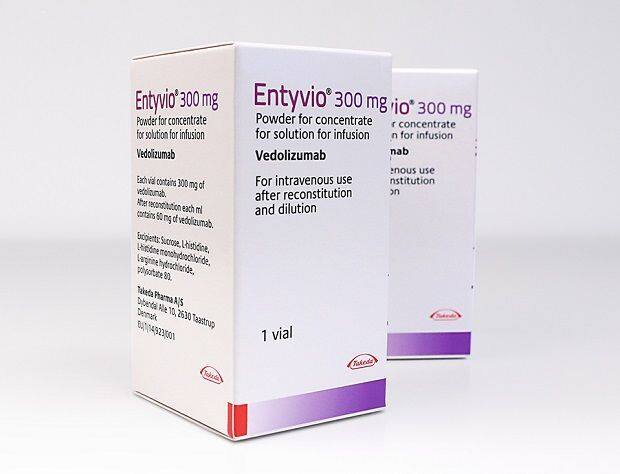
Entyvio is a gut-selective humanized monoclonal antibody that was approved for marketing in the United States and the European Union in May 2014. Currently, Entyvio intravenous infusion has been approved in more than 60 countries worldwide for the treatment of adult patients with moderately to severely active ulcerative colitis (UC) or Crohn’s disease (CD).
The active pharmaceutical ingredient of Entyvio is vedolizumab, a fully humanized monoclonal antibody that specifically antagonizes α4β7 integrin, inhibiting its binding to the gut mucosal cell adhesion molecule MAdCAM-1. MAdCAM-1 is selectively expressed in the gastrointestinal vasculature and lymph nodes. α4β7 integrin is expressed on a subset of circulating leukocytes, which have been demonstrated to play a critical role in mediating inflammation in Crohn’s disease (CD) and ulcerative colitis (UC).
Notably, on March 9 this year, Takeda announced the results of VARSITY, the first head-to-head Phase IIIb study evaluating Entyvio (vedolizumab) for the treatment of moderate-to-severe ulcerative colitis (UC), at the 14th Congress of the European Crohn’s and Colitis Organisation (ECCO) held in Copenhagen, the capital of Denmark. The results showed that at Week 52 of treatment, Entyvio demonstrated superior efficacy compared to AbbVie’s flagship product Humira (generic name: adalimumab) in achieving the primary endpoint of clinical remission. (Bioon.com)