

Phase 3 ADMIRAL Trial Data Show XOSPATA® (Gilteritinib) Significantly Prolongs Overall Survival in Adults with FLT3-Mutated Relapsed/Refractory AML
Apr 02, 2019 15:11
CST Updated
15:11

Astellas
Pharmaceutical R&D Manufacturer

April 02, 2019 News /BioonBIOON/ -- The 110th Annual Meeting of the American Association for Cancer Research (AACR) was held recently (March 29–April 3) in Atlanta, USA. This is the world’s largest cancer researchMeetingone. At this conference, the Japanese pharmaceutical company Astellas presented data from the Phase III ADMIRAL study (NCT02421939) of the targeted anticancer drug Xospata (gilteritinib).
This study is an open-label, multicenter, randomized Phase III trial enrolling patients with FLT3-mutated acute myeloid leukemia who are refractory to first-line therapy or have relapsed after treatment.Leukemia(AML) In adult patients, Xospata was compared with salvage chemotherapy. The primary endpoint of the study was overall survival (OS). A total of 371 patients with relapsed or refractory AML who were FLT3 mutation-positive in bone marrow or peripheral blood were enrolled in the study. Patients were randomized in a 2:1 ratio to receive either Xospata (120 mg) or salvage chemotherapy.
The results showed that, compared with the standard salvage chemotherapy group, the Xospata treatment group demonstrated a statistically significant prolongation in overall survival (OS). Specifically, the median OS was 9.3 months in the Xospata group versus 5.6 months in the salvage chemotherapy group (HR=0.637, 95% CI: 0.490–0.830, p=0.007). The one-year survival rate was 37% in the Xospata group and 17% in the salvage chemotherapy group.
Hematology, Perelman School of Medicine at the University of PennsylvaniaTumorAssociate Professor Alexander Perl stated, “The results of the ADMIRAL study are highly encouraging. Patients with relapsed/refractory FLT3-mutation-positive AML have a poor prognosis and short survival. Until recently, they had few treatment options. These findings have transformed the treatment paradigm for this patient population.”
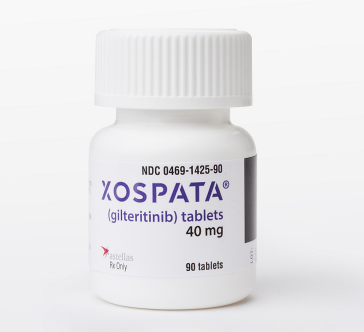
Xospata is a second-generation FLT3 inhibitor that inhibits two distinct types of mutations: internal tandem duplications (ITD) in the FLT3 juxtamembrane domain and mutations in the FLT3 tyrosine kinase domain (TKD). FLT3-ITD mutations affect approximately 30% of patients with acute myeloid leukemia (AML) and are associated with poorer disease-free survival and overall survival. FLT3-TKD mutations affect approximately 7% of AML patients. Although the clinical impact of these mutations is not yet fully understood, they are associated with treatment resistance.
In Japan and the United States, Xospata was approved in September and November 2018, respectively, for the treatment ofFDAAdult patients with relapsed or refractory AML whose FLT3 mutations have been confirmed by an approved diagnostic test. In the EU, the marketing authorization application for Xospata was accepted by the European Medicines Agency (EMA) in February 2019.
Currently, Astellas is conducting several Phase III studies to evaluate the efficacy and safety of Xospata in various patient populations with FLT3 mutation-positive acute myeloid leukemia (AML). Xospata was discovered through a research collaboration with Kotobuki Pharmaceutical Co., Ltd., and Astellas holds exclusive global rights for the development, manufacturing, and commercialization of Xospata. (Bioon.com)