3N Contact Lens Restorer Disrupts Market with FDA-Cleared Protein Removal Technology Ahead of IPO

3N Tech
Manufacturer and R&D of Corneal Contact Lens Care Technology and Products
On the day she welcomed her first wave of users, Sun Zhifan felt that she had entered the busiest period since starting her business. She mobilized resources from all directions and accelerated production to fill the market gap that had unexpectedly opened up.
A few days earlier, a Weibo influencer friend of Sun Zhifan posted about their experience using a contact lens restoration device. In those days, before the era of booming influencer-driven e-commerce, this post still brought Sun an unexpected surge in traffic. People who had long suffered from corneal inflammation due to wearing contact lenses and cosmetic colored lenses flocked to purchase the device, as if receiving much-needed rain after a prolonged drought. The flood of positive reviews from fans after trying out the product finally put Sun’s mind at ease after years of uncertainty.
At the time, the product was still a prototype. After multiple iterations, Sun Zhifan referred to this prototype as the first-generation 3N Restorer. The 3N Restorer utilizes protein electrophoresis technology to professionally remove tear protein residues from contact lenses, thereby reducing foreign body sensation and enhancing oxygen permeability.
However, the prototype was unsightly and cumbersome to use. Sun Zhifan knew that to truly penetrate the market, he could by no means rely on a product with significant flaws in user experience. Nevertheless, this sweat-drenched summer of 2015 was destined to become a landmark event in Sun Zhifan’s entrepreneurial journey.
Nine years ago, Sun Zhifan arrived in Suzhou and began an internship at the Laboratory of Biogenomics within the School of Basic Medicine and Life Sciences at Soochow University. Under the mentorship of Wang Yanhong, then a doctoral candidate at the university, she engaged in research and development related to protein antibodies. During this period, she developed a strong interest in protein electrophoresis technology.
At that time, many students around me were in the habit of wearing contact lenses. Contact lenses, also known as corneal contact lenses, are, as the name suggests, lenses placed directly on the cornea of the eye. The mesh-like porous structure of contact lens materials tends to retain proteins found in human ocular secretions. With prolonged use, these protein deposits can accumulate and clog the pores of the lenses, reducing oxygen permeability and posing a threat to ocular health. In Japan, contact lenses with a replacement cycle longer than one month have been banned from the market since 2015.
Under specific conditions, colloidal tear proteins carry a negative charge. Sun Zhifan’s initial technical concept was to use electrophoresis to generate an electric field, causing residual tear proteins on contact lenses to migrate toward the positive electrode and be adsorbed by probes, thereby restoring the lenses to a clean state. Although the integration of protein electrophoresis technology with the contact lens field represents a novel concept, the underlying technical principles are clear, leading Sun Zhifan to believe that the transformation of this technological achievement could be accomplished rapidly.
In fact, the translation process lasted five years—long enough to alter Sun Zhifan’s career trajectory. During this period, she co-owned a bar with friends and engaged in foreign trade on her own, investing nearly all her funds into the development of the restoration device. “We have invested close to 3 million RMB in total,” said Sun Zhifan.
Sun Zhifan set up a workspace on the second floor of a bar, which served as her R&D site. Adjusting parameters, matching power outputs, and fixing bugs—every optimization of product details came with the growing pains of breaking through bottlenecks. In early 2015, when the clumsy prototype finally met all her technical expectations, Sun Zhifan experienced the thrill of rebirth after being pushed to the brink. “You inevitably have to go through certain trials. Once the product is launched, you’ll realize that all the previous struggles were minor matters. This holds true for both technology commercialization and entrepreneurship.” Those years of solitary exploration honed Sun Zhifan’s ability to accurately grasp industry trends through repeated product iterations.
While running a bar, Sun Zhifan met her future partner, Bai Yang. An experienced project manager, Bai Yang decided to break away from her conventional life and take a risk by joining forces with Sun after learning about the restorer device Sun was developing. In March 2015, they registered their company, with Sun handling external affairs and Bai Yang managing internal operations. The company’s full name is Suzhou 3n Biological Technology Co., Ltd., abbreviated as 3N Tech, with its headquarters located in Suzhou Biobay. Sun Zhifan told VCBeat New Medicine that she hopes the team will always remain humble, maintain strong collaboration and cohesion, and thereby harness strength many times greater than their individual capabilities.
To date, 3N Tech has established a robust product pipeline.

Based on material characteristics, contact lenses are classified into two major categories: rigid and soft. Soft contact lenses, also known as soft corneal contact lenses, are made primarily from hydrogel materials and feature high oxygen permeability and excellent conformability; they represent the mainstream lens type in the market. Rigid contact lenses can be further subdivided into rigid gas-permeable (RGP) lenses, which are worn during the day, and orthokeratology lenses (OK lenses), which are worn overnight.
The dedicated soft lens cleaner is 3N Tech’s flagship product. A search by VCBeat New Medicine revealed that sales of the third-generation 3N Restorer exceeded 110,000 units on its Tmall flagship store alone, while the newly launched fourth-generation Restorer has surpassed 20,000 units. On JD.com’s “Best-Selling Eyeglass Accessories” list, the fourth-generation Restorer ranks among the top 20 and stands out as the highest-priced item and the only accessory with an automatic cleaning function on the list.
Priced under 200 yuan per unit, the 3N Restoration Device features a magnetically controlled integrated chamber design. Its self-developed cleaning probes, coated with a specialized formulation, are placed in the cleaning tank module to adsorb tear proteins. Meanwhile, the microcurrent generated by the electric field within the cleaning tank eliminates bacteria and microorganisms. Each operation cycle lasts 30 seconds. Sun Zhifan told VCBeat News that, under normal conditions, a single cycle of the Restoration Device can achieve 100% adsorption of tear proteins from the lenses. “We have validated the cleaning efficacy through thousands of tests.”
The usage method of the reduction device is shown in the figure below:
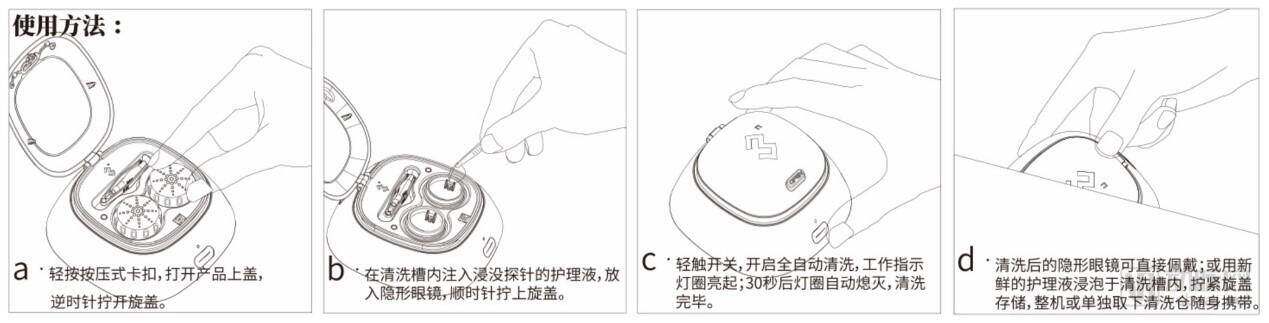
The fourth-generation restoration device adds features such as full-body washability and wireless charging compared to the third-generation product. Sun Zhifan, who is not a contact lens user herself, positions herself as a product manager. Through multiple product iterations, she has developed precise insights into user scenarios and usage logic. Transforming reliable technology into high-quality products that genuinely serve users has become the gold standard for the 3N team.
In October 2017, 3N Tech launched its third-generation 3N Reduction Instrument to the market, initiating a continuous process of user accumulation. Sun Zhifan told VCBeat New Medicine that by the end of 2018, 3N Tech had achieved cumulative sales of nearly one million units. For a team of fewer than 30 people, this was clearly a respectable performance. “In 2019, we intensified our efforts in expanding medical channels, and sales figures are highly likely to double.”
Currently, China has a myopic population of nearly 600 million, with a contact lens penetration rate of 6%–8%, resulting in a total user base of approximately 40–50 million. Of these users, nearly 90% use non-daily disposable lenses. These 30–40 million users constitute the target market for 3N Tech. Considering the consumer-oriented nature of its restoration device, Sun Zhifan believes the industry’s ceiling corresponds to a 20%–30% market share. With 3N Tech currently serving 500,000–800,000 users, there remains substantial room for growth. Furthermore, compared to mainstream international markets, the penetration rate of contact lenses in China remains extremely low. Sun Zhifan predicts that the stable penetration rate for China’s contact lens market will reach 20%–30%.
“There are few players in this industry, and innovation has been a key factor in 3N Tech’s success,” pointed out Sun Zhifan. Given that the annual cost of using daily disposable contact lenses is relatively high, ranging from RMB 6,000 to 8,000, monthly and semi-annual disposables remain the mainstream products. Incomplete lens cleaning has become an unresolved core pain point. Traditional players in the eyewear industry have largely focused on the production and optimization of lenses, while also selling accompanying care solutions; however, these solutions have limited efficacy in removing tear proteins.
For a long time, manual rubbing and oscillating cleaning have been the only options to compensate for the limitations of care solutions. However, these methods are prone to causing secondary damage and lens wear, while also demonstrating suboptimal efficacy in removing tear proteins. The 3N Restoration Device employs specialized technology to innovatively and specifically address this market gap.
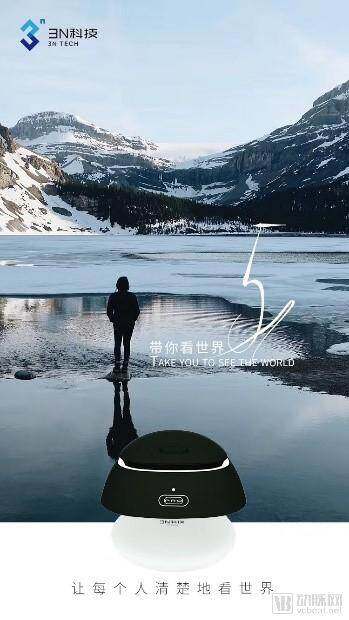
Typically, new products require 21 consumer touchpoints to drive purchase behavior. “The 3N Restoration Device achieved user conversion with only 4–5 touchpoints, and the conversion rate per single touchpoint reached as high as 40%–50%.” At its inception, 3N Tech’s product mission was to restore the ability of eyeglasses to help people discover beauty. After iterating through four product versions and reaping significant market rewards, Sun Zhifan decided to further focus on user needs, defining the company’s vision as “Enabling everyone to see the world clearly.”
Beyond the innovative product concept, Sun Zhifan shared three business insights with VCBeat New Medicine.
First, building up technical reserves. Within 3N Tech’s 25-person team, the product department maintains close collaboration with the technology department. Sun Zhifan believes that technological translation capability is crucial to delivering products that genuinely optimize user experience.
Second, rapid iteration. From the prototype to the fourth-generation restoration device, 3N Tech took less than four years, achieving an average of one iteration per year. This approach continuously aligned the product with user needs and facilitated its swift launch across all channels. Rapid product iteration not only tests a team’s user-centric mindset but also its channel capabilities. “The journey from product to market is arduous; it was only after extensive experimentation that we developed the ability to efficiently penetrate multiple channels.”
Third, building an intellectual property barrier. Sun Zhifan told VCBeat that Yang Xiaodong, a co-founder with extensive experience in domestic and international IP rights protection, established the core intellectual property barriers for 3N Tech, helping the company fend off numerous instances of unfair competition and solidify the market position of the 3N Reduction Instrument.
Sun Zhifan hopes that these three business principles will be continuously deepened in operations, forming an "iron triangle" that supports the company's development.
In Sun Zhifan’s strategic plan, 3N Tech is continuously enhancing the scenario-based functionalities of its restoration device—such as further eliminating excess sebum and adding interactive features—while simultaneously extending its reach upstream and downstream along the industry chain to gradually establish a self-contained product ecosystem.
Since May 2018, 3N Tech has entered the field of optometry and ophthalmic medical care, starting with ophthalmology. Its flagship product is the 3N Restorer Hard Lens Special Edition. Priced between RMB 499 and 699, this product features upgraded materials based on the fourth-generation 3N Restorer. According to Sun Zhifan, the 3N Restorer Hard Lens Special Edition has already been sold at the Eye, Ear, Nose, and Throat Hospital of Fudan University.
Sun Zhifan told VCBeat New Medicine that ophthalmic and optometric care was the market she initially intended to enter when designing the product. “The barrier to entry into medical settings is extremely high, so we chose to start with consumer scenarios.” Before the product’s functionality and the team’s service capabilities were validated by the market, Sun Zhifan did not want to rashly introduce the product into hospitals. The launch of the 3N Restorer’s rigid endoscope-specific version represents both an iteration of the product and an evolution of the team.
For Sun Zhifan and her team, venturing into the medical sector represented a new endeavor, as market pain points had shifted. In the consumer goods sector, users place great emphasis on product aesthetics and interactive performance; whereas in the medical field, doctors and patients focus primarily on product performance and quantifiable performance validation. Sun Zhifan told VCBeat New Medicine that, thanks to the team’s prior experience in the consumer sector, the establishment of medical distribution channels for their products proceeded smoothly.
Over the past year, 3N Tech has established in-depth collaborations with multiple ophthalmology experts to collect performance data on its restoration device through clinical trials, aiming to jointly develop scientific industry standards. Sun Zhifan believes that for a product like the 3N restoration device, which possesses both consumer and medical attributes, building substantial brand influence requires becoming a setter of industry standards.
In 2019, Sun Zhifan was attempting a more systematic expansion path in the medical sector. “We plan to consolidate multiple products and build a comprehensive care protocol for orthokeratology lenses, with protein electrophoresis cleaning as the core.”
Following technology commercialization from 2010 to 2015 and product iteration from 2015 to 2018, 3N Tech has gradually established a dual-track layout in consumer and medical sectors, adopting an asset-light model featuring independent R&D and outsourced production. Sun Zhifan told VCBeat New Medicine that, to strengthen control over its supply chain, 3N Tech is attempting to take controlling stakes in core suppliers. She aims to build 3N Tech into a technology-driven R&D enterprise with core assets.
Since its inception, Sun Zhifan has consistently funded product iteration R&D exclusively through product sales revenue. “We completed one round of financing, but we have never drawn on those funds,” said Sun. He believes that only by sustaining self-generated cash flow can a company maintain robust risk resilience.
Nowadays, the market has begun to take shape and brands are starting to emerge, but Sun Zhifan remains busy.
She worries that the team’s growth rate cannot keep pace with the expansion of business scale. Sun Zhifan candidly acknowledges that as the enterprise continues to grow, both its organizational structure and operational processes urgently need improvement. “If we focus solely on external market expansion while neglecting internal capability building, a disconnect will inevitably arise.” Therefore, she dedicates substantial blocks of time each day to work with employees on breaking down objectives, clarifying strategies, and formulating action plans, while also overseeing the implementation of each initiative. Sun Zhifan hopes that a culture characterized by humility, collaboration, and diligence will truly become the foundational tone for the team’s development.
She is concerned that the pace of brand maturation cannot keep up with the increasing refinement of industry competition. “A brand is a crucial moat for a company’s sustainable development.” Only when enterprises reach a certain scale do they qualify to compete alongside established traditional players; the strength of the brand will facilitate business expansion. Recently, Sun Zhifan initiated a new round of financing for 3N Tech, hoping to introduce high-quality investors to endorse the brand.
“To build a great enterprise, one must ultimately traverse an ordinary path, but with advance strategic planning.” Sun Zhifan has always considered himself highly goal-oriented, yet entrepreneurs are always on the journey.