

GE Healthcare's Digital Transformation: Showcasing Strength and Driving Real-World Implementation

GE Healthcare
Digital Solution Provider
CMEF: An Annual Showcase of Industry Strength
On May 14, the China Medical Equipment Fair (CMEF) was held in Shanghai. The theme of this year’s exhibition was “Intelligence Reshaping the Future,” while last year’s was “The Era of Digital Healthcare.” The two keywords—digitalization and intelligence—have become the central themes in the narratives of industry giants over the past two years. These concepts have gained prominence because the application of technologies such as AI and big data can enhance the performance and add greater value to traditional medical devices.
Taking GE Healthcare, one of the "Big Three" medical device manufacturers, as an example, the company showcased a total of 16 technological innovations and digital achievements in 2018. This year, it has increased that number to 21.
GE Healthcare’s success is inseparable from the group’s own keen sense of technological and market shifts.
In June 2018, GE announced the spin-off of its healthcare business into an independent medical company, a move that can be described as “slimming down.” Since then, the three giants of the traditional high-end imaging sector—GE, Philips, and Siemens—have all embarked on paths of independent development for their healthcare businesses.
As he stepped down in 2017, Jeffrey Immelt, then CEO of General Electric Company, shared his experiences and reflections on leading the massive conglomerate through profound transformations in a lengthy article. One passage left a particularly deep impression—
One reason for the failure of large corporations is that they believe they cannot afford certain initiatives and are unwilling to release resources for bold exploration. To transform GE into a digital industrial company, we invested approximately $4 billion in 2016 in the development of analytics software and machine learning.

Jeff Immelt’s maneuver can be described as “reshaping,” imprinting GE with the label of “intelligentization.”
Chen Jinlei, Vice President of GE Healthcare China, provided a further explanation of “intelligentization”: In the common understanding, “intelligentization” generally refers to technologies such as digitalization, artificial intelligence, and deep learning. However, for GE Healthcare, the deeper meaning of “smart transformation” lies in how to apply these technologies to products and the industry.
Chen Jinlei stated that GE Healthcare’s advantages in this area are primarily threefold: the largest installed base and vast amounts of raw data; the ability to directly embed AI and other applications into medical devices, enabling on-device AI applications to precisely process the most raw data and provide imaging-related information; and the advantages and resources of its application platform and ecosystem.
According to Leiphone, GE Healthcare has begun cultivating an ecosystem based on the Edison platform.
Regarding the product achievements at this exhibition, they mainly encompass two dimensions: innovations in intelligent imaging technology and innovations in digital healthcare.
At the Level of Intelligent Imaging Technology InnovationGE Healthcare showcased the latest version of its AW Intelligent Imaging Workstation. Integrated with GE’s imaging equipment portfolio, it provides an “analytical brain” for relevant applications and devices through intelligent image reconstruction and analysis capabilities. In addition, hardware updates were introduced, including the first cardiovascular-specific CT system, CardioGraphe, and the 7OR hybrid operating room solution.
In the Realm of Digital Healthcare InnovationGE Healthcare has been focusing on three key areas: asset operation management, clinical diagnosis and treatment outcomes, and hospital capacity building. Among these, the Cloud ECG solution for hospital capacity building and the latest clinical achievement, the Cardio MR AI application solution, were the highlights of this exhibition, as both solutions have demonstrated successful real-world implementation cases.
At last year’s CMEF, Leiphone already reported on GE Healthcare’s cloud-based ECG solution. A year later, what is the actual implementation status of this cloud-based ECG solution?
4. Four months ago, Dai Ying became the Chief Innovation Officer of GE Healthcare China. Since assuming the role, he has been primarily responsible for product development, marketing, and digital transformation.
Dai Ying believes that the beneficiaries of cloud-based electrocardiography (ECG) will be middle-aged and elderly individuals in primary care settings. This is because cardiovascular disease, a "common enemy" among the elderly, requires collaborative prevention, control, and treatment across healthcare institutions at all levels. A key aspect of this approach is migrating ECG data to the cloud, thereby fostering coordination between higher- and lower-level healthcare facilities.
At the CMEF venue, Lei Feng Network learned from Zhou Huaiyu, General Manager of GE Healthcare China’s Life Health Division, that by leveraging GE Healthcare’s Cloud ECG Solution, primary care hospitals can achieve one-click transmission of routine electrocardiogram (ECG) data. Within five minutes, physicians at tertiary hospitals can access the ECG data and provide a preliminary diagnosis, thereby buying critical time for critically ill patients.
Meanwhile, senior physicians can continuously monitor changes in patients’ electrocardiograms (ECGs) and guide primary-care physicians in delivering appropriate rehabilitation therapy, thereby jointly advancing grassroots training and patient follow-up.
In addition, the cloud-based ECG solution also integrates AI-powered preliminary ECG interpretation capabilities, shifting certain repetitive tasks upstream and alleviating physicians’ workload.
Taking Dalian Zhuanghe Hospital as an example, this hospital is the only Grade 3A hospital in the region that integrates medical emergency care, health preservation and rehabilitation, teaching, and scientific research. The aging phenomenon at Zhuanghe Hospital is prominent; from 2013 to 2016, the population aged 60 and above accounted for 5% of the total population in the region.
In June 2017, Dalian Zhuanghe Hospital introduced GE Healthcare’s cloud-based ECG solution, deploying systems for ECG examination and monitoring as well as data analytics to support the daily operations of a remote ECG consultation platform.
By the end of 2018, the remote ECG consultation platform had performed nearly 30,000 remote electrocardiographic diagnoses for a total of 24,000 patients. On average, it assisted primary care hospitals in treating 3–4 patients with ST-segment elevation myocardial infarction (STEMI) per month. The hospital’s volume of percutaneous coronary intervention (PCI) procedures tripled within two years, while the rate of cardiovascular patient referrals to external facilities decreased from 17% in 2016 to 7%. In 2018, nearly RMB 5 million was saved from the basic medical insurance and new rural cooperative medical scheme funds.
Over the next year, Zhuanghe Hospital will also carry out Phase II construction of the remote ECG consultation platform. First, routine electrocardiography services will be extended to cover all primary healthcare institutions across the district. Second, 5–10 pilot sites for remote 24-hour ambulatory electrocardiography monitoring will be established, thereby creating a more comprehensive diagnosis and treatment system.
Beijing Hospital also adopts GE Healthcare’s cloud-based ECG solution, with diagnostic results basically transmitted back to community centers within five minutes.
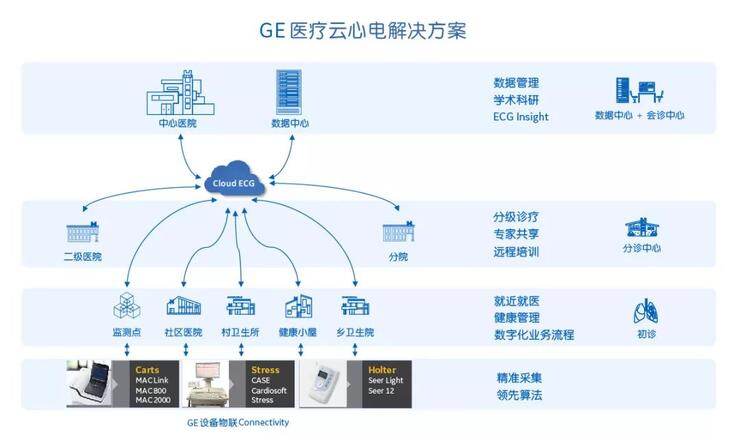
Chen Jinlei, Vice President of GE Healthcare China, stated that cloud-based electrocardiography (ECG) is inherently a three-dimensional architecture, offering robust solutions for the medical consortiums and medical communities heavily promoted by the national government. “We are currently collaborating with numerous county-level medical communities, transforming community hospitals into township health centers and designating higher-tier hospitals as the leading institutions within these medical communities. From the perspective of cloud ECG architecture, this model is entirely applicable.”
In addition to Cloud ECG, another noteworthy product is Cardio MR AI, known in Chinese as the Cardiac Magnetic Resonance AI-Assisted Diagnostic System. Developed through a collaboration between GE Healthcare and Arterys, a top-10 AI partner in the cardiology field, the system has received FDA clearance. According to Dai Ying, the launch of this system aims to enhance clinical output and outcomes.
The system’s highlight lies in introducing a temporal dimension to the original 3D MRI, thereby extending it to 4D. This not only provides a comprehensive visualization of cardiac structure but also displays the velocity, direction, and volume of blood flow.
Dai Ying stated that the CMR AI system is characterized by two key features: speed and flexibility. Traditional cardiac blood flow imaging typically takes on the order of minutes, whereas this cloud-based system leverages robust GPU computing power to reduce processing time by an order of magnitude. Furthermore, its web-based workflow offers greater flexibility.
Additionally, AI can assist physicians in rapidly performing localization and measurement analysis, thereby improving their work efficiency.
It is understood that the Cardio MR AI system comprises two components: acquisition and post-processing.
In terms of data acquisition, 4D Flow (cardiac blood flow imaging) enables volumetric acquisition of the entire heart or thorax during free breathing, facilitating hemodynamic analysis. This approach aids in the diagnosis of valvular diseases, aortic diseases, congenital heart diseases, and structural heart diseases. Dai Ying explained that this is currently one of the hot research topics in the industry.
In terms of post-processing, CMR AI solutions can perform image analysis for the vast majority of clinically established sequences and research sequences. With AI assistance, they automatically segment ventricular contours and measure cardiac function, achieving high measurement accuracy.
Currently, Cardio MR AI has been applied clinically at multiple hospitals, including Beijing Anzhen Hospital, Fuwai Hospital, and Shanghai Children's Medical Center.
Regarding the pricing structure of this system, there are two different models abroad: one is a subscription-like model based on the number of cases, and the other charges based on usage time. Chen Jinlei stated that government control over medical expenses is relatively strict. As for which payment model will be adopted in China, it will require exploration in collaboration with partner hospitals, as well as the introduction of relevant government policies.
When integrated with GE imaging systems, the AW Intelligent Imaging Workstation serves as an “analytical brain” for related applications and devices through its intelligent image reconstruction and analysis capabilities, particularly leveraging the Fast Stroke and VCAR software modules developed based on deep learning algorithms. These software modules provide quantitative information for image analysis and computer-aided diagnosis targeting seven high-incidence diseases.
Lung VCAR can assist CT equipment in automatically detecting suspicious pulmonary nodules measuring 2–10 mm, automatically outlining nodule contours, automatically measuring the composition and volume of pulmonary nodules, and automatically performing multiple comparative analyses.
Fast Stroke Function is primarily designed for patients with ischemic stroke. It leverages the advantages of rapid CT scanning to acquire cranial CTA images within 2 minutes for acute stroke patients (within 6 hours), enabling assessment of collateral circulation and assisting clinicians in formulating emergency treatment plans.
Stroke VCAR: Deep Learning-Based Intelligent Interpretation Software for Stroke. Designed for patients with hemorrhagic stroke, it automatically monitors and analyzes aneurysms, delineates the contours of intracranial hemorrhage, and automatically measures hemorrhage volume and various aneurysm parameters.
Jiangsu Province People's Hospital utilizes rapid CT scanning in emergency imaging to quickly determine the type of stroke. By applying Stroke VCAR and Fast Stroke for hemorrhagic and ischemic stroke patients, respectively, tailored treatment protocols can be implemented.
Dr. Hu Feiyun, Director of the Department of Radiology at this hospital, stated that for patients with acute stroke, it is crucial to save precious time for emergency treatment, as “time is brain.” Every minute saved can protect tens of millions of brain cells. In patients with acute cerebral infarction, where cerebral blood vessels are occluded, the Fast Stroke software can complete an assessment of collateral circulation in the brain within 2–3 minutes, thereby evaluating blood supply to the ischemic brain tissue.
In the emergency green channel at Jiangsu Province Hospital, a GE CT scanner is located within the emergency unit. If acute stroke is confirmed during the examination, the patient can be directly transferred to the adjacent emergency catheterization laboratory for immediate life-saving intervention.
Over the past year, Jiangsu Province Hospital has utilized this emergency care protocol to treat numerous patients. In one instance, a patient presented with sudden-onset left-sided limb weakness and was transported by ambulance for emergency care. From entering the emergency green channel for CT scanning, which identified ischemia, to assessment using the AW Fast Stroke system and subsequent thrombolytic therapy, the entire process took only 8 minutes.
In the past, when discussing the advantages of GPS compared to small startups, many people believed that "distribution channels are king." This is indeed the case, as these three multinational corporations monopolize over 70% of the market share for high-end medical equipment in China.
Dai Ying believes that in many people’s minds, channels are simply direct sales and distribution models. To achieve greater market coverage, should companies rely on products or solutions? Dai Ying argues that this is a critical issue for GPS and other companies whose DNA is rooted in “equipment advantages.”
As Chief Innovation Officer of GE Healthcare, Dai Ying told Leifeng.com that many challenges lie ahead in boosting the company’s market coverage.
First, the iteration of products or solutions is essentially an iteration of mindset. He believes that experience is a double-edged sword; to some extent, the mind remains constrained by experience, and innovation, in a sense, requires overturning established experience. Second, the challenge facing large enterprises is “capability + speed.” Due to their large scale and extensive teams, processes tend to be complex. Whether they can achieve biweekly iterations like small startups poses a significant challenge for GE.
According to Leifeng.com(Official Account: Leifeng.com)To ensure effective product updates and iterations, GE Healthcare has established a dedicated expert advisory panel. Experts engage in discussions at the earliest stages—when a product is not yet formed or even when it is merely an idea. For some new product development projects, up to ten expert advisory sessions may be conducted.
Additionally, to accelerate the iteration process, Dai Ying has summarized several models:
The first model adopts the approach used in the application software industry, where team sizes are reduced and a system of multiple specialized teams with divided responsibilities is established.
The second approach involves using more software to replace tasks traditionally performed by hardware. This is because software iterates faster than hardware; developing a hardware prototype requires significantly more time than updating software.
The third approach: Since hardware cannot be completely replaced, the team can unify the hardware architecture to make it “platform-based,” enabling a single core architectural innovation to drive innovations across different product categories.
Dai Ying’s current requirement for the team is that the R&D cycle for a new medical device, from project initiation to obtaining the NIPA registration certificate, must be less than 18 months.He stated that this is a highly challenging goal.
Currently, C-arms for orthopedics and surgery, along with two types of ultrasound devices, have been developed under this planned framework, and these products were showcased at the exhibition.
Li Xiting, Chairman of Mindray Medical, once stated that driven by favorable policies, increased R&D investment, and enhanced innovation capabilities, the domestic medical device industry in China would usher in its “Golden Decade” starting from 2018. Underpinning this “Golden Decade” is the growing commercial confidence of a large number of Chinese manufacturers. After decades of quiet development, these domestic players are now standing up to engage in direct competition with the “GPS” giants (GE Healthcare, Philips, and Siemens Healthineers).
Chen Jinlei stated that the concept of a “golden decade” is somewhat short-sighted, as China’s demand for healthcare can be described as mainstream on a global scale. “GE Healthcare adheres to a long-term strategy. Our investments in China are long-term, and so are our commitments to customers and partners. The rise of domestic manufacturers is a positive development for us.”
To counter the narrative of a “Golden Decade” for domestic manufacturers, traditional medical device giants such as GPS must embrace “digitalization” and “intelligentization” as essential weapons to uphold their stature.
During the exhibition, GE Healthcare set up a physical live streaming studio,Click the linkView more content.
Original article by Leiphone; unauthorized reproduction is prohibited. For details, seeReprint Guidelines。