

Beyond the deal: Lilly's $2.75B bet on Insilico's preclinical oral pipeline
On March 29, Insilico Medicine announced a drug discovery and AI pipeline licensing agreement with Eli Lilly, including a licensing deal for a novel oral drug pipeline and a drug discovery collaboration involving multiple selected targets.
Under the agreement, Insilico Medicine is eligible to receive an upfront payment of US$115 million, with further payments upon the achievement of development, regulatory, and commercial milestones, bringing the total transaction value to a maximum of approximately US$2.75 billion. In addition, Insilico Medicine will receive tiered royalties based on future sales.
Why did Lilly, which is going all in on AI, choose Insilico Medicine again?
1Is Lilly Acquiring a Metabolic Pipeline?
As early as November 2025, during the Bio-Europe conference, Insilico Medicine unveiled a pipeline portfolio targeting cardiometabolic diseases. However, shortly thereafter, Insilico Medicine indicated that certain programs within the portfolio were no longer open for external collaboration. This may have been the earliest indication of the current partnership.
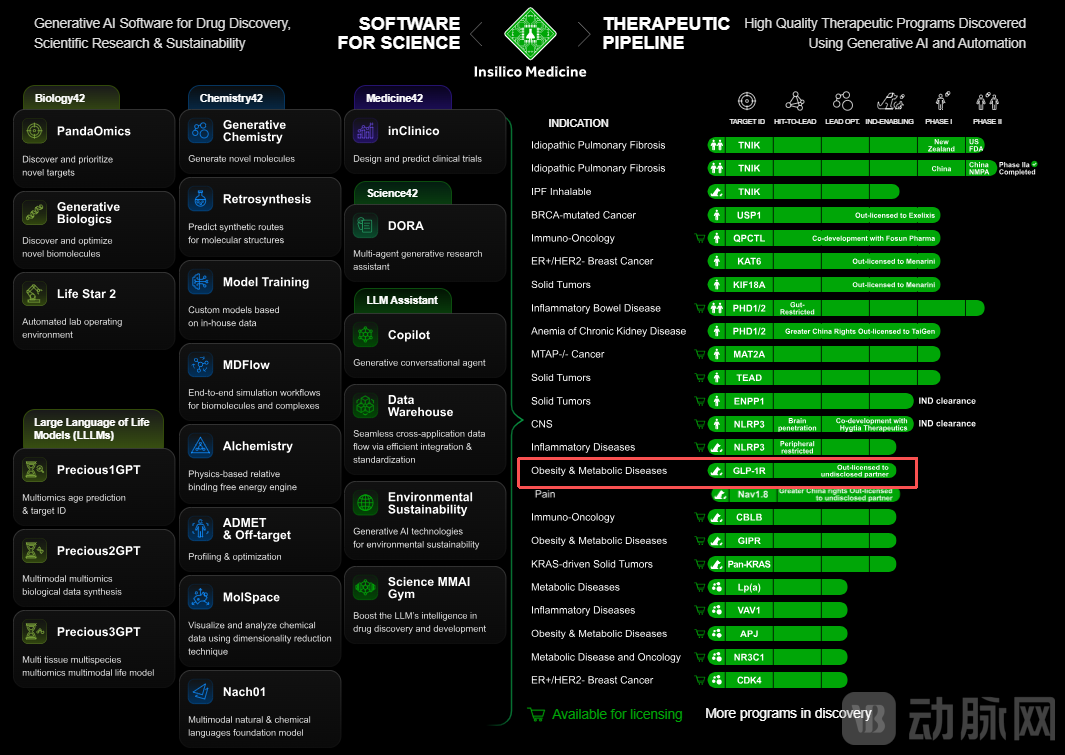
Pipeline on Insilico Medicine's official website as of March 30
Insilico Medicine's official pipeline chart shows that one of its metabolic disease programs targeting GLP-1R has had its rights status changed from "available for licensing" to "global rights granted to an undisclosed partner," suggesting the possibility that it has been acquired by Lilly.
In the metabolic disease space, Lilly's choices themselves serve as a reflection of industry standards. If the licensed pipeline in this collaboration is for metabolic disease indications, the "novel oral" formulation would complement Lilly's current product portfolio, directly addressing the market pain point of long-term adherence associated with injectable formulations. Meanwhile, Insilico Medicine's proprietary AI-driven pipeline also demonstrates potential for therapeutic paradigm shifts. For instance, ISM0676, an innovative oral small molecule antagonist targeting GIPR, achieved 31.3% body weight reduction in preclinical obesity models when combined with semaglutide, potentially overcoming key limitations of GLP-1 drugs such as post-withdrawal weight regain and loss of muscle mass.
A deeper level of alignment lies in the shared vision for the future.
Alex Zhavoronkov, PhD, founder and CEO of Insilico Medicine, once stated that longevity research is his first goal, and he aims to contribute to it or die for it. In the same year he founded Insilico Medicine, he launched ARDD (Aging Research and Drug Discovery), which has since grown into one of the largest conferences in the anti-aging field.
At the 12th ARDD in 2025, Andrew Adams, President of Molecule Discovery at Lilly, remarked that the GLP-1 space may give rise to the world's first anti-aging drug, a statement widely regarded by the industry as the first time a top multinational pharmaceutical company has incorporated anti-aging strategy into its core R&D narrative. Studies have shown that GLP-1 drugs can improve mitochondrial energy metabolism, reduce chronic inflammation, significantly lower the risk of cardiovascular and liver diseases, and have even been associated with trends toward younger biological age indicators in certain populations.
In a collaboration that appears incremental but is in fact accelerating, Lilly and Insilico Medicine have achieved a high degree of alignment between the supply of AI-driven drug discovery technology and strategic demand.
2Insilico Medicine: First Full-Chain Cooperation with MNC Client, Covering "Software Service - R&D Collaboration - Pipeline Licensing"
In just three years, Insilico Medicine and Lilly have rapidly advanced through a long-term strategic collaboration spanning "software services—R&D collaboration—pipeline licensing," extending further into capital alignment through equity investment.
- 2023: Both parties reached a software licensing cooperation based on the Pharma.AI platform, and Eli Lilly began trial use of Insilico Medicine's AI platform.
- November 2025: Both parties initiated a drug research and development collaboration, focusing on the generation, design, and optimization of candidate compounds for specified targets. Insilico Medicine is entitled to receive up to over 100 million US dollars in revenue, including upfront payments, R&D milestone payments, and tiered net sales royalties following future drug commercialization.
- December 2025: Lilly participated as a cornerstone investor in Insilico Medicine's Hong Kong IPO, subscribing for $5 million. Not only is Eli Lilly, as a corporate entity, serving as the cornerstone investor for a biopharmaceutical company's IPO for the first time, but it also marks Lilly's debut in the secondary markets of China and Hong Kong.
- March 2026: A $2.75 billion potential total deal marked the first collaboration between the two parties in a "single pipeline license + designated target research and development" dual partnership.
In the logic of business development transactions, the sustainability of a partnership stems from a progressive building of trust, starting from initial engagement and deepening over time. For Insilico Medicine, Lilly has served as a software services client, a pipeline licensee, and an equity investor—and more importantly, it is the first top-tier multinational pharmaceutical company (MNC) to achieve ecosystem integration through a full-chain collaboration.
Leveraging its AI-driven drug discovery and development platform, Pharma.AI, Insilico Medicine operates under a "dual-engine" model in the pharmaceutical space: one engine focuses on drug research and development and out-licensing, while the other focuses on commercial software licensing. In terms of business logic, by licensing its software solutions to MNCs and upstream and downstream partners, Insilico Medicine engages in high-touch interactions with potential licensing partners—transitioning from "the software works well" and "the collaboration is reliable" in one-off service subscriptions, to a value-added trust that "the assets are worth acquiring."
Notably, as usage data accumulates, tools undergo customized iterations, and laboratory feedback loops generate positive results, the research and development insights that clients build on the platform not only serve as evaluation points for pipeline value but also become priority leverage in deal negotiations. Over time, network effects and lock-in effects reinforce each other, enabling Insilico Medicine to form deeply embedded, symbiotic relationships with its clients.
This ecosystem underpins Insilico Medicine's current core AI narrative: building an AI-driven innovation factory—one that is moated by industry trust and capable of sustainably generating pharmaceutical assets. With an exceptionally high R&D input-output ratio and extremely low marginal costs such as time, the company moves beyond the traditional asset valuation framework of a pure-play biotech.
3Pharma Companies All in AI, Tech Giants Focus on Pharma
In January 2026, Lilly and Nvidia announced at the JPM conference the establishment of a joint AI innovation lab, committing over US$1 billion over the next five years to comprehensively reconstruct the entire drug discovery and development value chain. In February, the AI factory fully owned and operated by the pharmaceutical company, named "LillyPod," was officially launched, equipped with 1,016 Nvidia Blackwell Ultra GPUs and delivering a total computing power of 9,000 petaflops.
Large-scale collaborations between multinational pharmaceutical companies and technology giants or AI leaders are no longer a novelty. The new narrative is that pharmaceutical companies are transforming large-scale, high-quality proprietary data from drug research and development into platform-based, reusable commercial assets.
In September 2025, Lilly launched its AI/ML platform, Lilly TuneLab. Its first AI drug discovery model was built on over US$1 billion worth of proprietary data—accumulated from Lilly's years of valuable drug research and development and experimental experience.
Lilly TuneLab is being made available to early-stage biotechnology companies, leveraging innovative "federated learning" technology—a method of training AI models without anyone seeing or accessing the underlying data—allowing users to share AI capabilities without sharing core data. The first cohort of over a dozen biotech companies has been selected to access the platform's data and models free of charge.
In other words, AI is extending drug development capabilities to a broader range of participants—including biotech companies, AI startups, large language model developers, and those with the most advanced computing power and cutting-edge algorithms.
Along similar lines, in early 2026, Insilico Medicine released Science MMAI Gym, a large language model training framework encompassing high-quality pharmaceutical research and development data covering over 1,000 drug discovery benchmarks and approximately 120 billion tokens. The framework is designed to systematically "instruct" general-purpose large language models such as GPT, Claude, Gemini, Grok, Llama, and Mistral, enabling them to reason across medicinal chemistry, biology, and clinical development with the precision required for modern pharmaceutical research and development. Simply put, MMAI Gym serves as a specialized "training ground" for general-purpose large language models to develop a vertically focused model for drug discovery.
Insilico Medicine has already completed an initial validation of this approach. In early March, in collaboration with Liquid AI, a company focused on liquid foundation models, Insilico launched the first lightweight scientific foundation model, LFM2-2.6B-MMAI (v0.2.1). Built on just 2.6 billion parameters and designed for on-premise deployment, the model—trained via MMAI Gym—supports over 200 drug discovery task types, achieving performance comparable to or even better than systems ten times its size, with a molecular optimization success rate of up to 98.8%.
The iterative logic behind Lilly TuneLab and Science MMAI Gym is consistent: addressing the fundamental challenge facing vertical AI models for drug discovery—the lack of large-scale, high-quality proprietary data required to inform decision-making and train models.
It is important to clarify that the core value of AI-driven drug discovery and the value of in-house research and development by pharmaceutical companies do not conflict with the value of future AI infrastructure providers.
Specifically, in addition to its "high-touch services—asset out-licensing" chain, Insilico Medicine is adding a more ambitious second growth trajectory: exporting drug development capabilities to AI large language model companies, positioning itself as an AI infrastructure provider. At the same time, its core competencies as an AI-driven drug discovery company remain intact: high-value proprietary experimental data, internally validated algorithms, end-to-end integrated discovery workflows, and the continuously generated new data from drug discovery and experimental validation.
To a certain extent, training-based models and data-sharing initiatives follow the startup path—applying deep industry know-how and technological barriers (unique high-quality data and application expertise) to create proprietary platform-based assets. On the commercial front, platform licensing, customization, revenue sharing from new models, and pipeline asset sharing will offer pharmaceutical companies more flexible business opportunities. On the market front, leading technology companies often have well-defined vertical domains and detailed application roadmaps; early positioning in this space means securing a voice in shaping the landscape.
Alex Zhavoronkov has noted in interviews that collaboration with leading large language model developers and research teams on data and benchmarking provides insights into new model architectures, reasoning techniques, and training methods, accelerating innovation and maintaining a close connection to the cutting edge of AI.
The traditional AI-driven biotech model is essentially project-based, with revenue constrained by the number, stage, and delivery timelines of pipeline partnerships, resulting in inherent fluctuations in the growth curve. Transforming AI drug development capabilities and proprietary data into platform-based products should not be simplistically understood as shifting from "mining gold to selling shovels." Instead, it represents a strategy of both mining and selling gold, while also co-developing new shovels.