GSK Completes $5.1 Billion Acquisition of TESARO, Gaining PARP Inhibitor Zejula and a Portfolio of Oncology Assets
Jan 26, 2019 10:40
CST Updated
10:40

GSK
Pharmaceutical R&D Manufacturer

TESARO
Tumor Therapy Developer
January 26, 2019/BioonBIOON/--UK pharmaceutical giantGlaxoSmithKline(GSK) recently announced the successful completion of its acquisition of TESARO. The transaction was valued at $5.1 billion (approximately £4 billion).
The acquisition was announced on December 3, 2018. Upon completion of the acquisition, it will significantly strengthenGlaxoSmithKline PLC.pharmaceutical business, accelerating GlaxoSmithKline'sTumorPipeline development and commercial capabilities in the academic field.
Headquartered in Waltham, Massachusetts, USA, TESARO, Inc. is a commercial-stage oncology company whose marketed product, Zejula (niraparib), has been approved for the treatment of ovarian cancer. The active pharmaceutical ingredient in Zejula is niraparib, an oral, small-molecule poly(ADP-ribose) polymerase (PARP) inhibitor that selectively kills cancer cells by exploiting defects in DNA repair pathways. This mechanism of action confers upon the drug the potential to treat a broad range of tumors with DNA repair deficiencies. PARP is involved in a wide array ofTumorType-related, especiallyBreast Cancerand ovarian cancer.
In the United States and the European Union, Zejula has been approved for maintenance treatment of patients with recurrent epithelial ovarian cancer, fallopian tube cancer, or primary peritoneal cancer who are in response to platinum-based chemotherapy, regardless of BRCA mutation status orBiomarkersStatus.
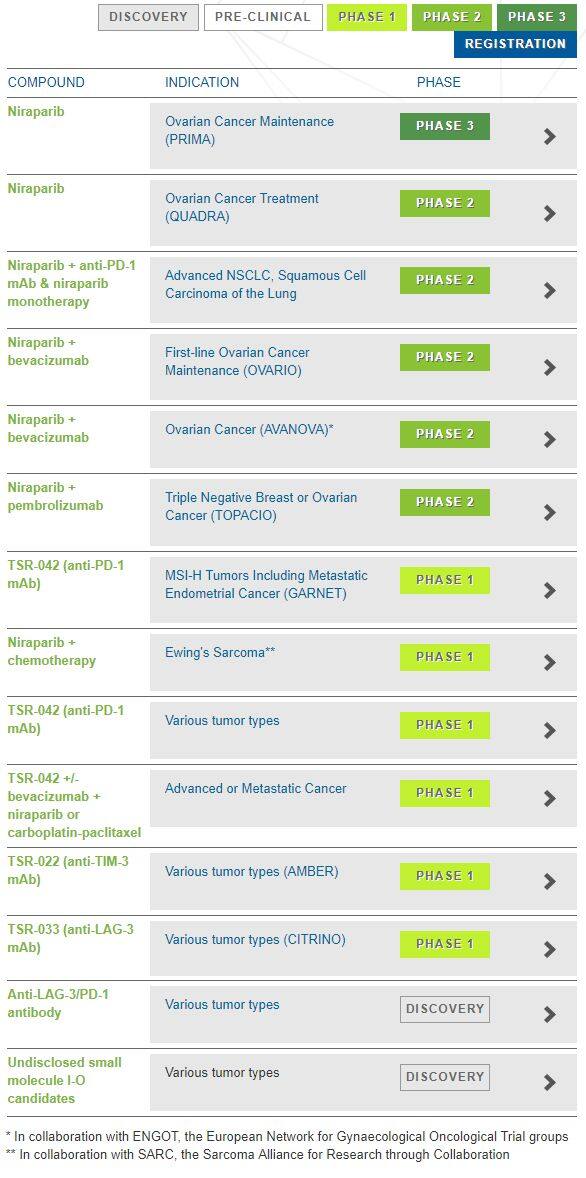
Currently, TESARO is advancing multiple clinical studies to further explore the potential of Zejula as both a monotherapy and combination therapy for ovarian cancer, including first-line maintenance treatment for ovarian cancer, as well as treatment for patients with germline BRCA (gBRCA) mutations and those who are homologous recombination deficiency (HRD)-positive or HRD-negative without gBRCA mutations. The first of these studies, PRIMA, is expected to release results in the second half of 2019.
GlaxoSmithKline believes that PARP inhibitors offer significant opportunities for the treatment of various types of cancer. In addition to ovarian cancer, Zejula is currently being evaluated as both monotherapy and combination therapy for lung cancer, breast cancer, and prostate cancer, including in combination with dostarlimab (formerly TSR-042), a PD-1 antibody developed by TESARO, Inc.
In addition to Zejula and dostarlimab, TESARO’s pipeline also includes a series ofTumoracademic assets, including antibodies targeting TIM-3 and LAG-3. (Bioon.com)