

Bayer’s Darolutamide Delays Worsening of Disease-Related Symptoms and Preserves Quality of Life in Non-Metastatic Castration-Resistant Prostate Cancer
Jun 05, 2019 15:04
CST Updated
15:04

Bayer
Pharmaceutical Product R&D Developer

June 05, 2019 /BioValleyBIOON/ -- German pharmaceutical giantBayer(Bayer) recently at the 2019 American Clinical held in ChicagoTumorExploratory analysis data from the pivotal Phase III ARAMIS study of the novel prostate cancer drug darolutamide were presented at the American Society of Clinical Oncology (ASCO) Annual Meeting. The results demonstrated that, in patients with non-metastatic castration-resistant prostate cancer (nmCRPC), darolutamide plus androgen deprivation therapy (ADT) significantly delayed the worsening of disease-related symptoms compared with placebo plus ADT. The incidence of exposure-adjusted treatment-emergent adverse events (TEAEs), including TEAEs notably associated with androgen receptor (AR) antagonists, was generally similar between the darolutamide plus ADT group and the placebo plus ADT group. Furthermore, the data indicated that darolutamide plus ADT maintained patients’ quality of life even after the conclusion of the study, compared with placebo plus ADT.
ARAMIS is a randomized, double-blind, placebo-controlled study that enrolled 1,509 patients who were receiving androgen deprivation therapy (ADT) as standard of care but were at high risk for metastatic disease. In the study, patients were randomized in a 2:1 ratio to two groups to receive either darolutamide or placebo, in addition to ADT.
Previously published study results showed that darolutamide + ADT significantly improved outcomes compared with placebo + ADTMetastasis-free survival (Median MFS: 40.4 months vs 18.4 months)、Reduces the risk of disease progression or death by 59%(HR=0.41, 95% CI: 0.34-0.50, p<0.001), reduced the risk of death by 29% (HR=0.71, 95% CI: 0.50-0.99, p=0.045), significantly prolonged progression-free survival (median PFS: 36.8 months vs. 14.8 months, HR=0.38, 95% CI: 0.32-0.45, p<0.001), and reduced the risk of local progression, distant metastasis, or death by 62%.
At this year’s ASCO Annual Meeting, an analysis focusing on patient-related endpoints revealed that, based on the secondary endpoint of time to pain progression assessed via the BPI-SF (Brief Pain Inventory–Short Form) patient questionnaire, darolutamide plus ADT delayed the time to pain worsening in patients with nmCRPC compared with placebo plus ADT (40.3 months vs. 25.4 months; HR=0.65; 95% CI: 0.53–0.79; p<0.0001).
In the pre-specified analysis of the FACT-P PCS (Functional Assessment of Cancer Therapy–Prostate Cancer Subscale) questionnaire, quality of life was maintained in patients receiving darolutamide plus androgen deprivation therapy (ADT), as assessed by mean FACT-P PCS scores. The FACT-P PCS questionnaire evaluates the impact of disease- and treatment-related symptoms on quality of life. Throughout the study, mean scores were maintained and similar between the two treatment groups. At the end of treatment, the change from baseline in the darolutamide plus ADT group was −8.55 points, which was comparable to that in the placebo plus ADT group. Quality-of-life scores remained stable after completion of study treatment.
A new post hoc analysis of the ARAMIS study data demonstrated that darolutamide plus androgen deprivation therapy (ADT) delayed the onset of urinary and gastrointestinal symptoms in patients compared with placebo plus ADT (urinary symptoms: 25.8 months vs. 14.8 months; HR=0.64; 95% CI 0.54–0.76; p<0.01; gastrointestinal symptoms: 18.4 months vs. 11.5 months; HR=0.78; 95% CI 0.66–0.92; p<0.01).Exposure-CorrectedThe incidence of treatment-emergent adverse events (TEAEs), including TEAEs associated with androgen receptor (AR) antagonists, was similar in the darolutamide + ADT group and the placebo + ADT group, including fatigue/asthenia (11.3% vs 11.1%),Hypertension(4.7% vs 5.1%), falls (3.0% vs 4.6%), cognitive impairment (0.3% vs 0.2%), memory impairment (0.4% vs 1.2%).
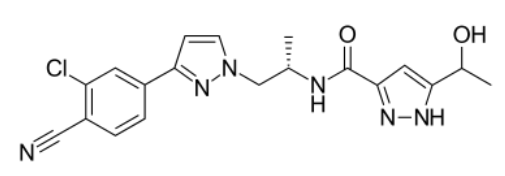
Molecular Structure of Darolutamide (Image source: Wikipedia)
Dr. Arim Fizazi, Professor of Medicine at the Gustave Roussy Institute, University of Paris, France, commented: “Patients with non-metastatic castration-resistant prostate cancer (nmCRPC) are generally asymptomatic and feel well. It is therefore important to employ effective treatments with limited side effects to delay prostate cancer progression for as long as possible while allowing patients to maintain their daily activities. The new data presented at this year’s ASCO Annual Meeting clearly demonstrate that darolutamide preserves patients’ quality of life. Combined with previously reported efficacy data, darolutamide represents an effective new treatment option that does not impose additional toxicity burdens on patients, making it an important therapeutic choice for the nmCRPC patient population.”
Darolutamide is an oral nonsteroidal androgen receptor (AR) antagonist with a unique chemical structure. It exhibits strong binding affinity to the receptor and potent antagonistic activity, thereby inhibiting receptor function and the growth of prostate cancer cells.Currently, the indication of darolutamide for the treatment of nmCRPC is under review in the United StatesFDApriority review, and has been submitted for review by the European Union, Japan, and other regulatory authorities. The drug was co-developed by Bayer and the Finnish pharmaceutical company Orion. In addition to nmCRPC, the two companies are also advancing another Phase III clinical study, ARASENS, to evaluate the efficacy and safety of darolutamide in the treatment of metastatic hormone-sensitive prostate cancer (mHSPC).(Bioon.com)
Original Source:Bayer Official Website