

Synthera secures several tens of millions of RMB in Pre-A funding, redefining industrial boundaries with "protein × material" innovation
Synthera
Industrial Enzyme Preparation and Enzyme Catalyst Product Developer

X&Q CAPITAL
Emerging Boutique Investment Firm
Synthera has announced the completion of a Pre-A funding round totaling several tens of millions of RMB. This round was led by Huaxi Yuanyou, with Eagle Capital participating as a follow-on investor, and Xiqiao Capital serving as the exclusive financial advisor. The funds will be primarily used to iterate Synthera's core R&D platform, CatalEditor®, support new product development, expand market reach, and grow the team.
Amid ongoing pressures on the global energy structure and heightened geopolitical uncertainties, the traditional industrial system reliant on fossil resources is undergoing a profound transformation. Biomanufacturing, which enables a more efficient, low-energy, and sustainable production pathway through molecular-level precision control, is rapidly emerging as the next-generation production modality that major economies around the world are racing to adopt.
Proteins, as core carriers of catalytic, recognition, and regulatory functions, are becoming the critical infrastructure of this new production paradigm—determining both the upper limits of efficiency and the boundaries of application. However, the inherent limitations of natural proteins in structural stability and environmental adaptability make it difficult to directly integrate them into complex industrial settings, posing a central bottleneck to the large-scale deployment of biom manufacturing. Synthera's protein AI design and material encapsulation platform, CatalEditor®, has for the first time overcome the limitations of natural protein functionality and structural flexibility, enabling the design of novel biomaterials tailored for industrial applications. This significantly expands the application boundaries and engineering potential of proteins, establishing a new AI4M (AI for Materials) application paradigm.
Addressing the core challenge of proteins—their powerful functionality coupled with structural fragility—material engineering can provide a "molecular armor" for proteins, imparting greater environmental tolerance. Professor Ge Jun from the Department of Chemical Engineering at Tsinghua University, founder of Synthera, is one of the first scientists in the world to propose and achieve the in situ encapsulation of enzymes using metal-organic frameworks (MOFs). With sustained dedication to this field, he has pioneered the industrial implementation of enzyme-MOF technology on a global scale. By creating a stable yet breathable microenvironment for proteins, this approach enables long-term retention of enzyme activity and imparts a range of industrially desirable characteristics such as resistance to high temperatures and pH extremes. In 2025, three scientists in the field of MOFs were awarded the Nobel Prize in Chemistry, further validating the cutting-edge significance of this technological pathway.
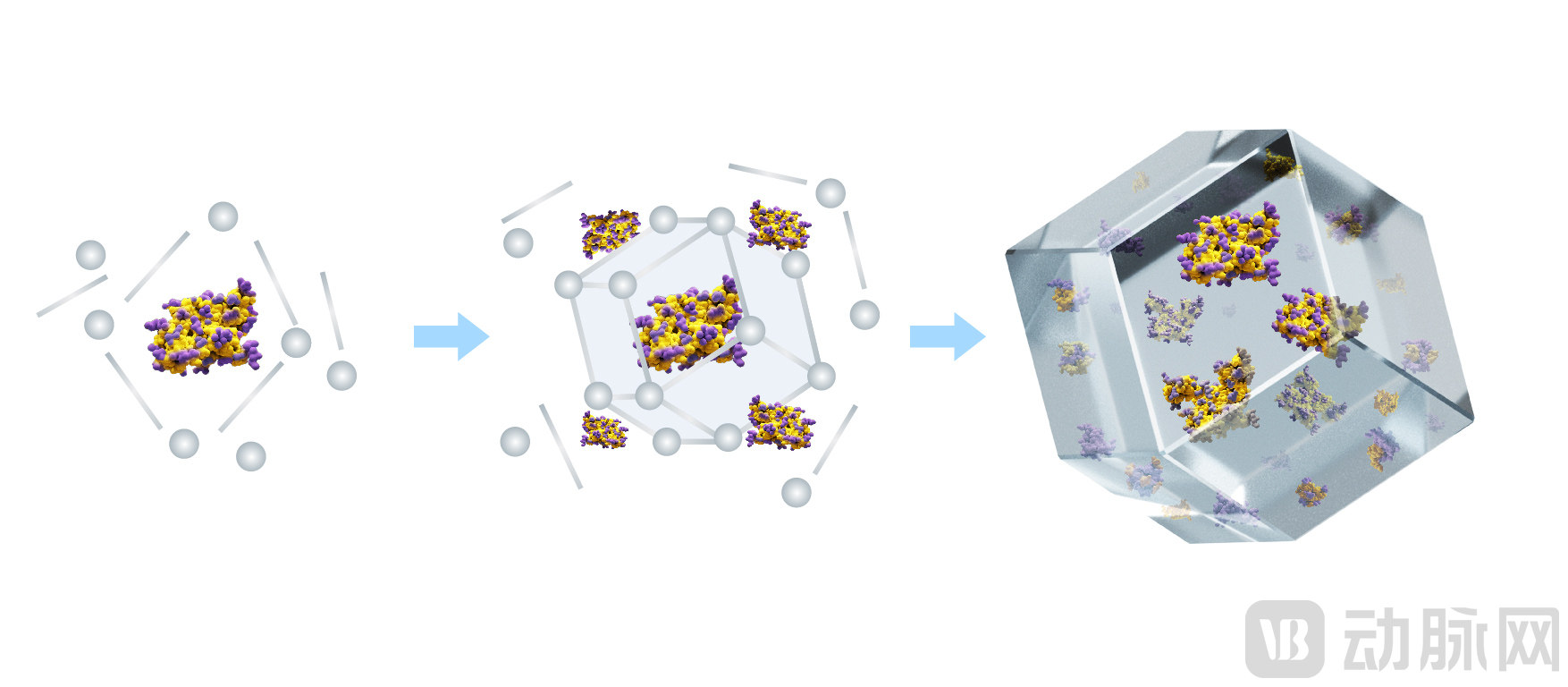 Fig. Schematic Diagram of the In-Situ Encapsulation Process of Enzyme-MOF Composites
The synergistic design of biological molecules and structural materials is inherently a complex systems problem involving cross-scale, multi-variable coupling, characterized by high-dimensional variables and intricate interactions. Traditional approaches reliant on experience and iterative trial and error struggle to achieve effective convergence. The founding team's nearly two-decade accumulation of a protein-carrier material database constitutes the foundational core asset of the CatalEditor® platform. This platform represents a global first by integrating the biological design of proteins and the structural design of materials into a unified data framework, enabling cross-scale synergistic optimization.
On the protein design front, the platform leverages artificial intelligence to accelerate the sequence-structure-function iterative loop, intelligently constructing protein molecules with specific functions and structures. On the material design front, it utilizes a self-developed Parallel Hybrid-space Bayesian Optimization algorithm, which significantly reduces the number of experiments required within high-dimensional candidate spaces, shortening the research and development cycle from years to months. The platform also possesses the capability for cross-system transfer and self-iteration, establishing a data-driven development paradigm that enables sustainable accumulation and reuse. Related research has been published in journals such as Nature Catalysis, Nature Nanotechnology, and Nature Communications.
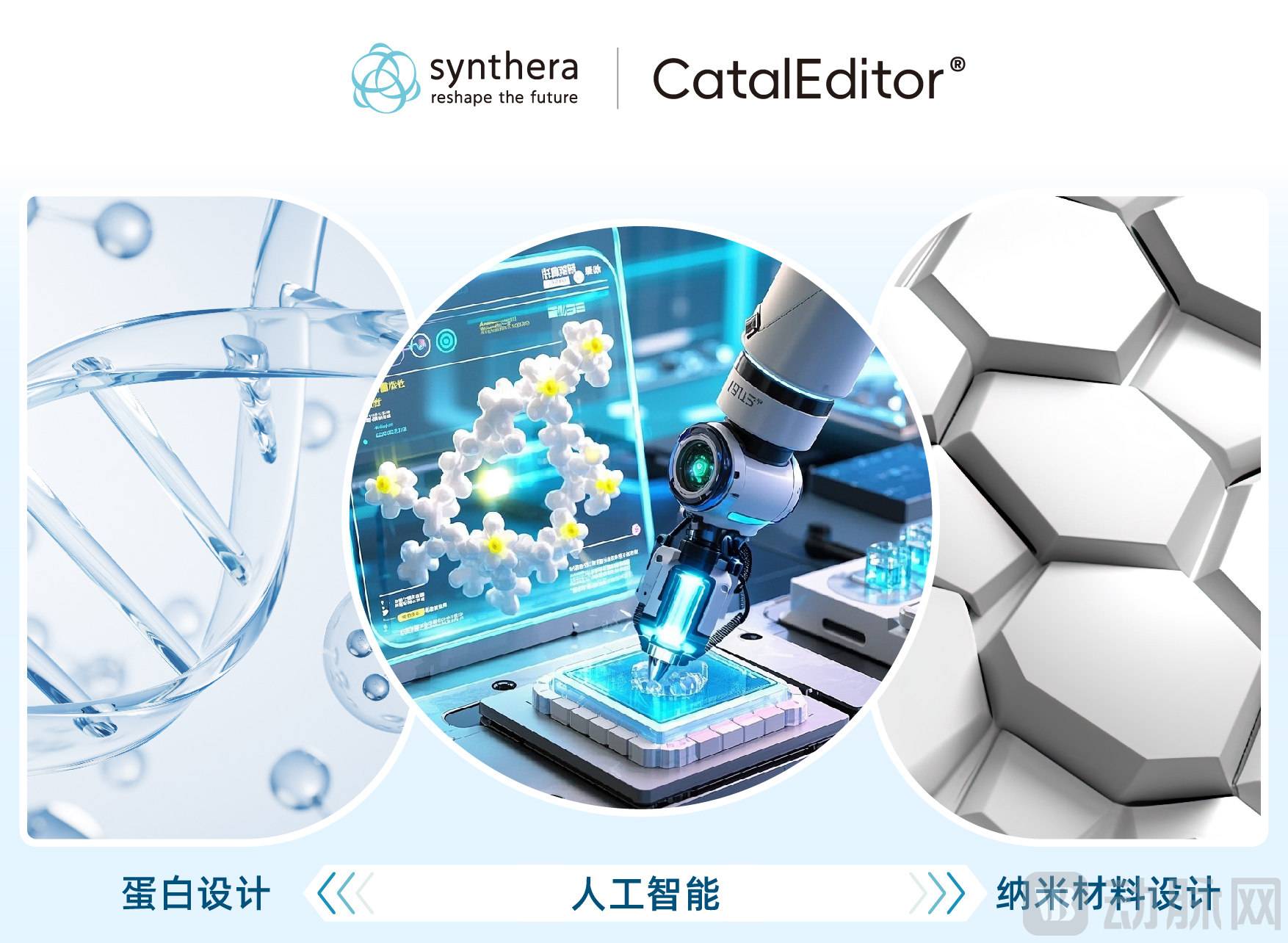 Fig. Intelligent Design and Encapsulation Platform for Protein Components CatalEditor®
The ultimate value of CatalEditor® lies in addressing real-world industrial challenges. Synthera has already established a complete process chain spanning from the laboratory to hundred-ton-scale production, and is advancing its protein × material solutions into multiple industrial scenarios—applying proteins in areas where they were previously considered impractical. Application implementation has been achieved in carbon capture and health-oriented consumer materials, with commercialization fully realized in collaboration with several leading brands. Having received sustained support from multiple industrial investors at an early stage, Synthera has developed a steady growth trajectory driven by practical applications.
Looking ahead, Synthera will continue to deepen customer partnerships, delivering efficient, green, and sustainable biological solutions to a broader range of industrial scenarios. Synthera remains committed to deploying its technology across sectors such as materials and energy, working together to build a new era of sustainability.