

Takeda's CD30-Targeted Therapy Adcetris Significantly Improves Survival in Peripheral T-Cell Lymphoma Patients, Redefining First-Line Treatment
Jun 14, 2019 12:16
CST Updated
12:16

Seagen
Monoclonal Antibody Developer

Takeda
Biopharmaceutical Manufacturer
June 14, 2019 / Bioon -- The 24th Annual Congress of the European Hematology Association (EHA) was recently held in Amsterdam, where Takeda and Seattle Genetics presented detailed data from the Phase III ECHELON-2 clinical trial (NCT0177152; Abstract #PS1070) evaluating the antibody-drug conjugate Adcetris (brentuximab vedotin) for the treatment of peripheral T-cell lymphoma (PTCL, also known as mature T-cell lymphoma, MTCL).
Background: Peripheral T-cell lymphoma (PTCL) comprises a heterogeneous group of aggressive non-Hodgkin lymphomas (NHL), accounting for approximately 10% of all NHL cases worldwide, with higher incidence rates reported in certain Asian countries. The most commonly used first-line regimens for PTCL are CHOP (cyclophosphamide + doxorubicin [an anthracycline] + vincristine + prednisone) or CHOP-like regimens. However, anthracycline-containing regimens are associated with low complete response (CR) rates (Savage K, et al. Ann Oncol 2004). Based on the encouraging activity and manageable safety observed in a Phase I study (Fanale M, et al. Blood 2018), the ECHELON-2 study was initiated to evaluate the efficacy and safety of Adcetris (A) in combination with the CHP chemotherapy regimen (cyclophosphamide + doxorubicin + prednisone) versus the currently accepted standard-of-care first-line treatment for PTCL, CHOP.
Methods: ECHELON-2 is the largest randomized, double-blind, Phase 3 study conducted to date in patients with peripheral T-cell lymphoma (PTCL). The study enrolled previously untreated patients with advanced-stage CD30-positive PTCL (with a target proportion of 75% ± 5% having systemic anaplastic large cell lymphoma [sALCL]). Patients were randomized in a 1:1 ratio to receive either the A+CHP regimen or the CHOP regimen. The primary endpoint was progression-free survival (PFS) in the intent-to-treat (ITT) population, as assessed by blinded independent central review (BICR). Key secondary endpoints included overall survival (OS), PFS in patients with sALCL, overall response rate (ORR), and complete response rate (CR).
Results: A total of 452 patients were enrolled from January 2013 to November 2016, with a median age of 58 years (range, 18–85 years). The majority of patients had systemic anaplastic large cell lymphoma (sALCL) (316 patients, 70%). The data showed that, compared with the CHOP regimen group, the A+CHP regimen group achieved a statistically significant improvement in progression-free survival (PFS) (median PFS: 48.2 months [95% CI: 35.2–NE] vs. 20.8 months [95% CI: 12.7–47.6]; HR=0.71 [95% CI: 0.54–0.93], p=0.01). The 3-year PFS rate was 57.1% (95% CI: 49.9–63.7) in the A+CHP regimen group and 44.4% (95% CI: 37.6–50.9) in the CHOP regimen group. Furthermore, the A+CHP regimen group also demonstrated a statistically significant improvement in overall survival (OS) compared with the CHOP regimen group (HR=0.66 [95% CI: 0.46–0.95], p=0.02), with the median OS not yet reached in either group. The A+CHP regimen also showed statistically significant advantages in other key secondary endpoints, including complete response (CR) (68% vs. 56%, p=0.007) and overall response rate (ORR) (83% vs. 72%, p=0.003).
In this study, the A+CHP regimen demonstrated comparable safety to the CHOP regimen, with similar incidence and severity of adverse events (AEs), including neutropenia and peripheral neuropathy, in both groups. Fatal adverse events occurred in 7 patients (3%) in the A+CHP group and 9 patients (4%) in the CHOP group.
Conclusion: The A+CHP regimen as first-line treatment for patients with CD30-positive PTCL demonstrated superior efficacy compared to the standard CHOP regimen, with statistically significant improvements in PFS and OS, and a manageable safety profile.
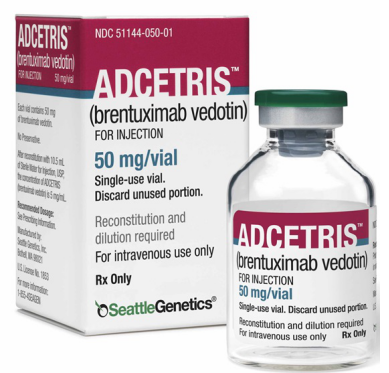
Based on data from the ECHELON-2 study, the A+CHP regimen was approved by the U.S. FDA in November 2018, becoming the first drug approved for the first-line treatment of CD30-positive peripheral T-cell lymphoma (PTCL), including systemic anaplastic large cell lymphoma (sALCL).
Adcetris is an antibody-drug conjugate (ADC) composed of a monoclonal antibody targeting the CD30 protein and a microtubule-disrupting agent (monomethyl auristatin E, MMAE), linked via a protease-sensitive linker. This conjugation technology is proprietary to Seagen, Inc. The CD30 protein is a definitive marker for classical Hodgkin lymphoma (HL) and systemic anaplastic large cell lymphoma (sALCL). Auristatin E inhibits tubulin polymerization, thereby impeding cell division. Adcetris remains stable in the bloodstream and releases MMAE upon internalization by CD30-positive tumor cells.
Adcetris was developed by Seagen (formerly Seattle Genetics). In 2009, Takeda entered into a licensing agreement to secure commercialization rights for the drug in all countries worldwide except the United States and Canada. To date, Adcetris has been approved in numerous countries around the world.
Currently, Takeda and Seagen, Inc. are actively advancing a large-scale Phase III clinical development program aimed at establishing Adcetris as a cornerstone therapy for CD30-positive lymphomas and redefining first-line clinical treatment for lymphoma. (Bioon.com)