

AI Drug Discovery Firm Fermion Secures Tens of Millions in Pre-A Funding Led by Challenger Capital and Panda Fund
Fermion
AI Drug Discovery Developer
Recently, VCBeat New Medicine (WeChat ID: biobeat1) learned that AI-driven drug discovery company Fermion Technology has completed a tens-of-millions-yuan Pre-A financing round, invested by Challenger Capital and Panda Fund.
Fermion Technology focuses on the development of an AI-assisted drug discovery platform targeting small-molecule chemical drugs. Through in-depth collaborations with CROs and originator pharmaceutical companies, it leverages AI technologies to enhance the efficiency of early-stage new drug development.
The global “AI + new drug development” sector is in a phase of rapid growth. Data from VCBeat’s Eggshell Research Institute shows that there are nearly one hundred innovative companies worldwide in the “AI + new drug development” space, covering seven key stages: target discovery, compound synthesis, compound screening, crystal form prediction, patient recruitment, optimization of clinical trial design, and drug repurposing. These innovative companies have collectively raised $1.31 billion in financing, with 80% of the funding occurring at the Series A round or earlier stages.
Entering the pharmaceutical sector was not Deng Daiguo’s original intention, but it seemed inevitable.
In 2014, Dr. Deng Daiguo and his team from Sun Yat-sen University achieved an outstanding third-place finish globally in the Imagnet Computer Vision Competition.
In 2015, Deng Daiguo led his team in applying deep learning technology to the fabric industry and founded Souya, a B2B e-commerce platform for fabrics, becoming the pioneer in image-based fabric search within the textile industry. Souya secured three rounds of financing—Angel, Series A, and Series A+—from Sinovation Ventures, Zero One Capital, Wu Xiaoguang (former Senior Vice President of Tencent), and other industry investors.
In 2016, Deng Daiguo learned that a close relative had been diagnosed with lung cancer, which became a significant motivator for his entry into the healthcare sector. At that time, second- and third-generation targeted therapies for this type of lung cancer were not yet available on the market in China; most such drugs were still in clinical trials or even earlier stages of development. Since then, Deng has been gathering industry information and insights on new drug development processes, connecting with professionals in pharmaceutical R&D, and exploring collaborations with pharmaceutical companies to accelerate drug discovery and development through AI technology.
In late 2018, Deng Daiguo founded Fermion Technology, bringing together accumulated AI talent and pharmaceutical R&D experts to accelerate the discovery and optimization of bioactive small-molecule drugs.
After committing to the drug R&D sector, Deng Daiguo actively strategized his layout. Leveraging years of accumulation and profound understanding in machine learning, the team rapidly entered the field through drug compound data. Within just a few months, Fermion’s AI-assisted drug discovery platform had secured core technologies in three areas: hit molecule screening, automated generation of novel molecular compound data, and lead small-molecule compound optimization, gaining delivery recognition from pharmaceutical R&D enterprises. Fermion aims to ultimately achieve, through its AI-assisted drug discovery platform, the automated generation and screening of virtual compound libraries against disease targets, along with side effect prediction, to finally generate candidate compound data, thereby forming a technical closed loop for the early-stage R&D of clinical small-molecule drugs. By leveraging AI, the company seeks to establish itself as a new type of pharmaceutical enterprise capable of rapid early-stage drug development.
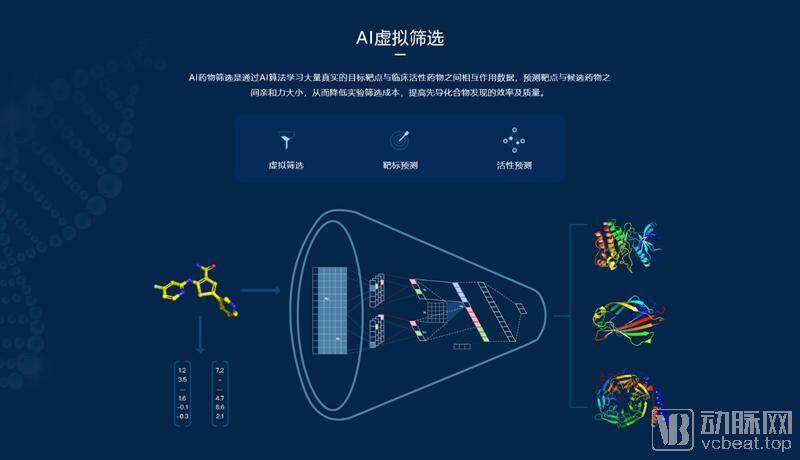
AI Virtual Screening
“We define ourselves as an AI-assisted drug R&D company, rather than a provider of early-stage new drug R&D technical services to CROs, originator pharmaceutical companies, and pharmaceutical research organizations; we directly provide pharmaceutical companies with candidate compounds before and after IND submission,” said Deng Daiguo.
Currently, Fermion’s team comprises AI technology specialists and experts in the field of drug discovery. The company’s drug development personnel leverage an AI-assisted pharmaceutical platform integrated with biological experiments to rapidly advance drug candidates targeting relevant therapeutic targets. Addressing the company’s challenges, Deng Daiguo stated, “We currently lack high-quality compound data suitable for machine learning, as well as cross-disciplinary talent proficient in both machine learning and drug discovery.”
Discussing future development, the team stated that the company has currently entered into in-depth collaborations with several pharmaceutical enterprises. Leveraging the characteristics of machine learning, Fermion has chosen to focus on the "me-too/me-better" domain, where data is more abundant, to develop candidate compound molecules with pharmacological activity. Some of these drug research projects have already progressed to the animal testing stage. In the future, the company will further deepen its efforts to advance its small-molecule drug pipeline into clinical trials and utilize AI to accelerate the overall drug R&D process. Dr. Dai Guo Deng acknowledged that the application of artificial intelligence in drug discovery is still in its early stages. Ultimately, the value of machine learning in drug R&D will depend on the extent to which it can help patients by selecting the right disease targets and enabling the faster development of new drugs at lower costs.