

93% Price Cut Reemerges as Likely Candidates for Second Round of '4+7' Centralized Drug Procurement Begin Voluntary Price Reductions

AstraZeneca
Biopharmaceutical Manufacturer
[Editor's Note] A report by IQVIA also points out that there is a significant price gap between most originator drugs and generic drugs. The unit price of over 70% of originator drugs is more than double the winning bid price, and the price difference between originator drugs and winning bid drugs has widened for the vast majority of varieties. Originator drugsPrice ReductionImmense pressure. However, the report also points out that while the pilot drugs have generally achieved an increase in the market share of generic drugs, the market share of originator drugs remains high. It is foreseeable that not only will originator drugs need to reduce prices, but generic drugs will also need to lower their prices.
This article was first published in E-Drug Manager, authored by Ba Gen; edited by Yiou Health for industry reference.
June 14,ShandongProvincial Public Resource Center Announces a Batch of Price-Reduced Drugs, Including Predicted Varieties from the Second Round of the “4+7” ProgramAstraZenecaof anastrozole tablets. Just four days ago, this same product appeared in the public notice of enterprise bid prices for the special centralized procurement of anticancer drugs in Chongqing Municipality. Previously, the listed online price for this product in Shandong Province was RMB 452.86 per box; it has now been reduced to RMB 419.13 in both regions.
Although the drug has maintained a pace of extremely slight price reductions during its more than decade-long market presence in China, does the current move to offer it at approximately a 10% discount carry any specific implication?
Price Reductions for Popular Drug Varieties
On May 14, a report from Menet pointed out that in the upcoming second batchVolume-Based ProcurementAmong them, AstraZeneca had two products with high sales at the terminal of public medical institutions in China in 2017, and some companies had already passed the consistency evaluation, making it highly likely that they would be included. One of these products is Anastrozole Tablets.
Currently, four companies in China have obtained approval for anastrozole: Yangtze River Pharmaceutical Group, Chongqing Huapont Pharmaceutical, Zhejiang Hisun Pharmaceutical, and Zhejiang Wansheng Pharmaceutical. Among them, onlyYangtze River Pharmaceutical GroupAnastrozole Tablets passed the consistency evaluation in March, becoming the first company to achieve this approval.
Data from Menet shows that in 2017, nearly 90% of the anastrozole tablet market was held by the originator company AstraZeneca, with terminal prices previously maintained at around RMB 500. Yangtze River Pharmaceutical Group ranked second in market share, accounting for only about 8%.
It is worth noting that on May 6HeilongjiangAccording to the information publicized on the Centralized Drug Procurement Network, Zhejiang Hisun Pharmaceutical has significantly reduced the price of Anastrozole Tablets from RMB 108.34 to RMB 7.5064. The public notice period has now expired, and there are no further updates regarding Hisun’s 93% price reduction. E-Drug Manager is currently verifying this substantial price cut. Hisun Pharmaceutical is filing a supplementary application for the consistency evaluation of Anastrozole Tablets, which is currently under review and approval by the Center for Drug Evaluation (CDE), with an acceptance date of January 21, 2019.
Meanwhile, three other domestic companies—Yangtze River Pharmaceutical Group, Chongqing Huapont Pharmaceutical, and Zhejiang Wansheng Pharmaceutical—implemented price reductions of approximately 10%. For instance, Yangtze River Pharmaceutical Group lowered the price of this drug from RMB 146.4 to RMB 138.
As a predicted candidate for the second round of the “4+7” volume-based procurement program, AstraZeneca has also demonstrated its emphasis on this drug. On April 24, AstraZeneca filed a patent lawsuit against Chongqing Huapont’s anastrozole tablets, a legal action that may also impact the future market landscape.
According to the Menet database, sales of anastrozole at public hospital terminals in China reached RMB 1.043 billion in 2017, with a market growth rate as high as 29.19%, indicating substantial future development potential.
Another AstraZeneca drug potentially entering the second round of volume-based procurement is quetiapine tablets. Its sales at public medical institution terminals exceeded RMB 1 billion in 2017, with AstraZeneca holding over 40% of the market share. Currently, Dongting Pharmaceutical’s product has passed the consistency evaluation, and the price difference between the generic and the originator is approximately fourfold.
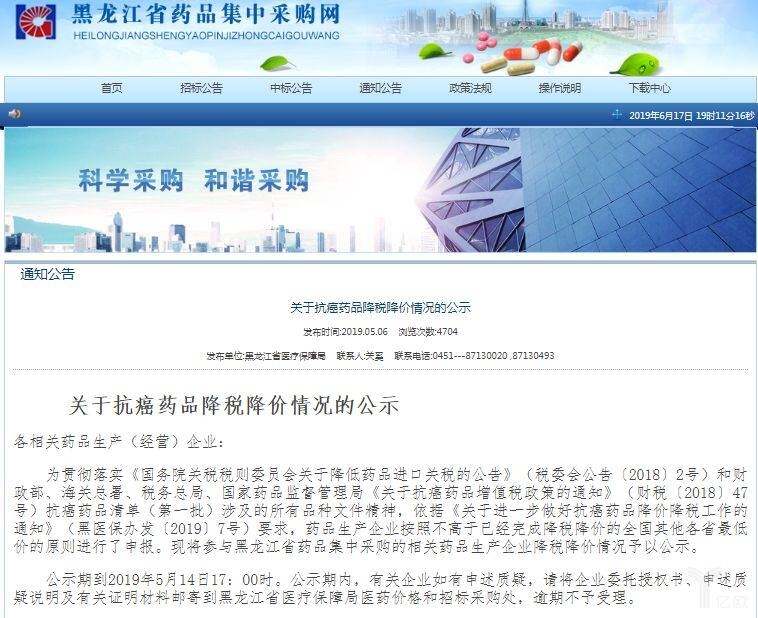

Price Reduction Information Published on the Heilongjiang Provincial Drug Centralized Procurement Network
Policy Follower
In recent years, AstraZeneca has closely aligned with policy developments in the Chinese market.
Iressa, a drug that performed poorly in European and American markets, is more suitable for the Asian population due to the higher EGFR mutation rate among Asians. It has performed well in the Chinese market over the past two years, with sales reaching hundreds of millions.
Since the former National Health and Family Planning Commission initiated national drug price negotiations in 2016, AstraZeneca has closely followed policy trends. In the first round of national negotiations, only three drugs were successfully negotiated, and AstraZeneca’s Iressa gained reimbursement listing through a 50% price reduction. Through these reimbursement negotiations, Iressa also achieved significant volume growth.
Two years later, the first national-level centralized procurement organized by the state was launched. AstraZeneca’s Iressa saw another significant price reduction, winning the bid at nearly 10% of its initial launch price. It became one of the few foreign original drugs in the “4+7” program, with a price even lower than that of generic alternatives at the time.
AstraZeneca reported Iressa sales revenue of $134 million in the first quarter of 2019, representing a robust 13% growth rate primarily driven by emerging markets led by China. In the U.S. market, Iressa generated negligible sales due to the expansion of Tagrisso.
However, rosuvastatin, another product, failed to secure a bid. The company attributed the 6% year-on-year decline in rosuvastatin’s sales in China to US$137 million in the first quarter of 2019, in part, to its failure to be included in the “4+7” volume-based procurement program. Due to the impact of this policy, the company expects that its future sales growth in China will not remain sustainably high.
Menet Network, citing industry insiders, stated that AstraZeneca has formulated a precise and robust sales strategy for Iressa: maintaining market share by securing inclusion in the National Reimbursement Drug List and winning bids in volume-based procurement programs, while bundling the newly launched Tagrisso with Iressa. This may also explain why AstraZeneca was willing to implement significant price reductions.
In China, a common treatment approach for patients with EGFR-mutant lung cancer is to initially use first-generation targeted therapies such as Iressa and Conmana, followed by the third-generation targeted therapy Tagrisso if resistance develops and a T790M mutation is present. A questionnaire survey on targeted therapy selection among lung cancer patients revealed that over half of the respondents opted for first-generation targeted drugs first, switching to third-generation agents upon resistance, primarily because they believed this sequence could prolong survival and were concerned about having no further treatment options after developing resistance to upfront third-generation therapy. Meanwhile, nearly half of the patients chose to start directly with third-generation targeted therapy.
Another industry insider told E-Drug Manager that the price reductions for expired originator drugs in recent years are also attributed to the accelerated review and approval process in China, fierce competition between innovative and generic drugs, and the desire of foreign pharmaceutical companies to rapidly scale up sales volume for originator drugs whose patents have expired.
“The 4+7” Impact Persists
In last year's "4+7" volume-based procurement, 25 drug varieties were selected as winners, with an average price reduction of 52%.
In late March and early April this year, the “4+7” volume-based procurement policy was successively implemented across 11 cities. However, its impact on drug prices continues to persist. Beyond the products predicted for the second round of procurement, the price war triggered by the first round of price reductions is still intensifying.
AstraZeneca’s Iressa won the bid with a 70% price cut; the winning bid price of RMB 547 was approximately one-third that of Qilu Pharmaceutical’s generic version at the time, exceeding many people’s expectations for the extent of the originator drug’s price reduction.
Subsequently, Qilu Pharmaceutical’s generic product had its online listing price adjusted across various regions to RMB 498, once again undercutting the originator drug, with this price representing less than 10% of the originator’s initial launch price.
Furthermore, Gleevec, which has previously attracted widespread attention, has recently seen a price reduction. The generic version manufactured by Jiangsu Hansoh Pharmaceutical won the bid in the “4+7” centralized procurement program at a price of RMB 623.82. In April this year, the originator drug Gleevec adjusted its prices in many provinces, dropping from RMB 9,998 to RMB 7,182. Meanwhile, the listed online prices of other generic versions, such as those produced by Chia Tai Tianqing and CSPC Ouyi Pharmaceutical, have continued to decline, currently approaching Hansoh’s winning bid price.
A report by IQVIA also points out that there is a significant price gap between most originator drugs and generic drugs, with over 70% of originator drugs priced more than double the winning bid price. For the vast majority of drug varieties, the price difference between originator drugs and winning bid drugs has widened, placing enormous pressure on originator drugs to reduce prices.
However, the report also points out that while the pilot varieties have generally achieved an increase in the market share of generic drugs, the market share of original research drugs remains high. It is foreseeable that not only will the prices of original research drugs decrease, but the prices of generic drugs will also drop.
The report suggests that multinational enterprises should formulate differentiated response strategies based on product competition patterns, market share, and price differentials. For originator drugs with a small market share, maintaining the original price level is recommended to secure profits through price stability. For originator drugs with a high market share, strategies such as reducing prices to maintain sales volume or maintaining prices to protect profit margins should be adopted. Given the lengthy decision-making cycles of multinational pharmaceutical companies, it is crucial for them to conduct a comprehensive assessment of opportunities and risks in China at an early stage and develop flexible response plans in the face of the impact of volume-based procurement. Meanwhile, Chinese domestic enterprises will further differentiate: innovative companies, large-scale enterprises, and those with strong cost control capabilities will continue to grow stronger and larger. In contrast, smaller enterprises lacking effective countermeasures will face the risk of being eliminated from the market.
The report predicts that, under the impact of volume-based procurement, mergers and acquisitions or alliances among small enterprises will become very frequent in the future.
From July 25 to 27, 2019, Yiou Big Health will host“GIIS 2019: The 4th China Summit on Upgrading the Greater Health Industry”The summit, themed “Yanqi Health Talk: Healthcare Transformation from [Scale] to [Value],” featured discussions on market conditions, investment hotspots, and industrial transformation in four key sectors: healthcare big data, pharmaceutical innovation, non-public healthcare, and health technology.
Event Registration Link:https://www.iyiou.com/post/ad/id/785
This article has been cited with sources and references. The copyright belongs to the original author. If there is any infringement, please contact us.