

G1 Therapeutics Announces Significant Overall Survival Benefit with Trilaciclib Plus Chemotherapy in Metastatic Triple-Negative Breast Cancer
Jun 15, 2019 12:01
CST Updated
Jun 21, 09:17
Roche
Oncology Drug Research, Development, and Manufacturing

June 20, 2019 News /BioonBIOON/ -- G1 Therapeutics is a clinical-stage biopharmaceutical company dedicated to discovering, developing, and delivering innovative therapies to improve the lives of cancer patients. The company is currently advancing three clinical-stage programs: trilaciclib and lerocilib are designed to enhance the efficacy of combination treatment strategies to improve multipleTumorPrognosis of Indicated Patients; G1T48 Is a Potential Oral Selective Estrogen Receptor Degrader (SERD) Developed for the Treatment of ER+Breast Cancer. The company also has discovery programs targeting cyclin-dependent kinases.
Recently, G1 Therapeutics announced preliminary overall survival (OS) data from a Phase II clinical trial (NCT02978716) evaluating trilaciclib (G1T28) in patients with metastatic triple-negative breast cancer (mTNBC). The study enrolled 102 patients with mTNBC who had previously received 0–2 prior therapies for recurrent or metastatic disease. Results demonstrated that patients receiving trilaciclib in combination with chemotherapy had significantly prolonged survival compared to those receiving chemotherapy alone. Detailed data from this study will be presented at a medical conference later this year.Meetingpublished above.
Trilaciclib is a first-in-class, short-acting CDK4/6 inhibitor being developed as a myeloprotective agent. It is administered via intravenous infusion prior to chemotherapy to protect patients’ bone marrow from chemotherapy-induced damage and improve patient outcomes.
At the 2018 San Antonio Breast Cancer Symposium (SABCS), G1 Company presented the bone marrow preservation results, objective response rate (ORR), progression-free survival (PFS), and safety data from its Phase II study in mTNBC. The latest anti-TumorEfficacy results demonstrated that, compared with female patients receiving chemotherapy alone (gemcitabine/carboplatin), those treated with trilaciclib in combination with chemotherapy (gemcitabine/carboplatin) exhibited a statistically significant improvement in overall survival (OS).
Dr. Mark Velleca, CEO of G1 Therapeutics, stated: “Triple-negative breast cancer (TNBC) is the most aggressive type of breast cancer, beingDiagnosisThere is an urgent need for new treatment options for women with metastatic triple-negative breast cancer (TNBC). We look forward to sharing these data with regulatory authorities and presenting detailed results at medical conferences later this year. As a pharmaceutical company dedicated to improving the lives, treatment options, and outcomes of patients with cancer, we are proud of our robust pipeline, which currently includes three candidate drugs with the potential to become new standards of care for breast cancer patients and help them benefit from early-stage disease treatment.
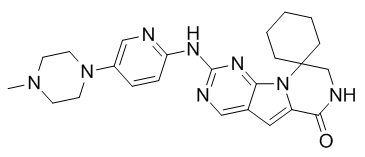
Chemical Structure of Trilaciclib (Image source: medchemexpress.cn)
Chemotherapy is an effective and important weapon in the treatment of cancer. However, chemotherapy cannot distinguish between healthy cells and cancer cells, killing both, including the vital cells in the bone marrow that produce white blood cells, red blood cells, and platelets.Stem Cells. This chemotherapy-induced bone marrow damage is referred to as myelosuppression. When white blood cells, red blood cells, and platelets are depleted, chemotherapy patients face an increased risk of infection,Anemiaand fatigue, and an increased risk of bleeding. Myelosuppression usually requires rescue interventions, such as growth factors and transfusions of blood or platelets, and may also lead to delays and reductions in chemotherapy doses.
Currently, chemotherapy remains the cornerstone of cancer treatment, and trilaciclib has the potential to benefit many of these patients. Trilaciclib is currently being evaluated in four randomized Phase II studies, including three small cell lung cancer (SCLC) studies (first-line treatment of extensive-stage SCLC in combination with chemotherapy [NCT02499770]; first-line treatment of extensive-stage SCLC in combination with chemotherapy and the immune checkpoint inhibitor Tecentriq [NCT03041311]; treatment of previously treated extensive-stage SCLC in combination with chemotherapy) and one breast cancer study (treatment of metastatic triple-negative breast cancer in combination with chemotherapy [NCT02978716]).
G1 Company reported positive results from all these clinical studies in 2018, with data showing clear evidence that trilaciclib effectively protects bone marrow and immune system function from chemotherapy-induced damage; furthermore, the drug's demonstrated bone marrow protective effects improved patient outcomes. Based on clinical data in small cell lung cancer (SCLC), G1 Company plans to submit marketing applications in the United States and the European Union in 2020 for trilaciclib to preserve bone marrow in SCLC patients. (Bioon.com)
Original Source:G1 Therapeutics Official Website