

GSK Consumer Health Innovation Salon Kicks Off Successfully in Nanjing

GSK
Pharmaceutical R&D Manufacturer
Yiou Health, July 1 – Recently,GSK"GSK Co-hosted with Euronet"Consumer Health Integrated Innovation"Series Salons" Successfully Concluded in Nanjing. The Salon Focused on "Leading Health Technology Trends, Jointly BuildingIndustrial Innovation“Ecosystem” as the theme, aiming to seek upstream and downstream partners in China dedicated to promoting the development of the consumer health management industry. This event also signifies GSK’s further in-depth expansion in the Chinese consumer health market.
Tang Shuai, Partner at GTJA Anhui Fund, PhD in Molecular Pathology, and Fellow of the Society of Actuaries (North America); Zheng Xiaoxun, Director of External Innovation for GSK Consumer Healthcare; Zhang Jinbin, Deputy Director of Collaborative Innovation at GSK China R&D Center; Zhang Zhiling, Partner at Zhenghe Huitong Medical; Gao Ang, Vice President of Euronet; and Yu Qinke, Founder and CEO of Shanghai Laisi Information Technology Co., Ltd., along with other entrepreneurs and investors from the healthcare industry, gathered together to share the world’s most cutting-edge technological and innovative achievements with their partners.
Technological Upgrades Accelerate Innovation in the Big Health Industry
WithArtificial Intelligence, with the continuous development of information technologies such as the Internet of Things (IoT) and big data, consumer health management is gradually forming an intelligent closed loop. Amidst the uneven distribution of high-quality medical and nursing resources and the pressure to control healthcare costs, daily monitoring data has become imperative.
For the consumer-facing segment, consumers are increasingly leveraging the internet to access medical information, and from the perspective of their product usage habits and purchasing behaviors,Moving beyond the previously singular channels of hospitals and pharmacies, consumer autonomy has begun to strengthen.
For healthcare institutions, the vast amount of data accumulated from extensive medical activities presents greater opportunities to strengthen their connections and engagement with consumers.In this context, numerous new opportunities for innovation have emerged within the industrial landscape.
As a science-led international consumer healthcare company, GSK Consumer Healthcare combines scientific expertise with consumer insights to safeguard consumers’ daily health and well-being through innovative, high-quality products.
“For example, in the Sensodyne Professional Repair series of toothpaste, we introduced NovaMin technology from external sources, which originated from bone regeneration, applying the technology initially used to promote bone tissue regeneration and repair to toothpaste research and development,” mentioned Zhang Jinbin in his sharing.
Yu Qinke also shared his entrepreneurial insights and industry judgments at the event. Shanghai LaiSi, which focuses on smart health products,Adopting a model of "hardware products + data platform + health management," with data as the foundational driver of innovation. Through hardware, consumer physiological metrics are digitized, and AI is then utilized to provide precise recommendations for management plans.Chang Zhaowei, CEO of Hangzhou Silipu Technology Co., Ltd., stated that through quantitative assessment and cross-industry integrated data analysis, Silipu aims to achieve more precise and effective sleep health management.
In addition, entrepreneurs such as Ke Xin, Founder and CEO of Yiwei Technology; Hu Longsheng, Founder of Changzhou Huajia Medical Device Co., Ltd.; and Pan Qi, General Manager of Nanjing Wenniu Technology Co., Ltd., also shared their entrepreneurial projects on-site, discussing how they seized innovation opportunities amidst the wave of new technological developments.
The Path to Innovation in Consumer Health Is Long and Arduous
Whether in the “Healthy China 2030” strategic plan or in the specific document “Medium- and Long-Term Plan for the Prevention and Control of Chronic Diseases in China (2017–2025),” health management has been elevated to an unprecedented level of importance. As health management for various populations—including patients with chronic diseases, children, and pregnant and postpartum women—is continuously implemented as part of the National Basic Public Health Services Program, China’s health management industry is gradually establishing a multi-level, multi-dimensional policy support network.
Within the industry chain, an increasing number of health management companies are emerging, serving consumers and enterprises through more innovative models. From the perspective of industrial investment, capital holds significant expectations for the consumer health sector; however, it also recognizes that the path to innovation in consumer health remains long and tortuous.
Tang Shuai, a partner at GTJA Anhui Fund, believes that amid the continuous advancement of digital technologies such as artificial intelligence and big data, GTJA is optimistic about two directions: first, the shift of products from clinical-grade to consumer-grade positioning, which offers clear advantages; second, the transition of scenarios, where healthcare services are evolving from analytical applications to home health services, demonstrating a trend toward consumer-oriented transformation.
Gao Ang, Vice President of Euronet, is optimistic about the current major trend toward rejuvenation and personalization among consumer health brands. “The primary issue facing society today is the shift from economic concerns to the imbalance and inadequacy in meeting people’s demands for a better life. Last year, Euronet conducted research on the pursuit of a better life, and we found that many aspects are closely related to healthcare needs. Healthier, more convenient, more comfortable, and safer medical and health services will give rise to countless innovation opportunities,” he said.
In Zhenghe Huitong's investment logic, the key to their bets lies in whether a company can rapidly achieve industrial commercialization."Drawing an analogy to the consumer health industry, whether it involves health monitoring or self-administered medication, Zhang Zhiling, a medical partner, believes that efficacy, safety, and long-term sustainability are crucial."
“Creating ‘blockbuster hits’ is currently trendy, but in the healthcare industry, it is unacceptable to launch a blockbuster product that becomes unusable within six months. Companies must consider whether their consumer health products and services are truly designed from the user’s perspective, or if they are merely focused on rapid market capture and profit generation,” stated Zhang Zhiling.
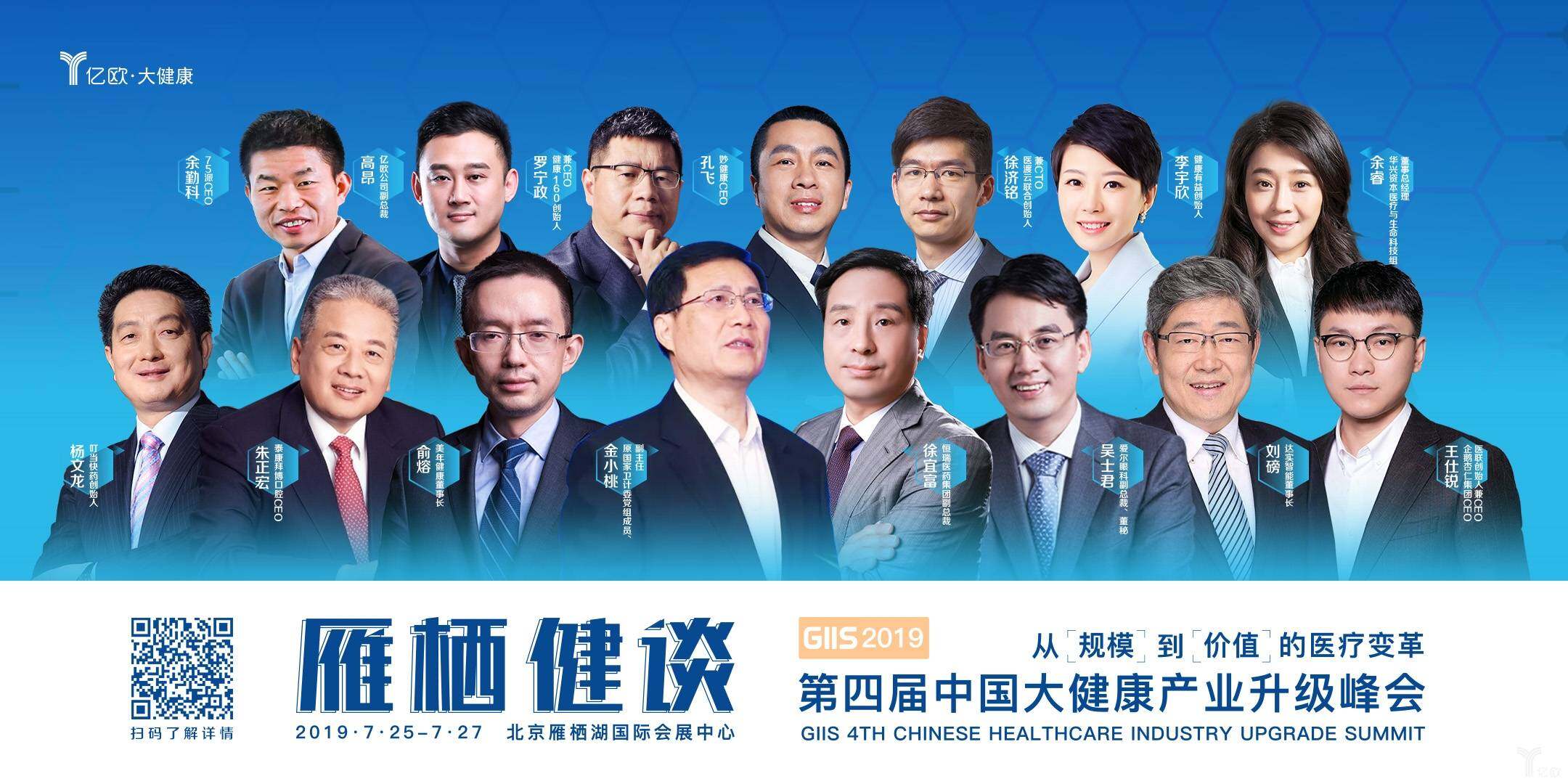
July 25–27, 2019: EY Health will host"GIIS 2019 The 4th China Health Industry Upgrade Summit"The summit, themed “Yanqi Health Talk: Healthcare Transformation from [Scale] to [Value],” focused on discussions around market environments, investment hotspots, and industrial transformations in four key sectors: healthcare big data, pharmaceutical innovation, non-public healthcare, and technology-driven healthcare.
Event Registration Link:https://www.iyiou.com/post/ad/id/785
Copyright Notice
Source: EO Intelligence. Published with authorization from EO Intelligence. All rights reserved by the original author. For reprints or content collaboration, please refer to the reprint guidelines. Unauthorized reprints will be subject to legal action.