

Long-Term Efficacy and Safety of Bayer's Pegylated Extended Half-Life Drug Jivi in Prophylactic Treatment of Hemophilia A for ≥5 Years
Jul 12, 2019 18:59
CST Updated
18:59

Bayer
Pharmaceutical Product R&D Developer

July 12, 2019/BioonBIOON/--German pharmaceutical giantBayerBayer recently announced new data from the Phase III PROTECT VIII extension study of its long-acting drug Jivi (BAY94-9027) for the treatment of hemophilia A at the 27th Annual Congress of the International Society on Thrombosis and Haemostasis (ISTH 2019), held in Melbourne, Australia.
The PROTECT VIII study evaluated the efficacy and safety of Jivi for prophylactic treatment, on-demand treatment, and perioperative management in patients with hemophilia A. Previously published results demonstrated that Jivi provided effective bleed prevention when administered prophylactically once every 7 days, once every 5 days, or twice weekly. Furthermore, Jivi effectively controlled bleeding events during surgery and successfully treated all bleeding episodes, with most cases requiring only one or two intravenous infusions.
This extension study aimed to evaluate the efficacy and safety of Jivi in patients who had completed ≥5 years of prophylactic treatment as of August 31, 2018.

Annual Bleeding Rate (ABR) Data in Patients Receiving Jivi Prophylactic Treatment for ≥5 Years
As of the cutoff date, a total of 36 patients completed 5 years of prophylactic treatment with Jivi (median exposure: 341 days). The median (interquartile range [Q1; Q3]) annualized bleeding rate was 1.2 (0.4; 2.1), and the median annualized joint bleeding rate was 0.8 (0.3; 1.8). No drug-related serious adverse events occurred during the study, and no patients developed confirmed factor VIII inhibitors (titer ≥0.6 Bethesda units).
These results indicate that the efficacy of Jivi remains consistent during the extension period when using an infusion regimen tailored to individual patient needs. This long-term evidence supports the favorable risk-benefit profile of this pegylated product. The data support Jivi as a long-term treatment option for patients with hemophilia A.
Jivi is a long-acting, site-specifically PEGylated recombinant human coagulation factor VIII (PEG-rFVIII) that delivers higher sustained levels of FVIII and has an extended plasma half-life due to PEGylation at specific sites. Jivi was approved in the United States, Japan, and the European Union in 2018, becoming the third hemophilia A drug in Bayer’s hemophilia portfolio, alongside Kovaltry and Kogenate-FS.
Currently, the standard of care for hemophilia A is factor VIII replacement therapy, which requires regular infusions to maintain sufficiently high factor VIII levels to prevent bleeding. Given the short half-life of currently available factor VIII products, prophylactic treatment may necessitate frequent administration, typically every other day or three times per week.
Jivi is meticulously designed to extend its half-life while preserving the biological activity of recombinant human coagulation factor VIII (rFVIII) by inserting a cysteine residue (Cys) into the protein surface, which serves as an attachment site for polyethylene glycol (PEG) polymers.
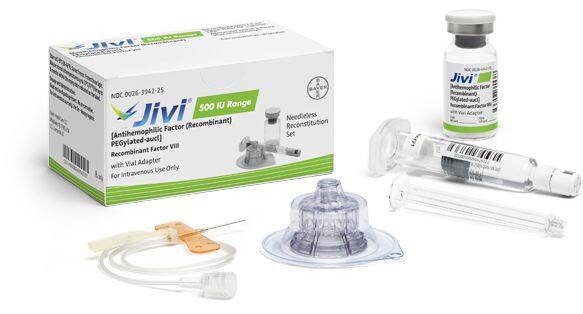
Hemophilia A, also known as factor VIII deficiency or classic hemophilia, is an X-linked recessive disorder caused by abnormalities in the quantity or molecular structure of coagulation factor VIII.HeredityHemophilia A is a hereditary hemorrhagic disorder that predominantly affects males. It is typically caused by a deficiency of coagulation factor VIII, characterized by the inability of blood to clot normally, leading to uncontrolled and frequent persistent or spontaneous bleeding, particularly into joints, muscles, or other tissues, resulting in chronic joint damage. Even minor external trauma can lead to serious consequences. Compared with healthy individuals, patients with Hemophilia A exhibit significantly prolonged clotting time.
The estimated incidence of hemophilia A is approximately 1 in 5,000.Over the past few decades, clinical treatment for hemophilia has made significant progress, with patient life expectancy increasing from 11.4 years in 1920 to that of the general population. Currently, research in the field of hemophilia primarily aims to reduce the treatment burden and improve patients' quality of life. (Bioon.com)