

Seven Chinese particle therapy companies raise 3 billion RMB in six months, slash costs by 70%

CASHIM
Integrated Solution and Service Provider for Ion Diagnosis, Treatment, and Health Recovery

APACTRON
Proton Therapy Equipment R&D and Manufacturer
HBNCT Technology
Boron Neutron Capture Therapy (BNCT) Technology Developer
Particle Therapy is a radiotherapy technology that utilizes high-energy particles to precisely target and destroy tumors, including proton therapy, carbon ion therapy, and boron neutron capture therapy. In the past six months, the particle therapy sector has seen several large-scale financing deals, such as CASHIM raising 800 million RMB, APACTRON completing a nearly 1 billion RMB Series B financing round, Mevion Medical securing a 1.5 billion RMB strategic investment, HBNCT Technology and CNNC Sparticle Healthcare both completing hundreds of millions of RMB financings, with total financing exceeding 3 billion RMB.
VCBeat has compiled a list of the seven leading particle therapy companies in China based on their financing activities in the particle therapy sector:
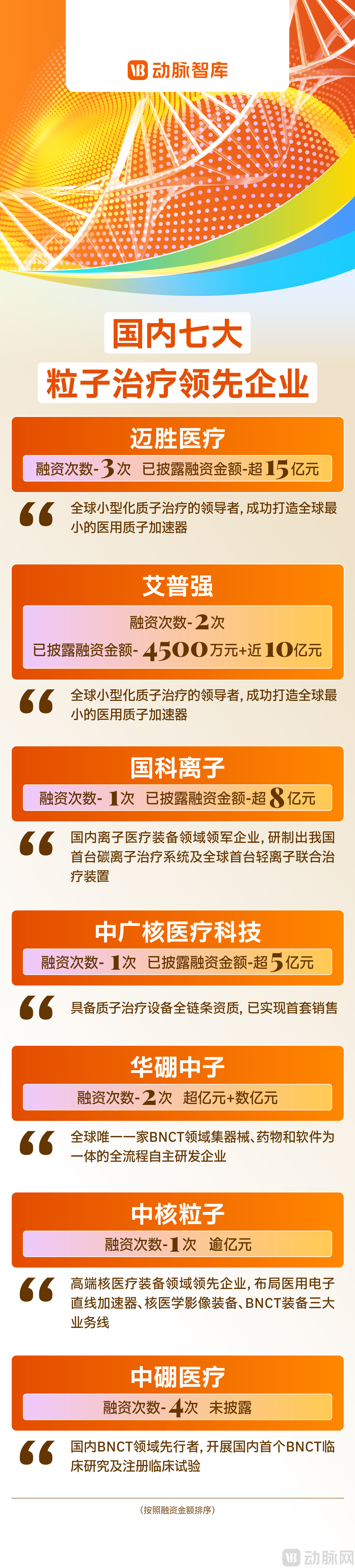
In addition, in the field of particle therapy, companies such as CIM, Raysco, Bortone, Casbnct, CNNC Kunpeng Boron Medical, and CAS Neutron Knife are actively making progress in China.
However, it is worth mentioning that the cost of particle equipment is extremely high, often reaching hundreds of millions of RMB. Additionally, it involves many aspects such as customized construction, installation and debugging, talent training, operation and maintenance, each of which requires a significant financial investment. Meanwhile, according to publicly available information, by the end of 2025, there will be approximately 5 operational heavy ion treatment centers (with 13 under construction) and about 8 proton treatment centers (with 23 under construction) in China. The numbers are still relatively low, and the relevant equipment market has yet to achieve large-scale breakthroughs.
So, how does the particle therapy field support over 3 billion yuan in financing? Why are state-owned capital and social capital betting on particle therapy? And what stage has China-produced particle therapy equipment reached?
At present, the market scale of particle therapy equipment is limited, but investment institutions are looking at the future.
Hao Wang, a partner at Leli Capital, believes: "In the past, the particle therapy market had low penetration due to factors such as technology and cost. However, with rapid advancements in particle therapy technology, significant clinical efficacy, and clear patient demand, it is expected that as technology continues to break through, equipment costs decreases, and policies provide support, particle therapy centers will accelerate their establishment, penetration rates will rise rapidly, and the market size will surge. Therefore, it is a forward-looking move for investment institutions to bet on the particle therapy sector at this stage."
Multiple particle therapy equipment companies also highly recognize this viewpoint, believing that the particle therapy equipment market will experience rapid growth driven by factors such as patient demand, policy support, and technological breakthroughs.
First, particle radiotherapy technology is an excellent treatment option for tumors, with a broad market prospect. According to data from the National Cancer Center, China sees over 4 million new cancer patients each year, with a significant demand for high-quality treatment solutions. Among the core methods for treating cancer, radiotherapy is one of the three main approaches, and approximately 70% of cancer patients may undergo radiotherapy at different stages of their illness.
At present, conventional radiotherapy technology (photon therapy using X-rays and γ-rays) still has pain points such as insufficient precision, potential harm to normal tissues surrounding the tumor, long treatment courses, and possible recurrence. In response, the market has innovated with particle beam radiotherapy technologies that utilize neutron beams, proton beams, and heavy ion beams.
Particle therapy is an internationally recognized cutting-edge radiotherapy technology. Proton and ion beams can form the Bragg peak of energy, which minimizes damage to healthy tissues while effectively targeting tumors. Compared with photon rays used in conventional radiotherapy, particle therapy offers higher precision and fewer side effects. With the release of clinical data, verification of therapeutic efficacy, and improved market education, it is expected that more doctors and cancer patients will choose particle therapy to achieve better treatment outcomes.
Mevion Medical believes that: "Proton therapy has unique values such as precision and better protection of organs at risk, with a potential annual treatment demand reaching hundreds of thousands of people. However, there are only more than ten proton therapy centers in operation across China, indicating a significant gap." It can be said that particle therapy is a burgeoning hundred-billion-RMB blue ocean market."
Secondly, policies are rapidly promoting the application of particle therapy. The National Health Commission issued notifications regarding the planning of particle therapy equipment configurations twice consecutively in 2018 and 2023, and adjusted to increase the number of configurations twice, indicating the country's favorable view and emphasis on particle therapy.
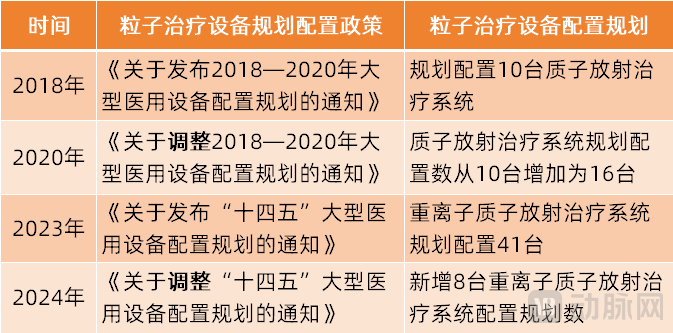
(Changes in the Planned Configuration Quantity of Particle Therapy Equipment)
In 2018, the National Health Commission issued the "Notice on the Plan for the Allocation of Large Medical Equipment," planning to configure 10 proton radiation therapy systems, and in 2020, it adjusted the plan to 16 systems.
In 2023, the National Health Commission issued the "14th Five-Year Plan for the Allocation of Large Medical Equipment," which specified that during the 14th Five-Year Plan period, a total of 41 heavy ion and proton radiotherapy systems would be allocated, bringing the total planned number to 60. In 2024, the National Health Commission made further adjustments to this plan, adding 8 additional units to the planned allocation of heavy ion and proton radiotherapy systems.
The market for particle therapy equipment has surpassed 30 billion RMB, based solely on the number of planned devices. According to past bidding data, the price of a single traditional particle therapy device exceeds 800 million RMB. For example, the Proton Therapy Center at Cancer Hospital, Chinese Academy of Medical Sciences, Shenzhen invested 860 million RMB to introduce proton equipment and supporting medical devices; Shanghai Proton and Heavy Ion Center spent 1.3 billion RMB to acquire proton and heavy ion equipment from Germany's Siemens.
At 800 million RMB per unit, the planned 49 heavy ion proton radiotherapy systems could reach 39.2 billion RMB. In addition, China is also constructing an emerging particle therapy project - Boron Neutron Capture Therapy (BNCT) treatment centers. According to incomplete statistics, as of now, there are a total of 19 operational, under construction, and planned BNCT projects in mainland China, showing a rapid increase compared to 2024. This further expands the market scale of particle therapy facilities.
Finally, technological breakthroughs in the particle therapy field continue to reduce equipment costs, which is expected to rapidly increase the penetration rate of particle therapy. The penetration rate of particle therapy in China has always been at a low level, and the core factor is the extremely high cost of particle therapy equipment.
HBNCT Technology stated: "The investment amount for traditional proton/heavy ion centers (including civil construction) generally exceeds 1 billion RMB, with some even reaching 3 billion RMB." For instance, the total investment in the Proton and Heavy Ion Tumor Treatment Center at Heyu Hospital is nearly 3 billion RMB. the Proton Therapy Center at Cancer Hospital, Chinese Academy of Medical Sciences, Shenzhen, has a planned total investment of approximately 1.648 billion RMB, while the total investment in the Proton Center at Shandong Cancer Hospital is 1.47 billion RMB.
At the same time, the construction period of proton/heavy ion centers is also relatively long, approximately 3-6 years. After completion, the operation and maintenance costs of the center are extremely high. For example, the annual maintenance cost of the proton therapy center at Shandong Zibo Wanjie Cancer Hospital reaches 6 to 10 million RMB.
Due to the high initial costs and subsequent expensive maintenance fees, the treatment costs for proton/heavy ion therapy are naturally very high in the early stages of development. It is reported that the treatment cost for a single course at the Shanghai Proton and Heavy Ion Center is approximately 278,000 RMB, with total expenses, including hospitalization and other medical procedures, averaging about 400,000 RMB.
In response, innovative companies in China are reducing the procurement, installation, and operation and maintenance costs of particle therapy equipment through technological innovation. This lowers the investment threshold for particle therapy centers, helping treatment centers achieve commercial profitability more quickly while driving down end-user treatment costs, expanding patient accessibility, and ultimately increasing the overall penetration rate of particle therapy.
So far, companies in China have reduced the price of proton therapy equipment from over 800 million RMB in the past to about 230 million RMB, marking a significant decrease of approximately 70%. For instance, recent bidding data shows that: the proton therapy system purchased by Guangzhou Science City Proton Therapy Center, which is made in China, costs around 228 million RMB; the single-room proton therapy system purchased by the Development Zone Branch of The First People's Hospital of Lianyungang, also domestically produced, costs about 237 million RMB.
When cost is no longer a barrier, the particle therapy market will experience exponential growth.
As of now, only a few countries, including China, Germany, the United States, and Japan, have mastered particle therapy technology. Relevant companies include IBA, Varian, Hitachi, Mitsubishi, etc. Among them, the three giants—IBA, Varian, and Hitachi—account for nearly 80% of the global market share.
Particle Therapy Includes Multiple Technologies Such as Proton Therapy, Carbon Ion Therapy, and Boron Neutron Capture Therapy (BNCT). Proton therapy, due to factors such as its long application history and abundant clinical data, is the mainstream of particle therapy. Among patients receiving particle therapy, proton therapy accounts for 85%.
In addition to proton therapy, global innovative companies are also exploring treatment technologies such as carbon ions, boron neutrons, and helium ions. For these rapidly developing particle therapy technologies, many innovative companies in China are actively making progress with remarkable achievements. For instance, among the companies that recently completed financing, CASHIM has laid out multi-particle combined radiotherapy technology, APACTRON and Mevion Medical have invested in proton therapy, while companies like HBNCT Technology, Neuboron, and Casbnct have focused on Boron Neutron Capture Therapy (BNCT).
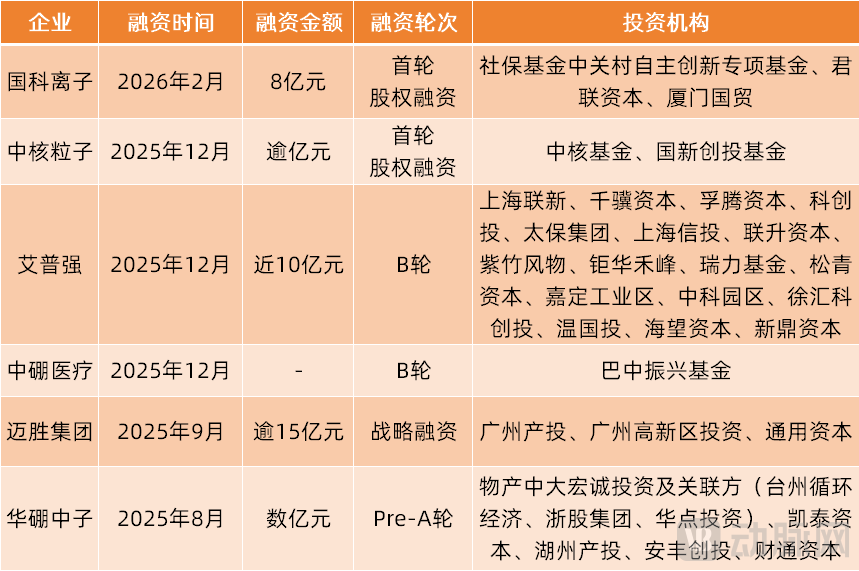
(Recent Financing Situation in China's Particle Therapy Field in the Past Six Months)
In the field of carbon ion therapy, CASHIM launched the first domestically produced carbon ion therapy system approved by the NMPA in China in 2019, which has been installed and is in use at Gansu Wuwei Tumor Hospital.
It is understood that carbon ion radiotherapy maximizes the dose of radiation focused on the target area by modulating the Bragg peak, achieving maximal destruction of tumor cells while optimally protecting surrounding normal tissues. Additionally, carbon ions exhibit significantly less scattering than photons, resulting in more precise dose distribution compared with photon therapy. In terms of indications, carbon ion radiotherapy is suitable for radiation-resistant tumors such as gliomas, chordomas, and melanomas. It also significantly improves efficacy in recurrent tumors, with normal tissues showing good tolerance.
Furthermore, CASHIM has innovatively developed the world's first light ion therapy device, which has successfully completed installation and equipment commissioning and is about to formally initiate medical device registration studies. This device integrates three major particle therapy technologies—proton, helium ion, and carbon ion—and also has the potential to offer proton CT. Among these, proton and helium ion beams are used for clinical treatment, while carbon ion beams are used for treating superficial tumors in areas such as the head, neck, and limbs.
In addition to integrating multiple particle therapy technologies, this device also achieves breakthroughs in cost. It requires a footprint of only 1,500 square meters, significantly reducing equipment and civil construction costs compared with heavy ion therapy devices, addressing the issue of high comprehensive investment and making it more suitable for deployment in medical institutions at the prefecture and city level.
In the field of boron neutron capture therapy (BNCT), HBNCT Technology's first BNCT system, HyBorSys, has completed medical device registration testing, and its boron drug recently received IND approval, with clinical trials about to commence.
Different from the technical principles of proton therapy and carbon ion radiotherapy, BNCT can be described as an "intracellular detonation." The treatment consists of three steps: first, a boron-containing drug (boron drug) is injected into the patient, which accumulates in tumor tissue and precisely targets the tumor; second, the tumor area is irradiated with a neutron beam, triggering a specific capture reaction between the neutrons and the boron drug; third, the lithium-7 and alpha particles released by this capture reaction precisely destroy cancer cells within the range of a single cell (approximately 10 micrometers), ensuring that surrounding healthy tissues remain unharmed.
Based on these mechanistic differences, BNCT achieves cellular-level destruction with higher precision and better protection of normal healthy tissues. This therapy is particularly effective against recurrent and infiltrative tumors and can be used in patients with head and neck tumors who have relapsed after radiotherapy or for whom re-irradiation is contraindicated, offering new hope for such patients. As a result, BNCT is hailed as the "fifth modality of cancer treatment."
Beyond treatment precision, the accessibility advantages of BNCT are equally noteworthy. Taking real-world application in Japan as an example, the cost of BNCT treatment ranges from approximately 3 million to 6 million yen, which is more economical than proton and heavy ion therapy. More importantly, while proton therapy typically requires four to six weeks with 20 to 30 irradiation sessions, BNCT usually requires only one to two sessions, each lasting 30 minutes, to complete treatment.
HBNCT Technology stated: "For hospitals, a significantly shortened treatment course means they can treat more patients within the same timeframe, greatly improving equipment turnover and enabling faster recovery of investment costs. As domestic technology matures, treatment costs are expected to decline further."
In terms of commercial development, the combination of "boron drug plus neutron irradiation" in BNCT also brings a "printer and ink cartridge" business model to innovative companies. Specifically, on one hand, innovative companies are vigorously developing compact, miniaturized accelerator neutron sources to reduce equipment prices as much as possible; on the other hand, they generate long-term revenue through the continuous consumption of boron drugs, thereby using a steady stream of cash flow for technological research and development, forming a virtuous cycle of technology and capital that accelerates market penetration.
Globally, overseas companies such as Neutron Therapeutics, Sumitomo Heavy Industries, RaySearch, TAE Life Sciences, and Stella Pharma have entered the field. In China, innovative forces represented by HBNCT Technology, Neuboron, and Casbnct are accelerating their breakthroughs, achieving differentiated leadership in core technology sectors.
For example, HBNCT Technology has established a fully integrated, self-developed system for BNCT covering "equipment, drug, and software." On the equipment front, the team utilizes high-current proton RFQ accelerator technology, achieving power stability of 35 kW, the highest level globally. On the drug front, its independently developed second-generation boron drug features a patent-protected efficient synthesis route, with high boron-10 utilization and controllable costs, and the injectable BPA formulation has completed clinical batch production. On the software front, HBNCT Technology employs a Monte Carlo physics engine to build a comprehensive solution covering multimodal imaging data processing and intelligent target volume delineation, ensuring precise irradiation.
As a cutting-edge technology, BNCT also faces challenges. Its clinical application still requires the accumulation of more real-world data, and indication expansion still requires collaborative exploration between enterprises and medical institutions. Yet precisely because of this, this field also harbors immense room for innovation. As domestic, self-developed programs accelerate, BNCT is expected to bring new hope to more patients with difficult-to-treat tumors.
In the field of proton therapy, domestic innovative companies in China are also addressing existing pain points through technological innovation and continuously iterating to optimize their products. For example, traditional proton centers have an extremely high investment threshold. Mevion Medical has developed a unique superconducting integrated proton therapy technology, reducing the footprint of treatment room equipment to one-thirtieth of that of conventional equipment. This technology can be directly adapted to existing radiotherapy vaults, shortening construction periods to just months and reducing the investment threshold to the hundred-million-RMB level.
Mevion Medical has also independently developed HYPERSCAN ultra-high-speed pencil beam scanning and Adaptive Aperture, which together achieve submillimeter-level "dose sculpting," with beam edges three times sharper than those of conventional machines. Acceptance test results published by Tongji Hospital affiliated with Tongji Medical College of Huazhong University of Science and Technology show that various accuracy metrics of its proton therapy system—such as spot size, positional deviation, and penumbra—are far superior to international standards, demonstrating excellent stability and reliability.
In addition, Mevion Medical is also advancing next-generation treatment modalities, such as arc therapy and FLASH ultra-high-dose-rate radiotherapy. Arc therapy technology can provide better dose distribution solutions for complex cases, while FLASH delivers irradiation in milliseconds.
It should be noted that proton therapy, due to its treatment precision and abundant clinical evidence, has become the mainstream in the particle therapy market, attracting competition from technological approaches such as carbon ion therapy and BNCT. However, proton therapy has not stood still but continues to innovate. Now, with a significant reduction in the cost of proton therapy equipment (with sales prices dropping from RMB 800 million to 1.3 billion in the past to a minimum of approximately RMB 200 million), and ongoing improvements in precision, efficacy, and indications, proton therapy is expected to accelerate its penetration rate.
Overall, domestically produced particle therapy equipment in China has achieved breakthroughs across multiple pathways, including proton, carbon ion, and BNCT, and offers differentiated advantages over overseas products, achieving breakthroughs in cost, efficacy, and safety. With the approval and application of domestically produced particle therapy equipment, the proportion of particle radiotherapy in overall radiotherapy is expected to continue to rise, providing Chinese patients with access to better clinical solutions.