July 14, 2019/
BioonBIOON/-- Janssen Pharmaceuticals, a subsidiary of US pharmaceutical giant Johnson & Johnson (JNJ), recently announced data from the Phase III COLUMBA study (MMY3012), which evaluated the subcutaneous (SC) formulation of Darzalex (daratumumab) in patients with relapsed/refractory multiple myeloma (MM). The results demonstrated that the SC formulation of Darzalex was non-inferior to the intravenous (IV) formulation in terms of efficacy and pharmacokinetics, while offering a shorter administration time (5 minutes vs. over 3 hours) and a lower incidence of infusion-related reactions (13% vs. 35%).
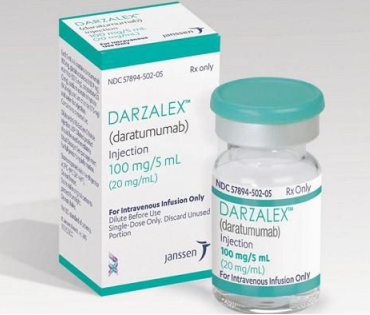
Darzalex SC was developed using Halozyme’s ENHANZE drug delivery technology and contains recombinant human hyaluronidase PH20 (rHuPH20) in its formulation. Currently, Darzalex IV has been approved for the treatment of certain patients with multiple myeloma (MM).
Darzalex is the world’s first CD30-targetedMonoclonal Antibody Drugs, it has been approved for first-line, second-line, and multi-line treatment of multiple myeloma, with sales exceeding $2 billion in 2018. The drug also holds potential for treating various other types of tumors with high CD38 expression.
COLUMBAMaria Victoria Mateos, MD, Principal Investigator of the study and Director of the Myeloma Unit at University Hospital of Salamanca in Spain, stated: “This study demonstrates that the subcutaneous formulation of Darzalex is non-inferior to the current intravenous formulation in terms of pharmacokinetics and efficacy. Importantly, it also offers the potential for fixed-dose administration, shorter infusion times, and a lower incidence of infusion-related reactions. Darzalex IV has been proven to be a critical therapy for multiple myeloma, and a new subcutaneous formulation will provide patients with a different experience, including shorter administration time.”
Janssen Research & Development, LLC
TumorDr. Mark Wildgust, Vice President of Global Medical Affairs, stated, “We have been exploring new ways to help patients, and these compelling study results reinforce the potential of a new route of administration for Darzalex. We look forward to submitting the regulatory application for this subcutaneous formulation, bringing this new treatment option to patients with multiple myeloma (MM).”
COLUMBA is a randomized, open-label, multicenter study that enrolled a total of 522 patients with relapsed or refractory multiple myeloma (MM) who had previously received at least three prior therapies, including a proteasome inhibitor (PI) and an immunomodulatory drug (IMiD), or whose disease was refractory to both a PI and an IMiD. In the study, the Darzalex SC group (n=263) received subcutaneous Darzalex (fixed dose of 1800 mg, co-formulated with rHuPH20 at a concentration of 2000 units/mL) once weekly during cycles 1–2, every two weeks during cycles 3–6, and every four weeks from cycle 7 onwards. The Darzalex IV group (n=259) received intravenous Darzalex (dose of 16 mg/kg) once weekly during cycles 1–2, every two weeks during cycles 3–6, and every four weeks from cycle 7 onwards. Each cycle lasted 28 days. In the Darzalex SC group, Darzalex was administered in a fixed volume, with subcutaneous injection completed within 3–5 minutes. In the Darzalex IV group, the median durations for the first, second, and subsequent intravenous infusions of Darzalex were 7.0 hours, 4.3 hours, and 3.4 hours, respectively. Treatment in both groups continued until disease progression or unacceptable toxicity.
The results showed that, with a median follow-up of 7.5 months, the Darzalex SC treatment group demonstrated non-inferiority to the Darzalex IV treatment group in terms of the primary endpoint, overall response rate (ORR), and the trough concentration (Ctrough) of daratumumab on Day 1 of Cycle 3. Specific data are as follows: (1) For ORR, the SC group was 41% and the IV group was 37% (ratio=1.11, 95% CI: 0.89–1.37, p<0.0001), meeting the prespecified non-inferiority criteria. ORR was similar across all clinically relevant subgroups, including those stratified by body weight. (2) For Ctrough, the geometric mean trough concentration was 499 μg/mL in the SC group and 463 μg/mL in the IV group (ratio=108%, 90% CI: 90%–122%), meeting the prespecified non-inferiority criteria. (3) Progression-free survival (PFS) was comparable between the two treatment groups (HR=0.99, 95% CI: 0.78–1.26, p<0.9258). (4) The median duration per SC injection was 5 minutes, whereas the median duration for IV infusion exceeded 3 hours.
In terms of safety, the most common (>5%) Grade 3/4 treatment-emergent adverse events (TEAEs) for Darzalex SC compared with Darzalex IV included thrombocytopenia (14% vs. 14%),
Anemia(13% vs 14%) and neutropenia (13% vs 8%). Darzalex SC was associated with a lower incidence of infusion-related reactions compared with Darzalex IV (13% vs 35%; OR=0.28, 95% CI: 0.18–0.44; p<0.0001). The primary reasons for treatment discontinuation included progressive disease (43% in the SC group vs 44% in the IV group) and adverse events (7% in the SC group vs 8% in the IV group).
(Bio Valley Bioon.com)
Original source: Johnson & Johnson website