

Imfinzi Granted Orphan Drug Designation by US FDA for Small Cell Lung Cancer
Jul 14, 2019 09:35
CST Updated
09:35

AstraZeneca
Biopharmaceutical Manufacturer

FDA
U.S. Food and Drug Administration
July 14, 2019/Bio ValleyBIOON/--UK pharmaceutical giantAstraZeneca(AstraZeneca) recently announced that the U.S. Food and Drug Administration (FDA) has been granted PD-L1TumorOrphan Drug Designation (ODD) for the Immunotherapy Imfinzi (durvalumab) in the Treatment of Small Cell Lung Cancer (SCLC).
Orphan drugs refer to those used for the prevention, treatment,DiagnosisOrphan drugs, while rare diseases are a collective term for conditions with extremely low incidence rates, also known as "orphan diseases." In the United States, rare diseases refer to disease types affecting fewer than 200,000 individuals. Incentives for orphan drug development include various clinical development incentives, such as tax credits related to clinical trial costs,FDAWaiver of User Fees,Clinical TrialsIn DesignFDAassistance, as well as a 7-year market exclusivity period after the drug is approved and launched.
Lung cancer is the leading cause of cancer death in both men and women, accounting for approximately one-fifth of all cancer deaths. Lung cancer is broadly classified into non-small cell lung cancer (NSCLC) and small cell lung cancer (SCLC), with SCLC comprising about 15%. Approximately two-thirds of patients with SCLC areDiagnosisExtensive-stage disease, meaning the cancer has spread widely throughout the lungs or to other parts of the body. SCLC is an aggressive, fast-growing cancer that, although initially responsive to platinum-based chemotherapy, relapses and progresses rapidly. The prognosis is particularly poor, with only 6% of SCLC patients surviving five years after diagnosis.
In June this year, the Phase III CASPIAN clinical trial of Imfinzi as first-line treatment for extensive-stage small cell lung cancer (ES-SCLC) met its primary endpoint. The results showed that compared with the chemotherapy group, the Imfinzi plus chemotherapy group demonstrated statistically and clinically significant improvements in overall survival (OS). Currently, AstraZeneca is also conducting another Phase III clinical trial, ADRIATIC, to evaluate the use of Imfinzi in patients with limited-stage SCLC following concurrent chemoradiotherapy (CCRT).
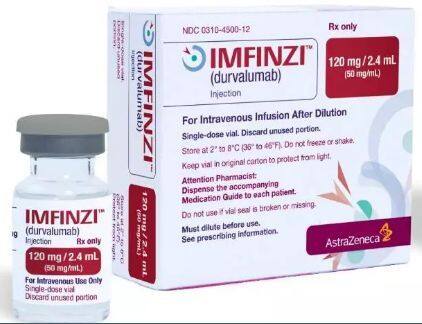
Imfinzi is a PD-L1 immunotherapy that targets and binds to programmed death-ligand 1 (PD-L1), blocking the interaction of PD-L1 with PD-1 and CD80, thereby combatingTumorimmune evasion strategies and release the suppression of immune responses.
Currently, Imfinzi has been approved in multiple countries and regions (including Hong Kong and Macao, China) for the treatment of patients with advanced bladder cancer who have previously received treatment.
In the field of lung cancer, Imfinzi has been approved in more than 45 countries worldwide (including the United States, the European Union, and Japan) for the treatment of patients with unresectable locally advanced (Stage III) non-small cell lung cancer (NSCLC). This approval is based on data from the Phase III PACIFIC study. In early June this year, at the American ClinicalTumorThe 3-year overall survival (OS) data presented at the American Society of Clinical Oncology (ASCO) Annual Meeting demonstrated durable and sustained OS benefits in patients with unresectable stage III non-small cell lung cancer (NSCLC) who did not experience disease progression following concurrent chemoradiotherapy (CRT): the 3-year OS rate was 57% in the Imfinzi group, with median OS not yet reached, compared to 43.5% and 29.1 months, respectively, in the placebo group. Based on these results, Imfinzi became the first immunotherapy proven to provide a 3-year survival benefit in the population with unresectable stage III NSCLC.
Currently, AstraZeneca is conducting a large-scale clinical program to evaluate Imfinzi as monotherapy and in combination with tremelimumab and other agents for the treatment of NSCLC, SCLC, bladder cancer, head and neck cancer,Liver Cancer, cervical cancer, biliary tract cancer, and other solid tumors. (Bioon.com)