

Novartis Nears Launch of Seven New Drugs in China Amid Accelerated Regulatory Review

Novartis
Drug Development and Manufacturing
Yi Yao Guan Lan/Report
According to incomplete statistics,Currently, the National Medical Products Administration (NMPA) of China is processing 10 marketing application acceptance numbers from Novartis, involving seven active ingredients, four of which have no equivalent products approved in China.Most of these products are currently under review and approval. If progress remains smooth, Novartis is expected to receive NMPA marketing approval for seven products in the near future. Additionally, according to recent reports from GBI, Dr. John Tsai, Global Head of Drug Development and Chief Medical Officer at Novartis, stated in an interview with China Daily that, given the NMPA’s accelerated review and approval process for new drugs, Novartis anticipates submitting 50 new drug applications in China by 2023. Today, we take an early look at these seven products that have already submitted marketing applications in China.
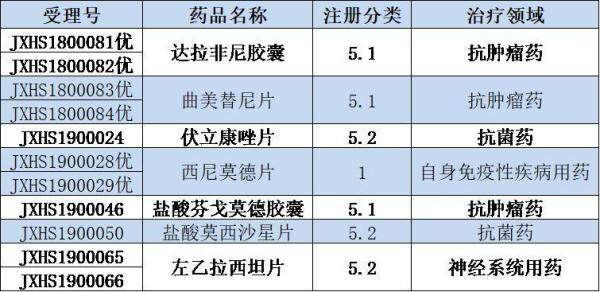
▲10 Marketing Application Acceptance Numbers Currently Under Review by the NMPA
1. Fingolimod
Fingolimod is a novel immunosuppressant developed by Novartis, belonging to the class of sphingosine-1-phosphate receptor modulators. It promotes the retention of lymphocytes in lymph nodes, thereby suppressing autoimmune responses. In 2010, the drug was approved by the U.S. FDA forMultiple Sclerosis (MS), approved in Europe in 2011 forRelapsing-Remitting Multiple Sclerosis (RRMS)。
In April this year, the Center for Drug Evaluation of the National Medical Products Administration (NMPA) accepted Novartis's marketing application for fingolimod.Currently, the product's application status with the NMPA is under review.Multiple sclerosis is an autoimmune disease primarily characterized by inflammatory demyelinating lesions of proteins in the central nervous system. The approval of fingolimod is expected to bring new hope for treatment to patients with MS.
2. Trametinib
Trametinib is an extracellular signal-regulated kinase (MEK) inhibitor that promotes mitogen activation, and was approved by the FDA in 2013.For the treatment ofBRAF V600E/KAdult Patients with Unresectable or Metastatic Melanoma Harboring Mutations. May 2018,FDA Approves Combination of Trametinib and Dabrafenib, asBRAF V600E/KAdjuvant Therapy for Patients with Mutant Melanoma. Notably, this combination therapy has received FDA Breakthrough Therapy Designation and Priority Review status.
In January this year, the Center for Drug Evaluation accepted the marketing application for trametinib, which was subsequently included in the priority review program.Currently, the product's application status with the NMPA is under review and approval.. Melanoma is one of the fastest-growing malignant tumors in China, with approximately 20,000 new cases annually. The approval of trametinib will, to some extent, meet the clinical needs of patients.
3. Dabrafenib
Dabrafenib is a BRAF inhibitor. It is not indicated for wild-type melanoma, and testing is required prior to use.BRAF V600EMutation. In 2013, the FDA approved itsFor the treatment of patients with metastatic melanoma and unresectable melanoma. This is the third drug approved by the FDA for the treatment of metastatic melanoma, following vemurafenib and ipilimumab.
In January this year, the Center for Drug Evaluation accepted the marketing application for dabrafenib, which was subsequently included in the priority review program.Currently, the product is under review and approval by the NMPA.。

4. Siponimod
Siponimod is an S1P receptor modulator with high selectivity for specific subtypes of S1P receptors. It binds to the S1P1 receptor subtype expressed on the surface of lymphocytes, preventing them from entering the central nervous system of patients with multiple sclerosis, thereby reducing inflammatory responses. In March this year,U.S. FDA Announces Approval of Novartis’ Mayzent (siponimod) for Market Launch, for the treatment of adult patients with relapsing multiple sclerosis.
In China, the Center for Drug Evaluation accepted the marketing application for siponimod in February this year, and the drug was subsequently included in the priority review program.Currently, the product is under review and approval by the NMPA.Previously, multiple sclerosis was included in China’s “First Batch of Rare Diseases Catalog.” The approval of siponimod is expected to bring new treatment options for this patient population.
5. Levetiracetam
Levetiracetam belongs to the pyrrolidone class of racetam drugs. It was first marketed in the United States in tablet form in 1999, and its extended-release tablet formulation received FDA approval in 2008. Epilepsy is a long-term, chronic brain disorder.Among the best-selling antiepileptic drugs worldwide, levetiracetam, as a broad-spectrum antiepileptic agent, is a cornerstone product in the antiepileptic drug market.。
In late May this year, the Center for Drug Evaluation accepted Novartis’s marketing application for levetiracetam tablets.Currently, the product is under review and approval by the NMPA.Data show that China has nearly 10 million patients with epilepsy, with approximately 400,000 new cases annually. Currently, eight domestically produced levetiracetam tablet products have obtained registration approval in China.
6. Voriconazole
Voriconazole is a broad-spectrum triazole antifungal agent, an improved derivative of fluconazole, primarilyFor the treatment of infections caused by fungi such as Aspergillus, Candida krusei, and Scedosporium species。
In February this year, the Center for Drug Evaluation accepted Novartis's marketing application for voriconazole.Currently, the product’s application status with the NMPA is under review and approval.. In China, 15 domestically produced voriconazole products have obtained registration approval.
7. Moxifloxacin
Moxifloxacin is a fourth-generation synthetic quinolone antibacterial agent and a second-line anti-tuberculosis drug.Indicated for the treatment of adults with upper and lower respiratory tract infections, such as acute sinusitis, acute exacerbation of chronic bronchitis, community-acquired pneumonia, and skin and soft tissue infections.
In April this year, the Center for Drug Evaluation accepted Novartis’s application for market approval of moxifloxacin.Currently, the product is under review and approval by the NMPA.. In China, 14 domestically produced moxifloxacin drug products have obtained registration approvals.
References:
[1] Query of Comprehensive Administrative Licensing Matters of the National Medical Products Administration, Retrieved July 11, 2019 from http://sq.cfda.gov.cn/datasearch/schedule/search.jsp?tableId=43&tableName=TABLE43&columnName=COLUMN464,COLUMN475&title1=%E8%8D%AF%E5%93%81%E6%B3%A8%E5%86%8C%E8%BF%9B%E5%BA%A6%E6%9F%A5%E8%AF%A2
[2] Novartis: Plans to Submit 50 NDAs in China by 2023, Retrieved July 10, 2019 from https://mp.weixin.qq.com/s?__biz=MzA5Njc0MTAxOQ==&mid=2649992879&idx=1&sn=102e95bb740ef40dec941e50a8799103&chksm=88ac7d5bbfdbf44d6153d138596011b965249f617a77e90614f515be0052e4cde1863131b8b0&mpshare=1&scene=1&srcid=0711p9jBtCBQz8m3yRUP82fb&pass_ticket=2OHE5g7Y0kfCNKCkZt3S2%2FmODmnwR9cLVR3IFCZqD10lykwtiUaM48JEFhA3XSMv#rd