

Janssen Announces Positive Phase 3 Results for Oral Selective S1P1 Modulator Ponesimod in Relapsing Multiple Sclerosis
Jul 27, 2019 16:33
CST Updated
16:33

Johnson & Johnson
Healthcare Product Manufacturers, Health Service Providers

Janssen Pharmaceuticals
Pharmaceutical R&D Developer

Sanofi
Pharmaceutical R&D Developer

July 27, 2019/BioValleyBIOON/-- Janssen Pharmaceuticals, a subsidiary of U.S. pharmaceutical giant Johnson & Johnson (JNJ), recently announced positive top-line results from the Phase III OPTIMUM clinical study. The study evaluated the efficacy and safety of ponesimod versus Aubagio (teriflunomide) in adult patients with relapsing multiple sclerosis (RMS). Aubagio is an oral multiple sclerosis medication marketed by Sanofi. The results demonstrated that the study met its primary endpoint and most secondary endpoints.
OPTIMUM is a head-to-head, prospective, multicenter, randomized, double-blind, active-controlled, parallel-group Phase III superiority study conducted in adult patients with relapsing multiple sclerosis (RMS) to evaluate the efficacy, safety, and tolerability of ponesimod 20 mg versus Aubagio 14 mg. The study enrolled a total of 1,133 patients, with a treatment duration of 108 weeks. The primary endpoint was the annualized relapse rate (ARR) at the end of the study. The key secondary endpoint was the change in fatigue-related symptoms from baseline to Week 108. From the patient perspective, fatigue is considered an important unmet need. Additionally, the study assessed other endpoints: the cumulative number of combined unique active lesions (CUAL) evaluated by magnetic resonance imaging (MRI), confirmed disability accumulation (CDA) over the first 12 weeks, and CDA over the first 24 weeks.
The safety profile of ponesimod observed in this study was consistent with that reported in previous studies of ponesimod and with the known safety profiles of other S1P receptor modulators.
Data from the OPTIMUM study have been accepted for presentation in 2019The 35th Congress of the European Committee for Treatment and Research in Multiple Sclerosis (ECTRIMS)Meetingpublished above. Based on the study data, Johnson & Johnson will submit marketing authorization applications for ponesimod in the treatment of relapsing multiple sclerosis (RMS) in the United States and the European Union later this year.
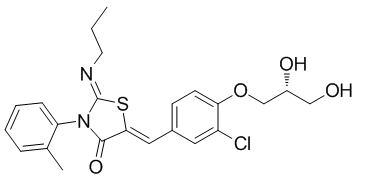
Molecular Structure of Ponesimod (Image Source: MedChemExpress)
Multiple Sclerosis (MS) is a chronic central nervous systemAutoimmunityMultiple sclerosis is an inflammatory demyelinating disease affecting 2.3 million people worldwide, with a higher prevalence in women than in men. The disease is characterized by demyelination and axonal loss, leading to neurological impairment and severe disability. The main subtype of MS is relapsing multiple sclerosis (RMS), which accounts for 85% of MS patients and includes clinically isolated syndrome (CIS), relapsing-remitting multiple sclerosis (RRMS), and active secondary progressive multiple sclerosis (SPMS).Relapse is defined as new, worsening, or recurrent neurological symptoms lasting more than 24 hours, in the absence of fever or infection. Relapses may fully resolve within days or weeks, or lead to persistent deficits and the accumulation of disability.
Ponesimod is a selective sphingosine-1-phosphate receptor 1 (S1P1) modulator, a class of drugs believed to functionally inhibit S1P activity and sequester lymphocytes within lymph nodes, thereby reducing the number of circulating lymphocytes. Consequently, fewer inflammatory cells enter the central nervous system (CNS) to damage myelin. Myelin is a protective sheath that insulates nerve cells and is impaired in patients with multiple sclerosis.
Currently, S1P has become an important target for new drug development in the field of MS. In March this year,NovartisMayzent (siponimod) Approved in the United StatesFDAApproved for the treatment of adult patients with RMS, including active secondary progressive multiple sclerosis (SPMS), relapsing-remitting multiple sclerosis (RRMS), and clinically isolated syndrome (CIS). Notably, Mayzent is the first and only therapy specifically approved for the treatment of patients with active SPMS in the past 15 years. The active pharmaceutical ingredient of Mayzent is siponimod, a next-generation, selective sphingosine-1-phosphate (S1P) receptor modulator that selectively binds to S1P receptor 1 (S1P1) and receptor 5 (S1P5).
In addition, in June this year, the marketing authorization application for Celgene’s oral S1P receptor modulator ozanimod for the treatment of RMS was accepted in the United States and the European Union. Ozanimod can selectively bind to S1P1 and S1P5 with high affinity, and its mechanism of action is similar toNovartisSimilar to Mayzent. Ozanimod selectively binds to S1P1, which is believed to inhibit the migration of a specific subset of activated lymphocytes to inflammatory sites, reduce the levels of circulating T and B lymphocytes—thereby exerting anti-inflammatory effects—and alleviate immune-mediated attacks on neural myelin. Due to its unique mechanism of action, ozanimod allows patients to maintain immune surveillance function. Furthermore, the binding of ozanimod to S1PR5 activates specialized cells within the central nervous system, promoting myelin regeneration and preventing synaptic defects, ultimately helping to prevent neural damage. Through the combined effects of these two mechanisms—"reducing damage" and "enhancing repair"—ozanimod has the potential to improve symptoms in various immune-mediated diseases. Currently, ozanimod is being developed for multiple immune-inflammatory indications, including relapsing forms of multiple sclerosis (RMS), ulcerative colitis (UC), and Crohn's disease (CD). (Bioon.com)