

Tencent: The Super Hunter of Medical IPOs

Tencent
Internet Comprehensive Service Provider
In the past year, medical IPOs have rebounded, with more than 37 domestic medical companies completing IPOs. Shenzhen Tencent Computer System Co., Ltd. has appeared behind multiple medical IPOs.
In the past three months, Tencent Investments has participated in the IPOs of three healthcare companies: Insilico Medicine, an AI-driven drug discovery company; Zozee Medical, a provider of mid-to-high-end medical services; and MicroPort Surgical Robotics, a surgical robotics company. This move has hit multiple hot sectors, bringing substantial book profits.
2026 is expected to be a big year for Tencent Healthcare's IPO harvest.Among the medical companies that have already submitted listing applications and are queuing up for IPOs, Tencent has also invested in multiple enterprises. These include Xianweda Bio, Sinovent Pharma, Elpiscience Biopharma, Aeonmed, Braun Medical, and WeDoctor, among others, all of which have received investments from Tencent. Tencent is expected to become the strongest medical IPO investor by 2026.
As early as a decade ago, Tencent began investing in the healthcare sector. In the early years, Tencent focused on the Internet healthcare track, but in recent years, the company's investment focus in medical enterprises has shifted to innovative drugs.
Tencent Investment, Focusing on Innovative Drugs, Enters the Healthcare IPO Harvest Period.According to VCBeat statistics, eight medical companies invested in by Tencent have submitted their prospectuses, with five of them being innovative drug companies. These companies are mostly from Tencent's investments over the past two years, and they entered at relatively later stages. This strategy of entering at a low valuation cost after the market has recovered has allowed Tencent to complete the cycle from investment to exit in a relatively short period.
Tencent also seized the window period when a batch of medical funds' investment terms expired, with a strong demand for reduction and exit. It invested in companies by acquiring the equity of old shareholders, such as its investment in Bomai Medical.
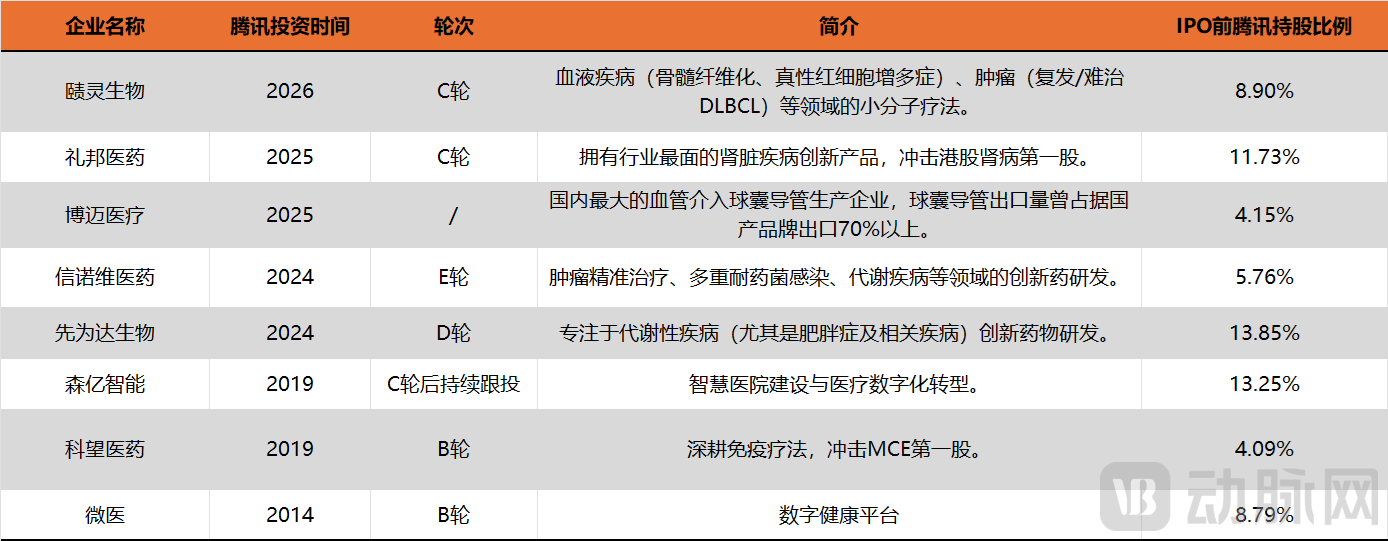
Tencent Healthcare Investment: Distribution of Enterprises Awaiting Listing
The IPO window period for innovative drugs resonates with Tencent's investment rhythm.Tencent Dares to Invest in the Later Stages of Innovative Drug Development, Successfully Riding the Wave of Innovative Drug IPO Recovery. In 2024, when pharmaceutical investments were still in an adjustment phase, Tencent began actively positioning itself in innovative drugs. By 2025, as the industry's recovery became clear, Tencent continued to increase its investments in innovative drugs.
In the field of innovative drugs, Tencent usually adopts ""Large-scale final push in the later stage"The strategy focuses on investing in the last round of financing before a company's IPO. Typical cases include Zeling Biotech, Libang Pharmaceuticals, Sinovet Pharmaceuticals, and SinoBio. Entering after the invested companies have demonstrated clear commercial prospects and mature technology platforms offers higher certainty.
From the subsequent development, Tencent's vision has been validated: multiple invested enterprises have continuously released growth momentum, intensively reaching several BD deals, demonstrating strong growth potential.For example, Xinnov Pharma has successively reached BD deals with well-known domestic and international pharmaceutical companies such as Astellas, Everest Medicines, and China Antibody. The total value of the agreements (including upfront payments, milestone payments, etc.) has exceeded 2 billion US dollars.
Elpiscience Biopharma entered into a global strategic collaboration with Astellas in 2023, totaling over $1.7 billion, focusing on the co-development of candidate drugs under the BiME® platform.
Sciwind Biosciences Partners with Pfizer; Pfizer Acquires Exclusive Commercialization Rights in China for Sciwind’s GLP-1 Biased Weight-Loss Drug, Xianweida. Sciwind Biosciences is entitled to receive up to $495 million in total payments from Pfizer.
Cornerstone investment is also the main way for Tencent to participate in medical IPOs.In the second half of 2025, the热度 of Hong Kong stock cornerstone investments surged. Tencent achieved substantial returns through its cornerstone investments. In the medical field, Tencent participated in cornerstone subscriptions for IPOs of companies such as Vilus Therapeutics, Jingfeng Medical, Insilico Medicine, and Joy Medical. These cornerstone investments in medical IPOs also brought significant book profits to Tencent's investment portfolio.
Tencent's participation in cornerstone investments for medical IPOs has two main characteristics: relatively low valuations and a strong preference for leading assets with high certainty.
Taking Jingfeng Medical and Insilico Intelligence as examples, the valuations of the two companies before their IPOs reached approximately 15 billion yuan and 9.5 billion yuan, respectively. Although these absolute figures are not low, they are more attractive compared to similar companies—Jingfeng Medical's peer company, MicroPort Robotics, had a pre-IPO valuation of about 25 billion yuan, while Insilico Intelligence's peer company, XtalPi, was valued at around 14 billion yuan. Reasonable pricing was key to attracting Tencent's participation as a cornerstone investor.
Tencent's investments are not just about buying "cheap." The targets of Tencent's investments are all top-three companies in their industries, with a preference for leading companies with clear growth paths. These companies generally perform well after going public, bringing substantial book profits to Tencent.
Healthcare is upgrading from the second tier of Tencent's investments to a core allocation.In addition to investing in medical enterprises through Pre-IPO and cornerstone investments, Tencent Investments has also strengthened its presence in the healthcare sector through early and mid-stage investments. Tencent Investments has become increasingly active in the medical field, making 10 investments in healthcare in 2025 and 7 in 2024. Over the past two years, Tencent's number of investments in the medical field has surpassed those in AI and gaming.
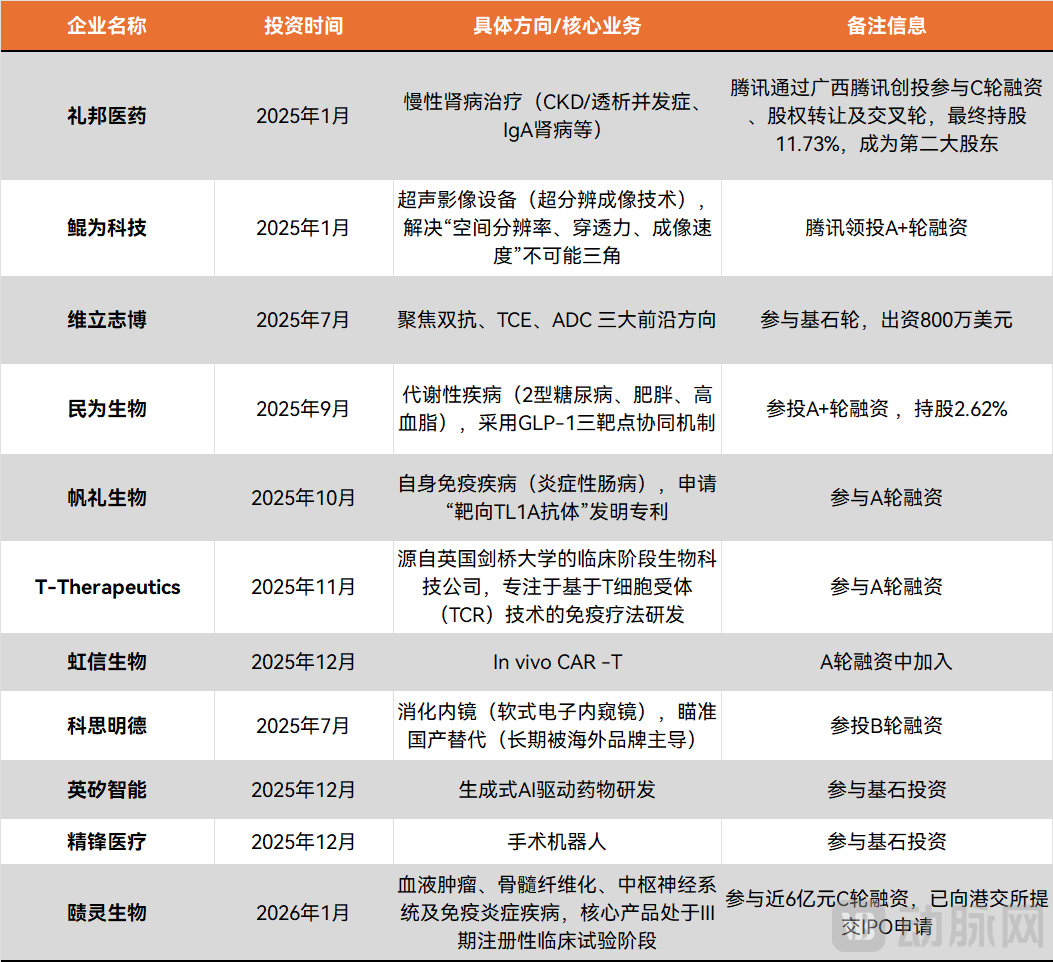
Medical Enterprises Invested by Tencent from January 2025 to January 2026
Which Healthcare Tracks Is Tencent Investing In?
In the field of innovative drugs, Tencent has a wide-ranging investment layout. In 2025, Tencent invested in Hongxin Biotech, Fanli Biotech, T-Therapeutics, and Minwei Biotech, further expanding its presence in the industry.In vivo CAR-T, Autoimmune Potential Target TL1A, TCE Immunotherapy, Weight Loss MetabolismTrack.
In the weight loss and metabolism sector, Tencent has successively invested in two companies, Xianweida Bio and Minwei Bio.
GLP-1 Drugs with 10%-25% Weight Loss Effects Quickly Create a Near-Trillion-Dollar Market, Becoming the Focus of the Pharmaceutical Industry. Among Many Targets, the Weight Loss Drug Companies Invested in by Tencent Compete to Rank in the First Tier in China: Leading Product Progress, Outstanding Clinical Data, and Endorsement from MNC Enterprises' BD.
The two GLP-1 companies invested in by Tencent also have significant differences, focusing on different targets. Among them,Xianweida Bio's Enotuglutide is the world's first biased GLP-1 receptor agonist, primarily functioning through the cAMP pathway rather than the common β-arrestin pathway. Enotuglutide (brand name: Xianweiying®) has been approved for marketing in China, with clinical data showing significantly better efficacy compared to Semaglutide. Pfizer China acquired the commercial rights to this product in China for $495 million.
Minsheng Bio was the first to occupy the technological high ground of triple-targeting.Its GLP-1/GIP/FGF21 receptor triple agonist MWN105 has reached an overseas licensing collaboration with a subsidiary of Novo Nordisk. The product has entered Phase II clinical trials in China.
The field of immunotherapy is also a promising track that Tencent is optimistic about.Immunotherapy is a treatment method that activates or enhances the function of the human immune system, enabling it to recognize and eliminate abnormal cells (such as cancer cells). After years of development, immunotherapy has formed a pattern of multi-technology pathway synergy, with CAR-T and TCE (T-cell engagers) being the two most focused core tracks. Other emerging directions include TCR-T, TIL, and cancer vaccines.
Tencent has laid out three tracks in the field of immunotherapy: In vivo CAR-T, TCE, and TCR-T, achieving a comprehensive layout in immunotherapy.
The In Vivo CAR-T Field is Heating Up: Tencent Invests in Industry Leader Hongxin Biotech. In Vivo CAR-T has the potential to overcome the limitations of traditional CAR-T therapy, which is known for its long cycle and high cost, bringing new breakthroughs in the treatment of cancer, autoimmune diseases, and more. This field will see a wave of business development (BD) activity by 2025, with Hongxin Biotech leading the way. Their In Vivo CAR-T using the mRNA-LNP approach has officially entered the clinical research stage and achieved clinical validation in humans for the first time, marking a milestone breakthrough in the industry.
TCE Route: Tencent Investment participated in the cornerstone investment of "TCE's First Stock" Weilizhibo. TCE therapy works by utilizing the body's own T cells to recognize and kill cancer cells. The design principle is to simultaneously bind to tumor-associated antigens (TAA) on tumor cells and receptors on T cells, thereby directing to tumor tissues and activating T cells to induce targeted cytotoxic effects. TCE uses "antibodies as a bridge to enable existing T cells in the body to attack tumors" without modifying T cells. This field has active BD transactions. The core product of Tencent-invested Weilizhibo, LBL-034, is the world’s second most advanced clinical GPRC5D-targeting TCE. Its clinical data rivals CAR-T therapy, with better safety advantages, and it has been selected for an oral presentation at the 2025 ASH.
TCR-T Route: Tencent and Sanofi Co-invest in an Overseas Company, T-Therapeutics. TCR-T involves genetically engineered T cells, where the TCR (T-cell receptor) on the T-cell surface is modified to recognize intracellular antigens within tumor cells. TCR-T equips T cells with navigation capabilities, enabling them to locate hidden tumor antigens, which requires genetic modification of T cells. In this area, Tencent participated in the Series A financing round of the overseas company T-Therapeutics. T-Therapeutics' TCR platform, OpTiMus®, can generate an almost unlimited number of highly specific, fully human TCRs, thereby targeting intracellular targets that have been validated but were previously undruggable.
Shenzhen Tencent Computer System Co., Ltd. adopts a "casting a wide net" strategy in the high-risk, innovation-driven pharmaceuticals sector with numerous competitive tracks. However, it typically times its investments after the completion of proof-of-concept and when multinational corporations (MNCs) become active in business development (BD), thereby avoiding the uncertainties associated with the early-stage research and development phase.
In the medical device field, Tencent invested in Kunwei Technology, Boma Medical, and Kesmingde in 2025, covering tracks such as ultrasound imaging, interventional balloons, and endoscopes.In the field of medical devices, Tencent prefers commercially mature sectors.The global market scale for interventional balloons, endoscopes, and other sectors exceeds tens of billions of yuan. The commercialization has been fully validated, and the market is in a period of rapid growth. At the same time, the investment targets of Tencent generally possess global commercialization capabilities, with a relatively high proportion of overseas revenue. For instance, Bomai Medical's vascular interventional balloons account for more than 50% of domestic brands, with overseas revenue contributing over half of its total revenue.
Tencent Invests in Medical Device Targets, Focusing on Both Innovative Assets and Manufacturing Capabilities.The core capabilities of the aforementioned companies invested in by Tencent are not only about innovating Class III medical device certificates but also include large-scale supply and manufacturing capabilities, which are typically difficult to replicate quickly in a short period.
Investment in people is also a key consideration in medical investment. From this perspective,Among Tencent's investment targets, the founding teams of multiple companies have a background combining top investors and scientists.For example, Elpiscience Biopharma was founded by Xiaohui Ji, former partner of Lilly Asia Ventures, and Hongtao Lu, a renowned immunologist who has深耕ed in tumor immunology for many years at top institutions in the United States. Additionally, the founder of Xenoval, Jing Qiang, is a seasoned investor who participated in the IPOs of large pharmaceutical companies such as Sinopharm, China Resources, and Fosun.
The combination of top investors and scientists provides double insurance for innovative drug IPOs, ensuring the technological leadership of innovative drug companies. The participation of investors also reduces obstacles during the listing process, bringing smoother financing and listing channels, helping to quickly establish management systems, and accelerating corporate growth.
Tencent has been involved in medical investment for over a decade. Its long-term and continuous commitment to the medical industry has enabled Tencent to acquire high-certainty assets during industry downturns and secure leading companies in popular sectors. The medical industry's ongoing evolution and ability to transcend cycles have also rewarded this sustained investment.