

Diega Tech Launches Remote AI-Assisted Diagnostic System with 94% Accuracy in Breast Ultrasound Analysis via Mobile Upload

iterative
Intelligent Medical Product R&D Manufacturer
Currently, the main track of medical AI in China seems to be saturated, but there are still some hidden gems waiting to be discovered in the market. Iterative is one of them. Founded at the end of 2018, Iterative is a remote intelligent diagnostic assistance platform. Within six months, they successfully developed an intelligent diagnostic system capable of automatically analyzing breast ultrasound images and providing real-time feedback. This system boasts an accuracy rate as high as 94%, surpassing experienced sonographers.
Today, Iterative has developed a comprehensive suite of AI-powered products spanning fields such as breast lesion diagnosis and characterization of thoracic diseases. These solutions enable rapid diagnosis and risk assessment for conditions including retinopathy, macular edema, infant health risk indicators, breast and thyroid nodules, and cytopathology. To gain deeper insights into the company, VCBeat conducted an exclusive interview with Dr. Chen Wei, CEO and Co-Founder of Iterative.
# DeepBC: The First AI-Powered Ultrasound Diagnostic System for Breast Cancer on Mobile Devices in ChinaDeepBC is the first system in China to provide intelligent diagnosis of breast ultrasound images via mobile devices. After receiving their ultrasound images and reports, patients can conduct a secondary review through the "Breast Cancer Ultrasound Intelligent Detection System" available on the "Iterative Technology" WeChat official account. By uploading photos of their ultrasound images taken with a smartphone, patients enable the system to automatically analyze the images and provide immediate feedback, allowing them to view the diagnostic report directly on their phones. This system offers a "secondary safeguard" for diagnostic accuracy, helping to prevent missed diagnoses.
Breast cancer is one of the most prevalent malignant tumors affecting women's health. According to 2012 data from GLOBOCAN (Global Cancer Observatory), although the incidence rate of breast cancer among Chinese women is relatively low on a global scale, China’s large population base means that its number of new cases and deaths account for 11.2% and 9.2% of the global totals, respectively, ranking among the highest worldwide. Early prevention of breast cancer is therefore critically important. Currently, early therapeutic intervention remains the cornerstone of breast cancer control.
Breast tissue is superficially located with minimal interference factors, making breast ultrasound a commonly used method for breast cancer screening. Dr. Chen Wei stated, "The current challenge is that physicians in large hospitals are overwhelmed by their daily workload and cannot dedicate time to specifically interpret color Doppler ultrasound images for patients." Furthermore, the interpretation of color Doppler ultrasound relies heavily on physicians' individual experience and clinical expertise; physicians in primary care hospitals may have slight deficiencies in experience and diagnostic capability.
“In a sense, artificial intelligence can be regarded as replicating the expertise of specialists.” Dr. Chen Wei explained to VCBeat that the DeepBC intelligent diagnostic system for breast cancer ultrasound can prevent misdiagnoses resulting from physicians’ limited experience and address the shortage of sonographers.
Three Major Modules + 8,145 Samples
DeepBC: An Intelligent Ultrasound Diagnostic System for Breast CancerThe DeepBC intelligent ultrasound diagnostic system for breast cancer is built upon artificial intelligence deep neural networks. It provides sonographers with rapid and reliable computer-aided diagnosis for differentiating between benign and malignant breast lesions on ultrasound. The system comprises three core modules: an image denoising module, an image classification module, and a missed-diagnosis prevention module.
The image denoising module can significantly mitigate the impact of factors such as elastic deformation, tilt, noise, poor lighting conditions, and motion blur during mobile phone photography; the image classification module enables granular categorization of color Doppler ultrasound images; and the missed-diagnosis prevention module, leveraging adversarial learning algorithms, effectively reduces the rate of missed diagnoses for malignant breast lesions.
Missed diagnosis is a major challenge in breast cancer diagnosis. The DeepBC intelligent ultrasound diagnostic system for breast cancer is a specialized anti-missed-diagnosis system developed based on adversarial learning algorithms. It performs secondary diagnosis on ultrasound images with indistinct features of malignant breast lesions, reducing the missed diagnosis rate by 59.46%.
Three Major Modules Give DeepBC, the Intelligent Ultrasound Diagnostic System for Breast Cancer, a Technological Edge, While Authoritative Data Sources Strengthen Its Credibility in Assisted Diagnosis.
Dr. Chen Wei introduced that Iterative, backed by West China Hospital, has collected 8,145 samples from 2,667 patients. These data were annotated by authoritative experts in the Department of Breast Surgery at West China Hospital, thereby establishing a robust database with all annotations verified against pathological examination results. The substantial volume of data has led to exceptionally high diagnostic accuracy. In comparative tests against human physicians, the DeepBC breast cancer diagnosis system demonstrated significant superiority, achieving an accuracy rate of 94.48%. Furthermore, Iterative has established close collaborations with multiple expert teams, including Sichuan University and the Children's Nursing Hospital affiliated with West China Provincial Hospital.
It is understood that the fee for the DeepBC intelligent ultrasound diagnostic system for breast cancer is RMB 100 per scan. Iterative has cleared the way for the market promotion of the DeepBC system by collaborating with Quick Ask Doctor, multiple internet hospital platforms, and physical hospitals such as West China Hospital and Sichuan Provincial People's Hospital. Since entering the market in early 2019, the system’s consumer base has expanded to cover more than 20 provinces and municipalities across China, accumulating over 100,000 users.
Dr. Chen Wei also mentioned that Iterative is developing a breast cancer risk prediction model. The model’s product is a questionnaire comprising 16 questions, developed by experts from West China Hospital and other medical institutions. Iterative will leverage this model to expand its business into full-lifecycle breast health management, thereby achieving comprehensive coverage across the entire industrial chain of health management services.
Dr. Chen Wei told VCBeat that Iterative has conducted in-depth research on intelligent medical big data and developed a series of intelligent medical products.
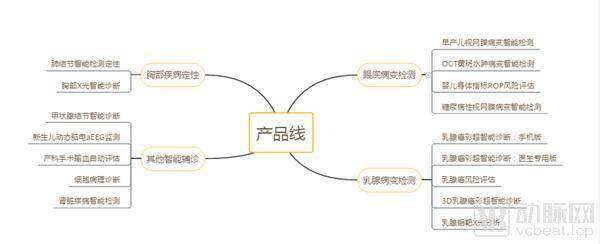
Iterative's Product Line
The breadth of Iterative’s product portfolio is closely tied to the capabilities and experience of its founding team.
Dr. Chen Wei introduced that the team at Iterative mainly consists of three parts: a management team with extensive operational experience, an artificial intelligence technology team from Sichuan University, and a team of doctors composed of top experts from hospitals such as West China Hospital.
In late 2018, with the support of Sichuan University, members of the Machine Intelligence Laboratory (MILab) at Sichuan University founded Iterative Technology. Subsequently, centered around Professor Zhang Yi, Dean of the School of Computer Science at Sichuan University, and leveraging the Machine Intelligence Laboratory (MILab), Iterative Technology brought together top-tier domestic and international experts and high-end talent in the fields of artificial intelligence and healthcare. The company aims to gradually apply research achievements to more hospitals, utilizing AI technology to address technical challenges and resource constraints within the existing healthcare system.
It is reported that the Machine Intelligence Laboratory (MILab), founded by Professor Zhang Yi, has won multiple international competitions. On April 19, the MILab team claimed the championship in the global LiTS medical imaging competition, setting a new record in the Liver and Tumor Segmentation Challenge (LiTS). This record was previously held by top-tier artificial intelligence teams such as Tencent Youtu Lab and Jianpei Technology. Building on its existing strong performance, MILab further raised the Dice coefficient for AI-based tumor segmentation.
Currently, Iterative boasts expert teams from West China Hospital of Sichuan University, Sichuan Provincial People’s Hospital, Chengdu Military Region General Hospital, and Chengdu Women’s and Children’s Central Hospital. By deeply understanding physicians’ needs and patients’ experiences, the company leverages these insights to develop its artificial intelligence products.
“‘Achieving AI-embedded hardware technology and integrating it into medical devices’ is the short-term goal of Iterative,” Dr. Chen Wei revealed to VCBeat. In the future, Iterative will focus on building an AI product R&D ecosystem, establishing a complete “data-technology-industry” value chain, deepening its presence in the Chinese market while expanding into international markets. Dr. Chen further disclosed that Iterative is currently undergoing angel-round financing to strengthen product development and promotion efforts, as well as to attract top talent and bolster its team capabilities.