

FDA Approves Turalio (Pexidartinib), the First Therapy for Rare Joint Tumor TGCT
Aug 03, 2019 14:03
CST Updated
14:03

FDA
U.S. Food and Drug Administration

Daiichi-Sankyo
Pharmaceutical R&D Developer

August 03, 2019 News /Bio ValleyBIOON/ -- Japanese pharmaceutical company Daiichi Sankyo’s targeted anticancer drug Turalio (pexidartinib capsules) recently received approval from the U.S. Food and Drug Administration (FDA) approved for the treatment of adult patients with symptomatic tenosynovial giant cell tumor (TGCT) who have severe morbidity or functional limitations and are not candidates for surgical improvement. TGCT is a rare tumor that affects the synovium and tendon sheaths, thisTumorMalignant cases are rare, but the condition can lead to thickening or overgrowth of the synovium and tendon sheaths, causing damage to surrounding tissues.
Notably, this approval makes Turalio the first and only drug approved for the treatment of TGCT. Turalio was approved through the FDA’s Priority Review program and had previously beenFDAGranted Breakthrough Therapy Designation and Orphan Drug Designation for the treatment of TGCT. Currently, Turalio is also under review by the European Medicines Agency (EMA), having previously been granted Orphan Drug Designation by the EMA for the treatment of TGCT.
It is important to note that the Turalio drug label includes a boxed warning alerting healthcare professionals and patients to the risk of severe and potentially fatal liver injury. Prior to initiating treatment, healthcare professionals should assess patients’ liver function tests, and monitoring should continue at specified intervals during therapy. If liver tests become abnormal, Turalio treatment may need to be interrupted, the dose reduced, or permanently discontinued, depending on the severity of liver injury. Turalio is available only through the Turalio Risk Evaluation and Mitigation Strategy (REMS) program. The most common side effect observed in patients receiving Turalio is elevated lactate dehydrogenase (LDH).Elevated levels, elevated aspartate aminotransferase (AST), lightening of hair color, elevated alanine aminotransferase (ALT), and elevated cholesterol.
FDAIt is recommended that healthcare professionals advise women of childbearing potential and male patients with female partners of childbearing potential to use effective contraception during treatment with Turalio. Pregnant or breastfeeding women should not take Turalio, as it may cause harm to the developing fetus or newborn. A Medication Guide describing important information about the drug’s uses and risks must be dispensed with each prescription of Turalio.
Director of the FDA Office of Oncology Excellence,FDARichard Pazdur, Executive Director of the Office of Hematology and Oncology Products at the Center for Drug Evaluation and Research, stated: “TGCT can cause debilitating symptoms in patients, such as pain, stiffness, and limited mobility. This tumor can significantly impact patients’ quality of life and lead to severe disability. Surgery is the primary treatment option; however, some patients are not suitable candidates for surgery, even postoperatively.”Tumormay also relapse. Today’s approval marks the first therapy for this rare diseaseFDAApproved therapies.”
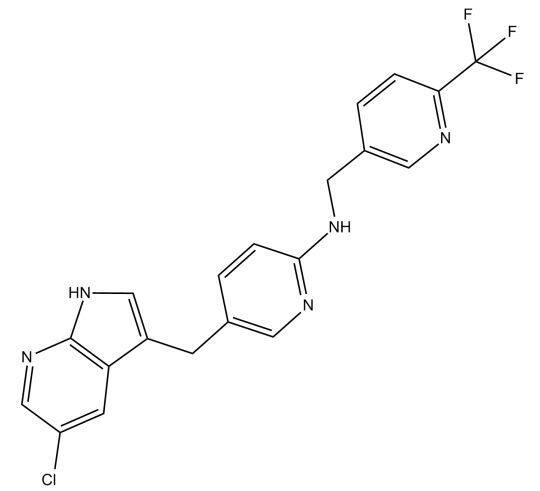
Molecular Structure of Pexidartinib (Image Source: apexbio.cn)
The active pharmaceutical ingredient of Turalio is pexidartinib, a novel oral small molecule discovered by Plexxikon, the small-molecule structure-guided discovery center of Daiichi Sankyo. It effectively inhibits colony-stimulating factor 1 receptor (CSF1R), the primary growth driver of the abnormal cells in the synovium associated with tenosynovial giant cell tumor (TGCT). Additionally, pexidartinib also inhibits c-kit and FLT3-ITD.
January 31, 2019, U.S. ClinicalTumorThe American Society of Clinical Oncology (ASCO) designated “Advances in Rare Cancer Treatment” as the “Advance of the Year” and selected pexidartinib as one of the top five advances in rare disease treatment, hailing it as the first promising therapy for tenosynovial giant cell tumor (TGCT).
FDAApproval of Turalio, based on data from the pivotal Phase III ENLIVEN study. This was the first placebo-controlled study evaluating a systemic therapy in patients with tenosynovial giant cell tumor (TGCT), enrolling a total of 120 patients, of whom 59 received placebo. The primary efficacy endpoint was the overall response rate (ORR) analyzed at 25 weeks of treatment. Data showed that, assessed using Response Evaluation Criteria in Solid Tumors version 1.1 (RECIST v1.1), the ORR at Week 25 was 38% in the oral pexidartinib group versus 0% in the placebo group, demonstrating a statistically significant difference (p < 0.0001) and meeting the study’s primary endpoint. In the pexidartinib group, the complete response (CR) rate was 15% and the partial response (PR) rate was 23%. Among the 23 patients who achieved a response, with a minimum follow-up of 6 months, 22 patients maintained their response for ≥6 months. Among the 13 patients with a minimum follow-up of 12 months, all patients maintained their response for ≥12 months.
Tenosynovial Giant Cell Tumor (TGCT), also known as Pigmented Villonodular Synovitis (PVNS) or Giant Cell Tumor of the Tendon Sheath (GCT-TS), is a rare, typically benign tumor of the joints or tendon sheaths, with some cases exhibiting locally aggressive behavior. TGCT affects synovial joints, bursae, and tendon sheaths, leading to swelling, pain, stiffness, and reduced mobility in the affected joints or limbs. Patients are typically diagnosed between the ages of 20 and 50, depending on the TGCT subtype, with women being more commonly affected.SwellingThe likelihood is twice as high in males.
TGCT is classified into two types: localized (90%) and diffuse (10%). The recurrence rate of localized TGCT after complete resection is approximately 15%, while that of diffuse TGCT after complete resection is approximately 20-50%. Currently, the primary treatment for TGCT includes surgical tumor resection. However, for recurrent, difficult-to-treat, orTumorIn patients with diffuse-type tenosynovial giant cell tumor (TGCT) involving the bones, tendons, ligaments, and other joint structures, surgical resection is more challenging or may fail to yield improvement. In more severe cases, additional surgeries may lead to serious joint damage, debilitating functional impairment, reduced quality of life, and amputation. (Bioon.com)
Original source:FDA approves first therapy for rare joint tumor