

Bayer Launches Nubeqa (Darolutamide) in the U.S. for Non-Metastatic Castration-Resistant Prostate Cancer
Aug 03, 2019 14:03
CST Updated
14:03

Bayer
Pharmaceutical Product R&D Developer

August 03, 2019 News /BioValleyBIOON/ -- German pharmaceutical giantBayer(Bayer) recently announced the launch of its new anticancer drug Nubeqa (darolutamide) in the U.S. market for the treatment of non-metastatic castration-resistant prostate cancer (nmCRPC). This medication will provide clinicians with a new therapeutic option that can significantly prolong metastasis-free survival in patients with nmCRPC. Nubeqa is an oral non-steroidal androgen receptor (AR) inhibitor, which received approval in late JulyFDAApproved, for use inTumorPatients with prostate cancer that has not yet spread to other parts of the body and no longer responds to medical or surgical treatments aimed at lowering testosterone levels.
Nubeqa features a unique chemical structure that binds to the receptor with high affinity, exhibiting potent antagonistic activity, thereby inhibiting receptor function and the growth of prostate cancer cells. Unlike other existing treatments for nmCRPC, Nubeqa does not cross the blood-brain barrier, resulting in fewer potential drug interactions and central nervous system side effects (such as seizures, falls, and cognitive impairment).
FDAApproval of Nubeqa was based on data from the pivotal Phase III ARAMIS study. The results demonstrated that, in patients with non-metastatic castration-resistant prostate cancer (nmCRPC), darolutamide plus androgen deprivation therapy (ADT) significantly prolonged metastasis-free survival (median MFS: 40.4 months vs. 18.4 months; p < 0.0001) and reduced the risk of metastasis or death by 59% compared with placebo plus ADT. Darolutamide plus ADT exhibited a favorable safety profile in this study.
Nubeqa was co-developed by Bayer and the Finnish pharmaceutical company Orion. In addition to nmCRPC, the two companies are also advancing another Phase III clinical trial, ARASENS, to evaluate the efficacy and safety of darolutamide in the treatment of metastatic hormone-sensitive prostate cancer (mHSPC).
Castration-resistant prostate cancer (CRPC) refers to prostate cancer that continues to progress despite androgen deprivation therapy (ADT) when testosterone levels in the body are reduced to very low levels. In the United States, it is estimated that more than 73,000 men will be diagnosed with CRPC in 2019. Approximately one-third of non-metastatic (nmCRPC)Metastasis occurred in the patient within two years. Patients with nmCRPC typicallyIn the absence of disease symptoms, the primary treatment goal is to delay the spread of prostate cancer and limit treatment-related side effects.
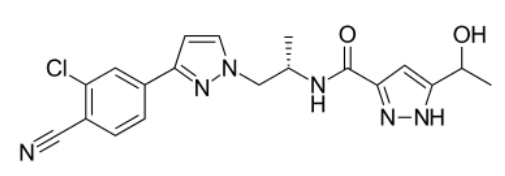
Molecular structure of darolutamide (Image source: Wikipedia)
ARAMIS is a randomized, multicenter, double-blind, placebo-controlled study that enrolled 1,509 patients who were receiving androgen deprivation therapy (ADT) as standard of care and were at high risk for metastatic disease. In the study, patients were randomized in a 2:1 ratio to two groups to receive either darolutamide (600 mg twice daily) or placebo, concurrently with ADT. The primary endpoint was metastasis-free survival (MFS), defined as the time from randomization to evidence of metastasis or death. Secondary endpoints included overall survival (OS), time to pain progression, time to initiation of first cytotoxic chemotherapy, time to first symptomatic skeletal event (SSE), and the safety and tolerability profile of darolutamide.
The results showed that, compared with the placebo + ADT group, the darolutamide + ADT group achieved a statistically significant improvement in MFS (HR = 0.41, 95% CI: 0.34–0.50, p < 0.001), indicating a 59% reduction in the risk of metastasis or death, thereby meeting the primary endpoint of the study. The median MFS was 18.4 months in the placebo + ADT group versus 40.4 months in the darolutamide + ADT group, representing an overall extension of median MFS by 22 months.
Regarding overall survival (OS), the darolutamide + ADT regimen demonstrated a favorable trend compared with the placebo + ADT group, with a 29% reduction in the risk of death (HR = 0.71; 95% CI: 0.50–0.99; p = 0.045). In terms of progression-free survival (PFS), the darolutamide + ADT regimen significantly prolonged PFS compared with the placebo + ADT group (median PFS: 36.8 months vs. 14.8 months; HR = 0.38; 95% CI: 0.32–0.45; p < 0.001), reducing the risk of local progression, distant metastasis, or death by 62%.
Furthermore, all other secondary endpoints favored darolutamide, including time to pain progression (40.3 months vs. 25.4 months; HR=0.65, 95% CI: 0.53–0.79, p<0.001) and time to cytotoxic chemotherapy (not reached vs. 38.2 months; HR=0.43, 95% CI: 0.31–0.60, p<0.001). Another secondary endpoint, time to first symptomatic skeletal event (SSE), also favored darolutamide.Importantly, the incidence of treatment-emergent adverse events (AEs) with an occurrence rate ≥5% or Grade 3–5 was comparable between the two groups; only fatigue occurred in more than 10% of patients (12.1% in the darolutamide group vs. 8.7% in the placebo group), and quality-of-life outcomes were similar between the two groups. (Bioon.com)