

Deucravacitinib (BMS-986165): A Highly Selective TYK2 Inhibitor for the Treatment of Autoimmune and Chronic Inflammatory Diseases
Aug 04, 2019 16:43
CST Updated
16:43

Bristol-Myers Squibb
Biopharmaceutical and Nutritional Product R&D and Sales
August 4, 2019 /Bio ValleyBIOON/---Despite recent advances in the treatment ofAutoimmunityAdvances in the treatment of diseases and chronic inflammatory conditions have provided significant benefits to some patients; however, unmet medical needs remain high for many patients, particularly those suffering from these debilitating diseases, who require better efficacy and robust disease remission.
Furthermore, many therapies representing the current standard of care present safety concerns that either limit their long-term use (e.g., glucocorticoids) or are associated with a significant compromise in host defenses, which can lead to severe infections or an increased risk of malignancy.TumorRisk.
Tyrosine kinase 2 (TYK2) is a non-receptor tyrosine kinase that regulates the signal transduction pathways downstream of the interleukin-23 (IL-23), IL-12, and type I interferon (IFN) receptors. These cytokine/receptor axes activate the functions of T helper 17 (TH17) cells, TH1 cells, B cells, and myeloid cells, wherein these cells are involved inAutoimmunityDiseases and Chronic Inflammatory Diseases---Including SystemicLupus Erythematosus(SLE), lupus nephritis, Sjögren's syndrome, Crohn's disease, psoriasis, and systemic sclerosis play a key role in the pathobiology of ---.
A variant has recently been identified that causes the proline residue at position 1104 in the TYK2 catalytic domain to be substituted by alanine, thereby blocking receptor-mediated TYK2 activation. In a previous meta-analysis of genome-wide association studies, this loss-of-function P1104A variant was shown to prevent multipleAutoimmunityDiseases, including multiple sclerosis, Crohn's disease, ulcerative colitis, ankylosing spondylitis, and psoriasis, and for this variant, the gene dosage effect is significantly greater than the additive effect in the homozygous state. This same loss-of-function variant may also prevent systemicLupus Erythematosus, ClassRheumatoid Arthritis, Type 1Diabetes, and may also prevent systemic sclerosis. The homozygosity of this variant is not associated with an increased risk of hospitalization due to mycobacterial, viral, or fungal infections, suggesting that leveraging novel therapies to inhibit TYK2 activation may achieve an optimal balance between efficacy and safety.
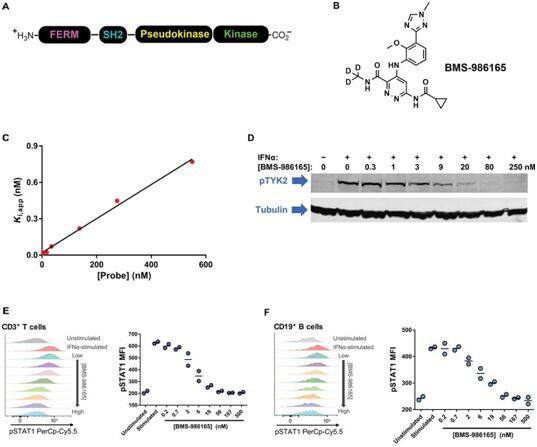
TYK2, a complex multi-domain protein related to the Janus kinases JAK1, JAK2, and JAK3, participates in regulating intermolecular and intramolecular interactions that mediate receptor-induced activation of its catalytic domain. Its pseudokinase domain (also known as the JH2 domain) is evolutionarily related to kinases but lacks catalytic activity. Instead, this domain plays a key role in regulating receptor-mediated activation of the adjacent catalytic domain through autoinhibitory interactions. Researchers at Bristol-Myers Squibb Company previously reported the use of small-molecule ligands to stabilize the TYK2 pseudokinase domain in a conformational state that inhibits receptor-mediated TYK2 activation and catalytic domain activity by preventing the autoinhibitory interaction between the pseudokinase and kinase domains. This stabilization leads to the blockade of downstream signal transduction and STAT (signal transducers and activators of transcription)-dependent gene transcription, recapitulating the protective mechanism against various autoimmune and chronic inflammatory diseases provided by the P1104A coding variant.
Given that targeting this pseudokinase domain also offers a strategy for developing highly selective inhibitors of TYK2-mediated signaling pathways, in a new study, researchers from Bristol-Myers Squibb Company focused their drug discovery efforts on the TYK2 pseudokinase domain to identify potential therapeutic agents for treating autoimmune diseases and chronic inflammatory disorders. The relevant findings were recently published in Science Translational Medicine under the title “Autoimmune pathways in mice and humans are blocked by pharmacological stabilization of the TYK2 pseudokinase domain”.
These researchers reported that the highly selective agent BMS-986165 inhibited autoimmune pathways in cells in preclinical models of lupus nephritis and inflammatory bowel disease, and in Phase I trials involving healthy volunteersClinical Trial, it also suppresses the SLE-like gene signature induced by exposure to type I interferons.
In summary, these findings suggest that BMS-986165 has the potential to treat various immune-mediated diseases. (Bioon.com)
References:
James R. Burke et al. Autoimmune pathways in mice and humans are blocked by pharmacological stabilization of the TYK2 pseudokinase domain. Science Translational Medicine, 2019, doi:10.1126/scitranslmed.aaw1736.
Furthermore, many therapies representing the current standard of care present safety concerns that either limit their long-term use (e.g., glucocorticoids) or are associated with a significant compromise in host defenses, which can lead to severe infections or an increased risk of malignancy.TumorRisk.
Tyrosine kinase 2 (TYK2) is a non-receptor tyrosine kinase that regulates the signal transduction pathways downstream of the interleukin-23 (IL-23), IL-12, and type I interferon (IFN) receptors. These cytokine/receptor axes activate the functions of T helper 17 (TH17) cells, TH1 cells, B cells, and myeloid cells, wherein these cells are involved inAutoimmunityDiseases and Chronic Inflammatory Diseases---Including SystemicLupus Erythematosus(SLE), lupus nephritis, Sjögren's syndrome, Crohn's disease, psoriasis, and systemic sclerosis play a key role in the pathobiology of ---.
A variant has recently been identified that causes the proline residue at position 1104 in the TYK2 catalytic domain to be substituted by alanine, thereby blocking receptor-mediated TYK2 activation. In a previous meta-analysis of genome-wide association studies, this loss-of-function P1104A variant was shown to prevent multipleAutoimmunityDiseases, including multiple sclerosis, Crohn's disease, ulcerative colitis, ankylosing spondylitis, and psoriasis, and for this variant, the gene dosage effect is significantly greater than the additive effect in the homozygous state. This same loss-of-function variant may also prevent systemicLupus Erythematosus, ClassRheumatoid Arthritis, Type 1Diabetes, and may also prevent systemic sclerosis. The homozygosity of this variant is not associated with an increased risk of hospitalization due to mycobacterial, viral, or fungal infections, suggesting that leveraging novel therapies to inhibit TYK2 activation may achieve an optimal balance between efficacy and safety.
Image from Science Translational Medicine, 2019, doi:10.1126/scitranslmed.aaw1736.
TYK2, a complex multi-domain protein related to the Janus kinases JAK1, JAK2, and JAK3, participates in regulating intermolecular and intramolecular interactions that mediate receptor-induced activation of its catalytic domain. Its pseudokinase domain (also known as the JH2 domain) is evolutionarily related to kinases but lacks catalytic activity. Instead, this domain plays a key role in regulating receptor-mediated activation of the adjacent catalytic domain through autoinhibitory interactions. Researchers at Bristol-Myers Squibb Company previously reported the use of small-molecule ligands to stabilize the TYK2 pseudokinase domain in a conformational state that inhibits receptor-mediated TYK2 activation and catalytic domain activity by preventing the autoinhibitory interaction between the pseudokinase and kinase domains. This stabilization leads to the blockade of downstream signal transduction and STAT (signal transducers and activators of transcription)-dependent gene transcription, recapitulating the protective mechanism against various autoimmune and chronic inflammatory diseases provided by the P1104A coding variant.
Given that targeting this pseudokinase domain also offers a strategy for developing highly selective inhibitors of TYK2-mediated signaling pathways, in a new study, researchers from Bristol-Myers Squibb Company focused their drug discovery efforts on the TYK2 pseudokinase domain to identify potential therapeutic agents for treating autoimmune diseases and chronic inflammatory disorders. The relevant findings were recently published in Science Translational Medicine under the title “Autoimmune pathways in mice and humans are blocked by pharmacological stabilization of the TYK2 pseudokinase domain”.
These researchers reported that the highly selective agent BMS-986165 inhibited autoimmune pathways in cells in preclinical models of lupus nephritis and inflammatory bowel disease, and in Phase I trials involving healthy volunteersClinical Trial, it also suppresses the SLE-like gene signature induced by exposure to type I interferons.
In summary, these findings suggest that BMS-986165 has the potential to treat various immune-mediated diseases. (Bioon.com)
References:
James R. Burke et al. Autoimmune pathways in mice and humans are blocked by pharmacological stabilization of the TYK2 pseudokinase domain. Science Translational Medicine, 2019, doi:10.1126/scitranslmed.aaw1736.