

Smartphone "Listens" to Detect COPD! Luca Medical's "CoughSearch" Enters Innovation Fast Track, Completing Screening in 4 Minutes
Recently,A chronic obstructive pulmonary disease (COPD) auxiliary assessment software, aiming for a Class III certificate, has successfully entered the special review process for innovative medical devices in China.
This is the "CoughSearch: Chronic Obstructive Pulmonary Disease (COPD) Auxiliary Assessment Software" (hereinafter referred to as "CoughSearch") developed by Luca Healthcare.Its core value lies in: Smartphones collect the sound of coughing, combined with clinical symptoms, COPD detection can be completed within 4 minutes.
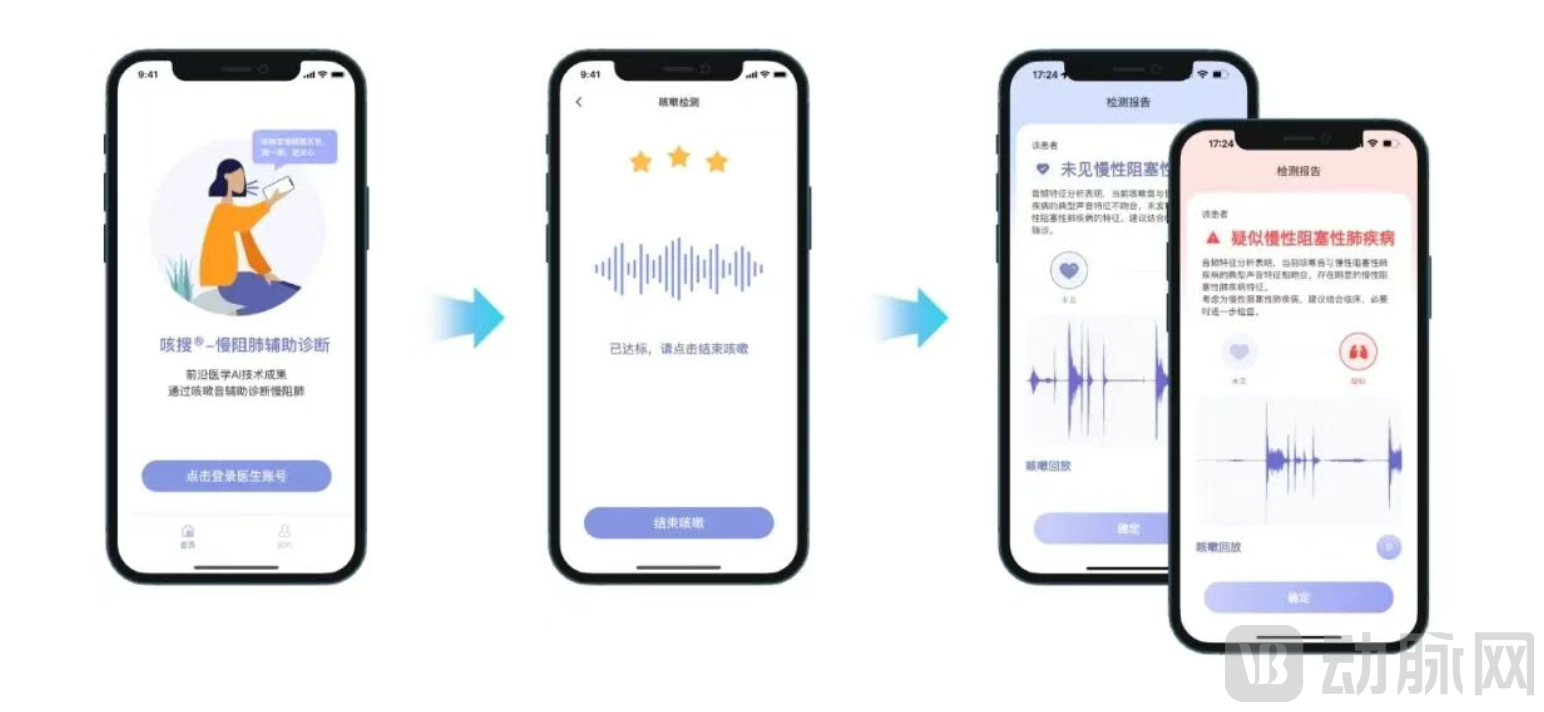
Source: Luca Healthcare Official Account
Using Cough Sounds as Digital Targets to Make COPD Screening Accessible
"Cough Sound" chooses cough sounds as the digital target for measuring COPD.
So-called digital endpoints refer to objective, quantifiable physiological and behavioral data collected and measured through digital devices. Such data can be used to explain, influence, and/or predict health-related outcomes. Devices that collect this type of data include commonly used smartphones and wearable devices. This kind of data is generally easier to access and allows for semi-continuous or continuous monitoring, thus receiving widespread attention in recent years.
"Kesou" chose cough sounds as a digital target for assessing COPD because the organic lesions in the airways of COPD patients can cause changes in cough sounds. For instance, narrowing and obstruction of the airways can alter the frequency distribution of cough sounds; large amounts of mucus adhering to the airway walls can affect the energy and clarity of cough sounds; and the loss of elasticity in lung tissue can influence the duration of coughing, the speed of energy rise, and peak height.
Based on this,The team developed and obtained an invention patent — "Audio Processing Method, Device, and Computing Equipment for Pulmonary Function Indicators." Based on this patent, "Cough Search" can predict FVC (Forced Vital Capacity, the total volume of air forcefully exhaled as quickly as possible after a deep inhalation), FEV1 (Forced Expiratory Volume in the first second), FEV1/FVC values, and ultimately provide corresponding final predicted values for at least one pulmonary function indicator.
The principle of this patent applied to the prediction of lung function indicators is as follows:
First, this patented technology can collect at least one audio clip from the user. This audio clip must include at least one of the following: "a first audio clip containing cough sounds," "a second audio clip containing blowing sounds," or "a third audio clip containing vowels." In addition to cough sounds, the reason this patent includes "blowing sounds" and "vowels" in its processing scope is to achieve more accurate and helpful prediction results.
Secondly, based on two key dimensions—determining the background noise threshold and identifying whether a cough is valid—the patented technology accurately extracts the cough envelope or effective blowing sounds and vowel segments from cough audio clips, thereby achieving more precise predictive results. Additionally, the patent provides a method for calculating background noise to pre-evaluate the user’s ambient noise environment. If the background noise is too loud, the system prompts the user to change locations to avoid affecting the audio recording quality during formal recording due to excessive noise.
Finally, after accurately extracting at least one valid audio segment of "cough sound," "blowing sound," or "vowel" and combining it with a machine learning model, the patented method can determine the corresponding final predicted value for at least one lung function indicator.
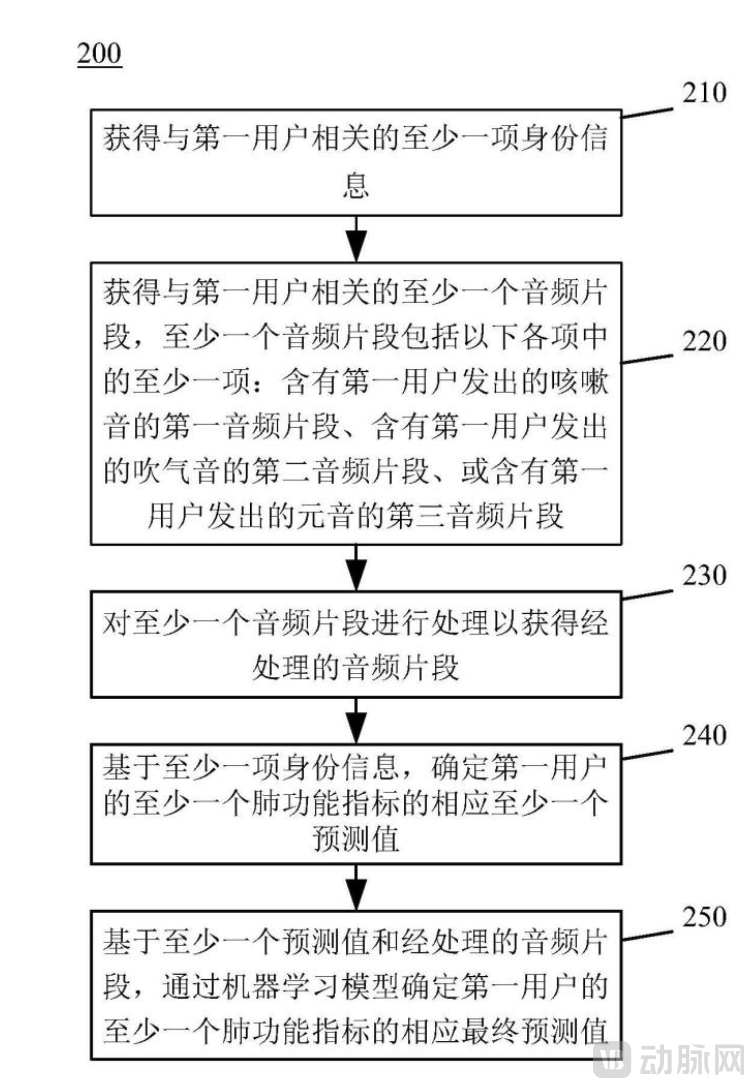
Source: "Audio Processing Method, Device, and Computing Equipment for Pulmonary Function Parameters" Patent Specification
In addition, the patented method can encode data containing personal identity information and supports other encoding methods, desensitization algorithms, or other data processing methods to anonymize personal information, thereby ensuring the legality and compliance of data collection, processing, and analysis.
Cross-device versatility promotes the widespread adoption of COPD screening.
After completing the technical development for precisely extracting cough sounds and/or other digital biomarkers to predict lung function, and given that the application goal of "Cough Search" is to improve the screening rate of respiratory diseases such as COPD, the team still faces the challenge of how to promote it on a large scale.
Looking further, the large-scale promotion of "Cough Search" mainly faces two major challenges: the first is how to make this technology feasible for large-scale application; the second is how to partner with more collaborators to accelerate its implementation after the "product" takes shape.
To this end, in terms of technical foundation,The team ensured that the patented technology of "predicting lung function using cough sounds" can be used on various client devices, including not only mobile and desktop computers but also mobile applications, wearable devices, and even lightweight WeChat mini-programs.This lays a solid foundation for using cough sounds to screen for COPD.
In addition, the team developed and obtained the invention patent for "A Multi-Modal Deep Learning Model with Enhanced Device Invariance and Its Application".After the cough audio tensors, symptom descriptions, and demographic text information are input through the input module and converted into vectors, the encoding module extracts audio features and text features. These are then processed by the modality fusion module to form the final joint representation, which is subsequently processed by the classification module to obtain classification results and corresponding probabilities. The final results are output by the output module.This model can achieve high-accuracy recognition of various respiratory system diseases, including COPD, without relying on specific brand acquisition devices, and demonstrates strong generalization and stability across multi-device and multi-center data.
According to enterprise reports, using the spirometry results from the COPD diagnostic guidelines as the gold standard for comparison, "Cough Search" achieved a sensitivity of 92% and a specificity of 89%. Additionally, in real-world testing across 33 centers, the stability and examination efficiency of "Cough Search" were validated—sensitivity reached 91%, examination efficiency increased threefold, and it demonstrated the ability to operate continuously and be implemented in complex environments and diverse populations.
According to the team, "CoughSearch" adopts the Transformer architecture and enhances cross-device and cross-environment generalization and stability through strategies like adversarial learning. This allows for better adaptation to various mobile phone models and audio capture devices, further broadening technical accessibility and improving the screening rate of respiratory system diseases, including COPD.
Collaborate with leading enterprises to accelerate the construction of a respiratory digital health ecosystem
In terms of ecological cooperation,According to publicly available corporate data, "Kesou" has reached a cooperation with leading industry platforms to accelerate the application landing process.
For example, as early as 2023, "Kesou" had already appeared in JD Health's online patient digital intelligence diagnosis project and was integrated into JD Health's online diagnosis and treatment system. In 2025, at the 2025 Inclusion·Bund Summit hosted by Ant Group, "Kesou" also appeared as an ecosystem partner of the then AQ platform of Ant Health Medical AI.
"Kesou" and Its Collaboration with JD Health and Ant Group: Building a Respiratory Digital Health SolutionThe collaboration between "Kesou," JD Health, and Ant Group reveals one of the key pathways for its practical application: partnering with digital health platforms to jointly construct a respiratory digital health solution covering "early screening - risk warning - online consultation - health management." Within this solution, users can not only promptly assess their respiratory health status but also swiftly access diagnostic and subsequent health management resources, thereby enjoying more efficient, convenient, seamless, and even smarter respiratory health management services.
As for whether "Kesou" will explore more landing forms after its official approval for marketing, we will wait and see.