

OpenClaw, the Next AI Hit in Hospitals?

Tencent
Internet Comprehensive Service Provider
The ultimate goal of medical AI is to create an Agent with the knowledge, logic, and judgment of a real doctor. Currently, no AI can reach this goal, but autonomous agents led by OpenClaw seem to have reached the threshold.
In the first wave of practice, some intelligent agents have entered the hospital system for trial, attempting to assist in hospital operations management or accelerate research output.
However, autonomous agents consume an extremely high number of tokens in inefficient configurations, and their outputs often deviate from expected patterns. There is also a risk of "loss of control" once AI gains system permissions, resulting in applications like OpenClaw lacking the capability for large-scale deployment in hospital settings.
Especially the "safety" red line, which has prompted some hospitals to issue a ban, strictly prohibiting the deployment of OpenClaw on their intranet.
Nevertheless, internet companies and medical IT enterprises have not given up on this emerging technology. Currently, Tencent has optimized its CodeBuddy for medical scenarios, Baidu is about to launch the first doctor version of "DoctorClaw," and many startups have quickly entered the market, introducing various "intelligent employees" designed for medical settings.
On one side are numerous users voicing their criticisms, while on the other side lies a new competitive arena for top tech companies. Amidst layers of uncertainty, will OpenClaw in medical scenarios be a fleeting phenomenon, or can it truly carve out a new path, offering fresh possibilities for large models to enter hospitals?
OpenClaw has attracted a large number of followers because its AI invocation concept is bold enough.
When using general models such as DouBao and YuanBao, users mostly utilize consulting services, meaning they send a request to the cloud-based large model, which then retrieves and outputs the required information from its own knowledge base. For more complex tasks, customized intelligent agents need to be built, requiring developers to possess development logic and be able to afford the construction costs at a certain scale.
By contrast, the difference with autonomous agents like OpenClaw is that they reside in the user's computer and gain system-level permissions. When correctly configured, it can access the computer’s files, think independently, plan actions autonomously, generate sub-agents, and thus methodically complete specific tasks assigned by the user, much like a real person.
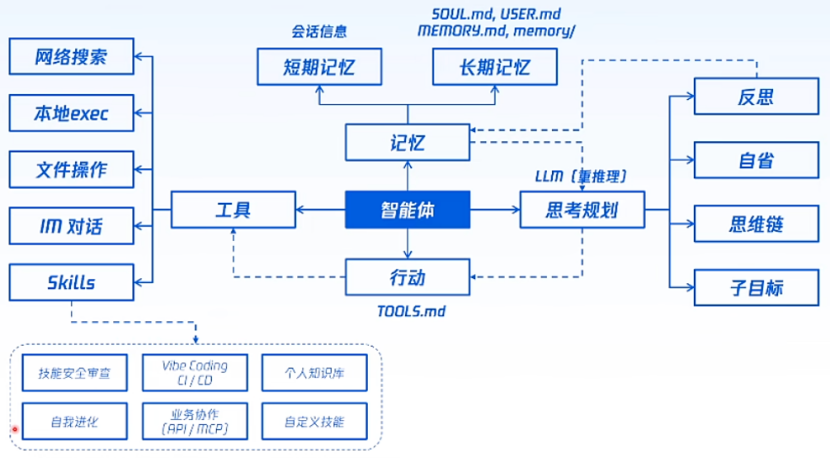
Core Capabilities of the OpenClaw Intelligent Agent (Image Source: Tencent Health)
From the current perspective,Such capabilities are particularly well-suited for the information department in hospital settings.。
In daily work, the limited IT staff need to face a large number of information systems developed by different developers. They have neither the time nor the ability to conduct real-time analysis and monitoring of massive amounts of information. The lack of operation and maintenance in hospital systems is a common phenomenon.
Compared with humans, the advantage of autonomous agents lies in their ability to easily navigate obscure backend computer commands, thus possessing stronger comprehension, response, and processing capabilities, which in turn compensates for deficiencies in system operation and maintenance.
When an urgent bug occurs online, in theory, the operations staff only need to send a command to the autonomous agent, invoking its backend AI programming capabilities, to directly fix the code. At the same time, it can quickly complete the entire process of testing, version release, and going live.
After specific training, AI can also be used to review security logs, identify high-risk vulnerabilities in hospital systems, and promptly notify maintenance personnel for repair.
If autonomous agents can be integrated into clinical workflows, their capabilities will be further amplified.
For example, medical staff in China have a large amount of paperwork in their daily work. For instance, after completing patient diagnosis and treatment, they need to make some written summaries, which is the main reason for many doctors' occupational burnout.
In this scenario, the value of intelligent agents like OpenClaw lies in acting as smart assistants, quickly retrieving information to generate content, allowing doctors to transition fromWriterTransform intoReviewer。
On the other hand,Every hospital will have "break points" in its business processes.", which means that when a doctor completes a task with the help of a computer, the next step lacks information system support and requires manual intervention before being entered into the next system.
Take email as an example. After doctors receive the email, they need to manually analyze the information in it and manually enter the information and forms that need to be processed into the system.
To address such "break points," hospitals in the traditional pathway need to introduce a new system that meets doctors' needs and then integrate it with the preceding and succeeding systems. Generally, implementing such a process incurs costs of hundreds of thousands of yuan and requires at least three months to go live.
Now, with the support of autonomous agents, doctors can configure requirements, and AI can independently process documents and extract key information, assisting doctors in data entry. This completes the "last mile" of the medical information system.
In addition, OpenClaw does not need to go through a heavy R&D process, allowing for quick and low-cost configuration, reducing the system optimization time to just a few days.
As for independent individual doctors, the current potential of autonomous agents still needs to be explored, with mainstream testing directions focusing on medical research and medical science popularization.
In terms of scientific research, while doctors diagnose and treat patients, they also assess whether the patients meet the inclusion criteria for clinical trials.
In this scenario, AI can consolidate complex medical records, and based on the inclusion criteria for clinical trials, quickly recommend eligible records to doctors for secondary decision-making. It can also identify records that trigger exclusion criteria, preventing unsuitable patients from being enrolled, thereby establishing the patient screening capability for clinical trials.
At the same time, autonomous intelligent agents can also help doctors read medical records in batches like previous AI research platforms, then extract corresponding indicator information, and form structured data to accelerate the writing of scientific research papers.
Compared with traditional AI platforms, OpenClaw can understand more flexible commands and further expand its functions through app markets like Clawhub.
The application in medical science popularization is similar to the application of OpenClaw in streaming media. After handing over the majority of video work to AI, doctors can focus on being sharers, thereby achieving the production of medical science popularization content.
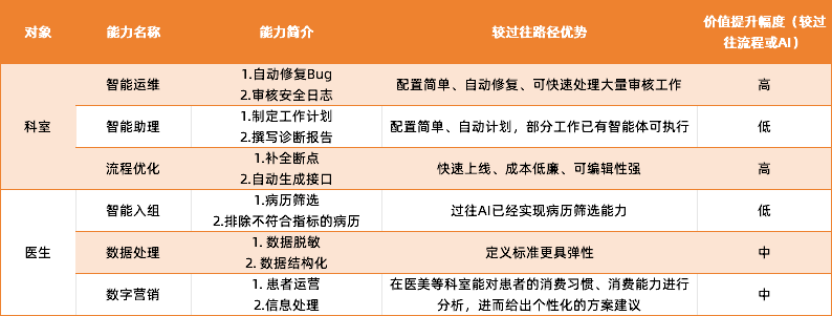
Summary of Application Scenarios for Autonomous Intelligent Agents
Beyond the aforementioned scenarios, autonomous intelligent agents can automatically generate system interfaces and write work plan codes in hospital settings; they also have broad application potential in outpatient scenarios such as patient profiling analysis (e.g., medical aesthetics, dentistry) and patient disease management.
Overall, autonomous agents like OpenClaw have lowered the operational barriers for related tasks and can handle jobs that were previously difficult for AI to access by leveraging system permissions.
In this process, it has not only found an incremental market in the hospital scenario but also achieved cost reduction, quality improvement, and efficiency enhancement for its existing business. With these advantages, OpenClaw has laid the commercial foundation to rival previous AI systems and is expected to become the first breakout AI product capable of generating revenue in hospitals.
Despite its many advantages, OpenClaw has only been online for 2 months, and many of its technologies are not yet mature. In serious scenarios such as healthcare, these flaws will significantly delay the deployment of autonomous agents, or even lead to their outright rejection by hospitals.
First, there are issues related to safety and capability. Deploying OpenClaw necessarily involves granting system authorization to the AI, but after authorization, in most cases, OpenClaw does not generate the programs users expect. Instead, it arbitrarily deletes or modifies system files in order to achieve the desired outcome.
Secondly, the explosive consumption of tokens after authorization is equally difficult to control. Even today, when token prices have dropped significantly, it is not uncommon for users to burn through thousands of yuan in a single night.
The aforementioned issues are not without solutions. The generation process conflicting with the goal is most likely due to the AI's failure to comprehend the requirements during configuration. As for security concerns, relevant enterprises need to tailor solutions for the new era of AI.
Zhou Tiance, Chief Solutions Architect of Tencent Health, believes: "The training of digital employees is the same as that of ordinary employees. First, their skills must be clarified, and the business scenarios covered by digital employees, the types of operations they can perform, and their boundaries must be determined."
What needs to be noted here is that there may be information bias in communication between people, and communication between humans and AI also requires adjustment. Therefore, users should...Repeatedly confirm requirements with the Agent., orLet it generate an outline in advance before execution., to avoid deviations.
"When the capabilities of an intelligent agent are clearly defined, its corresponding operational scope, system permissions, and authorization policies are naturally locked in, enabling precise matching of permissions and abilities. Conversely, deducing permissions in reverse from the asset side or the business side often results in complex authorization chains and blurred boundaries."
Kai Xue, Senior Product Director of Meichuang Technology, believes: currently...One of the most core issues in the implementation of the main intelligent agent is still the clear definition of the "authorization boundary."。
"Enterprises introducing digital employees is essentially like hiring an assistant position within the organization. What it can do, what it can access, and to what extent it can participate in business decision-making should fundamentally be subject to phased and standardized authorization based on job responsibilities."
"If this process is skipped, the capabilities of digital employees will be limited to basic actions such as querying and viewing, making it difficult to truly enter core business operations like execution, triggering, and decision support, and their value naturally cannot be fully realized."
Specifically, when users want OpenClaw to perform medical-related tasks, it is more appropriate to adopt the approach of "task decomposition + multi-agent collaboration" for implementation. In other words, a single agent should not directly undertake complex tasks; instead, the task should be broken down into multiple simple, clear, and verifiable steps, which are then executed by multiple agents respectively.
This approach not only transforms complex problems into standardized, high-frequency small tasks but also helps reduce the risk of agent hallucinations, preventing the continuous consumption of tokens on incorrect paths, or even destructive modifications to the system environment due to misoperations.
Regarding safety issues, Xue Kai believes that autonomous intelligent agents will inevitably move towards the construction of dedicated safety solutions in the future, with the core focus being on three key capabilities:Identity Trustworthy, Access Controllable, Behavior Auditable。
He pointed out that in the traditional large-scale medical model application system, the overall security architecture mostly adopts a distributed mode, with access primarily relying on API calls: intelligent capabilities are provided by the large model, and subsequent actions are executed through MCP. The corresponding auditing system is also typically composed of two parts: one part involves log tracing at the API interface layer, while the other part involves deploying traffic probes before the security boundary within the MCP execution chain to collect, correlate, and trace execution traffic, forming a complete audit loop.
OpenClaw, on the other hand, has significant architectural differences: its deployment typically involves setting up a unified front-end entry point, which generally relies on office platforms like Feishu or WeChat Work as interactive input channels. All interactions and operations are initiated by the business side and deeply integrated with business scenarios, rather than being limited to the traditional API interface invocation model.
In addition, since OpenClaw has anthropomorphic operation characteristics, the safety strategy also needs to effectively identify and distinguish the sources of operation behaviors, differentiating between those executed by machine agents and those performed by real personnel.
The mainstream strategy in the industry, "modeling after models," may potentially resolve safety issues with intelligent agents like OpenClaw.
By constructing specialized discriminative models to verify, analyze, and infer the triggering behaviors and operational trajectories of digital employees and agents, relevant solutions may have the capability to achieve identity recognition and behavioral control of autonomous agents, thereby ensuring security during use.
Of course, for institutions such as hospitals,Whether or not there is a ban, doctors had better not take the risk to configure OpenClaw by themselves.。
Under the风口, Tencent, Alibaba, and Baidu have all provided corresponding complete solutions. Automated programming through AI programming tools such as Claude Code, CodeBuddy, and DoctorClaw is evidently safer and more convenient.
Since the wave of domestically produced large models brought by DeepSeek began, the medical industry, known for its stability, has started to embrace technology, unwilling to lag behind other industries. Autonomous intelligent agents have arrived at an opportune time and may be able to spread across medical institutions faster than previous Agents.
But due to the inherent complexity of the healthcare system, even if autonomous agents resolve safety issues, and even if ClawHub gathers sufficient solutions, healthcare IT solution providers will still face the challenge of "product standardization."
In simple terms,Every hospital has its own structure and proprietary processes. To fully apply intelligent agents in the healthcare system, it is essential to thoroughly understand the operational logic and style of the hospital.。
Under the existing technical capabilities,ThisMeans that medical IT solutions providers have to develop personalized Agent solutions for each hospital.。Referencing the early construction of smart hospitals, companies invested sufficient time and effort but struggled to achieve the expected returns.
Of course, these restrictions will not affect the rooting of autonomous agents that meet safety requirements in hospitals. Landing and payment are two different things. Even with a commercial foundation, true commercial transformation may not be achieved, especially when dealing with a special payer like a hospital.