

Teva's CGRP-Targeting Antibody Ajovy Demonstrates Robust Efficacy in Patients with Refractory Migraine
Aug 23, 2019 16:15
CST Updated
16:15

Teva
Drug Developer
August 23, 2019 News /Bio ValleyBIOON/ -- Israeli pharmaceutical giant Teva recently announced that the results of the Phase IIIb FOCUS study evaluating the migraine medication Ajovy (fremanezumab) have been published in the prestigious medical journal The Lancet. The results demonstrated that Ajovy exhibited significant efficacy in adult patients with refractory migraine.
FOCUS was a randomized, double-blind, parallel-group, placebo-controlled study evaluating the efficacy and safety of two Ajovy dosing regimens (675 mg once quarterly and 225 mg once monthly) versus placebo. The study enrolled a total of 838 adult patients (aged 18–70 years) with episodic migraine (39%) and chronic migraine (61%), who had demonstrated an inadequate response to 2–4 pharmacological classes of migraine preventive medications over the past 10 years. Patients were randomly assigned to the placebo group (n=279), the Ajovy once-quarterly group (n=276), or the Ajovy once-monthly group (n=283). In this study, inadequate response was defined as lack of efficacy after at least three months of treatment at a stable dose, intolerance to the medication, contraindication to the medication, or unsuitability of the medication for the patient. The medication classes included: beta-blockers, anticonvulsants, tricyclic antidepressants (amitriptyline), calcium channel blockers (flunarizine), angiotensin II receptor antagonists (candesartan), botulinum toxin type A, and valproic acid.
The results showed that the study met all primary and secondary endpoints. During the 12-week treatment period, the reductions in monthly migraine days, moderate-to-severe headache days, and acute headache medication use were approximately 3.5 days (30%, p<0.0001) greater with Ajovy than with placebo. Furthermore, the proportion of patients achieving a ≥50% reduction in migraine days within the first 4 weeks after initiation of treatment was approximately six times higher in the Ajovy group than in the placebo group (p<0.0001). Across dosing and migraine classification subgroups, patients treated with Ajovy experienced a reduction of 3.1–3.8 fewer migraine days compared with those receiving placebo (baseline: 9.4–17.1 days). In this study, the most commonAdverse ReactionsIt was an injection site reaction, and the discontinuation rate due to adverse events in the Ajovy treatment group was less than 1%.
Migraine is the third most common disease and the sixth leading cause of disability worldwide. It is a common chronic neurovascular disorder characterized by recurrent, severe headaches, typically unilateral. Globally, it is estimated that more than 1 billion people suffer from migraine. Approximately 90% of these patients have episodic migraine (EM), defined as having up to 14 migraine days per month; the remaining 10% have chronic migraine (CM), defined as experiencing headaches on at least 15 days per month, with migraine features present on eight or more of those days, for a duration exceeding three months. Currently, there is no medication that can cure migraine. The World Health Organization (WHO) has listed migraine among the top 10 most disabling diseases. Compared with the general population, individuals with migraine are more likely to experience depression, anxiety, sleep disorders, other pain conditions, and fatigue.
Migraine: Competitive Landscape of CGRP Targets
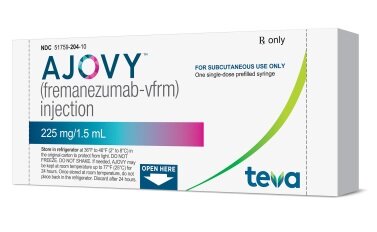
Ajovy is a monoclonal antibody drug that targets and binds to the calcitonin gene-related peptide (CGRP) ligand, blocking its interaction with receptors. CGRP is a neuropeptide that has been shown to be released during migraine attacks and is considered a trigger for migraine episodes. Currently, CGRP has become a hot target in the development of migraine medications.
To date, three anti-CGRP therapies have been approved in the United States and the European Union for the treatment of migraine, including:Novartis/Amgen Aimovig (erenumab),Eli LillyEmgality (galcanezumab) and Teva’s Ajovy (fremanezumab). In terms of administration, both Aimovig and Emgality are administered via subcutaneous injection once monthly, whereas Ajovy can be administered via subcutaneous injection either once monthly or once every three months, offering greater convenience and providing patients with a differentiated treatment option. In addition to the aforementioned three antibody drugs, Alder BioPharmaceuticalsMonoclonal Antibody DrugsEptinezumab (administered via intravenous infusion once every three months) is under regulatory review in the United States, with approval expected in early 2020; the drug has demonstrated response rates as high as 100% in certain patients.
It is worth mentioning that,Eli LillyEmgality received FDA approval for a new indication in June this year for the treatment of episodic cluster headache (ECH) in adults. With this approval, Emgality becomes the first and only medication for the treatment of ECH. The drug is also approvedFDAThe first and only CGRP-targeting antibody approved for the treatment of two distinct headache disorders. Regarding Teva, the company announced in April the termination of its Phase III clinical program for Ajovy in the treatment of cluster headache, based on a futility analysis.
Currently, several companies are still developing oral CGRP inhibitors. In early March this year, Allergan submitted a marketing application in the United States for the oral drug ubrogepant for the acute treatment of migraine (with or without aura).FDAA final review decision will be made in the fourth quarter of 2019. If approved, ubrogepant will become the first oral CGRP receptor antagonist for the acute treatment of migraine (with or without aura) in the U.S. market in the past 25 years.
However, in mid-March of this year, Biohaven Pharmaceuticals made a substantial investment of $105 million to acquire a Priority Review Voucher (PRV) from GW Pharmaceuticals, and in the second quarter of this year, it submitted toFDAA marketing application has been submitted for Zydis (rimegepant), an orally disintegrating tablet formulation of the oral CGRP receptor antagonist. This Priority Review Voucher (PRV) will be applied to the New Drug Application (NDA) review, shortening the standard 10-month review period by four months and enabling completion of the review within six months.
This means that Allergan and Biohaven have engaged in direct competition for the title of “first oral CGRP receptor antagonist.” Let us wait and see who will come out on top. (Bioon.com)
Original Source:Teva