

Johnson & Johnson's Darzalex in Combination with VMP Approved in Japan for First-Line Treatment of Transplant-Ineligible Multiple Myeloma
Aug 23, 2019 16:15
CST Updated
16:15

Genmab
Differentiated Antibody Therapy Developer

Johnson & Johnson
Healthcare Product Manufacturers, Health Service Providers

Janssen Pharmaceuticals
Pharmaceutical R&D Developer

August 23, 2019 /BioonBIOON/ -- Johnson & Johnson partner Genmab recently announced that the Japanese Ministry of Health, Labour and Welfare (MHLW) has approved the targeted anticancer drug Darzalex (daratumumab), in combination with bortezomib (a proteasome inhibitor), melphalan (an alkylating chemotherapy agent), and prednisone (a corticosteroid), for newlyDiagnosisnot suitable for autologous useStem CellsTreatment of patients with multiple myeloma (MM) undergoing autologous stem cell transplantation (ASCT).
Darzalex was developed pursuant to an agreement entered into in August 2012, under which Genmab granted Janssen Biotech, a Johnson & Johnson company, the exclusive global license to develop, manufacture, and commercialize Darzalex. With this approval in Japan, Genmab will receive a $70 million milestone payment from Janssen.
This approval is based on data from the Phase 3 clinical study ALCYONE (MMY3007). This study was a randomized, open-label, multicenter trial that enrolled a total of 706 patients with newlyDiagnosisof patients with multiple myeloma who are ineligible for autologous stem cell transplantation (ASCT). In the study, patients were randomly assigned to receive either 9 cycles of Darzalex plus VMP (bortezomib, melphalan, and prednisone) or VMP alone. In the Darzalex group, patients received Darzalex at a dose of 16 mg/kg: once weekly for 6 weeks (Cycle 1; one cycle = 42 days), once every 3 weeks during Cycles 2–9, and once every 4 weeks from Cycle 9 onward until disease progression. The primary endpoint was progression-free survival (PFS).
The results showed that, compared with the VMP treatment group, the Darzalex + VMP treatment group had a 50% significant reduction in the risk of disease progression or death. Detailed data were presented at the 2017 American Society of Hematology (ASH) Annual Meeting.Dr. Jan van de Winkel, CEO of Genmab, stated: “Multiple myeloma remains one of the most common types of blood cancer in Japan. The Darzalex + VMP regimen will provide new”Diagnosisprovides an important new treatment option for patients with multiple myeloma who are not suitable for ASCT.”
Darzalex: The world’s first CD30-targetingMonoclonal Antibody Drugs, with sales reaching $2 billion in 2018
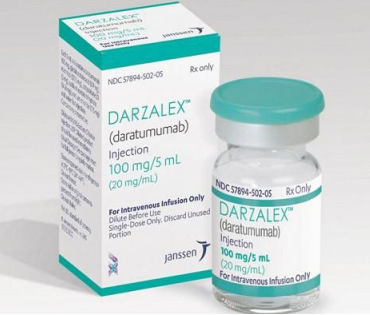
Darzalex is the first CD38-mediated, cytolytic antibody drug approved globally, with broad-spectrum killing activity. It can target and bind to the CD38 molecule, a transmembrane extracellular enzyme highly expressed on the surface of multiple myeloma cells and various solid tumor cells. Darzalex induces rapid death of tumor cells through multiple immune-mediated mechanisms of action, including complement-dependent cytotoxicity (CDC), antibody-dependent cell-mediated cytotoxicity (ADCC), antibody-dependent cellular phagocytosis (ADCP), and viaApoptosis(apoptosis). Furthermore, Darzalex has also been shown to targetTumorImmunosuppressive cells in the microenvironment thereby exhibit immunomodulatory activity.
Darzalex is a product heavily developed by Johnson & Johnson. In addition to multiple myeloma, Darzalex also has the potential to treat other types of cancers with high expression of CD38 molecules.Tumor, including diffuse large B-cell lymphoma (DLBCL), chronic lymphocyticLeukemia(CLL), acute lymphoblastic leukemia (ALL), plasma cell leukemia (PCL), acute myeloid leukemia (AML), follicular lymphoma (FL), and mantle cell lymphoma (MCL).
In the United States, Darzalex was first approved in November 2015FDAApproved, with global sales exceeding $2 billion in 2018. Currently, the indications for Darzalex include: (1) as a monotherapy for adult patients with multiple myeloma (MM) who have previously received at least three prior therapies, including a proteasome inhibitor (PI) and an immunomodulatory agent (IMiD), or who are double-refractory to both a PI and an IMiD; (2) in combination with lenalidomide and dexamethasone, or in combination with bortezomib and dexamethasone, for adult patients with MM who have received at least one prior therapy; (3) in combination with pomalidomide and dexamethasone, for adult patients with MM who have previously received at least two prior therapies, including lenalidomide and a PI; (4) in combination with bortezomib, melphalan, and prednisone, for patients ineligible for autologousStem Cellsadult patients with newly diagnosed multiple myeloma (NDMM) eligible for autologous stem cell transplantation (ASCT); this approval makes Darzalex the first therapy approved for the treatment of NDMMMonoclonal Antibody Drugs(5) In combination with lenalidomide and dexamethasone, for adult patients with newly diagnosed multiple myeloma (MM) who are ineligible for autologous stem cell transplantation (ASCT).
In February this year, a split-dose regimen of Darzalex also receivedFDAApproved. This regimen will allow healthcare professionals to choose, as needed, when treating MM patients, to administer the first intravenous infusion of Darzalex as split infusions over two consecutive days instead of a single one-time infusion.
In July this year, the subcutaneous formulation of Darzalex was submitted for marketing approval in the United States and Europe. Phase III clinical study data demonstrated that the subcutaneous formulation of Darzalex was non-inferior to the intravenous formulation in terms of efficacy (overall response rate: 41% vs. 37%; ratio=1.11; 95% CI: 0.89-1.37) and pharmacokinetics (daratumumab trough concentration [Ctrough]: 499 mg/mL vs. 463 mg/mL; ratio=108%; 90% CI: 90%-122%). Additionally, the subcutaneous administration required significantly less time (5 minutes vs. more than 3 hours) and was associated with a lower incidence of infusion-related reactions (13% vs. 35%). (Bioon.com)
Original Source:Genmab