

Smashing 3500 GPUs, NVIDIA GTC Outlines the "Ultimate Blueprint" for Medical AI
NVIDIA
Artificial Intelligence Computing Service Provider
Recently, NVIDIA unveiled a series of key technological advancements covering healthcare and life sciences at its annual GTC conference, forming a complete chain from underlying computing power to vertical tools and further into the penetration of industry value chains. These advancements are outlining NVIDIA's grand vision in healthcare AI, transforming AI from an auxiliary tool into a core engine driving industrial change.
Looking at the medical AI landscape showcased by NVIDIA at GTC 2026, its layout is not a scattered series of technical releases but a logically clear, progressively layered systematic strategy aimed at deeply integrating into and accelerating the value cycle of the entire healthcare industry.
First, it is to solidify the foundation and provide universal "computing power" and "data".
NVIDIA's enterprise-level AI computing infrastructure, built with the Blackwell architecture GPU and more, provides indispensable underlying computing power for processing massive amounts of genomic, protein, and medical imaging data. At the same time, by opening up key databases like the protein complex database, Nemotron model weights, and trillion-parameter genome maps, it offers critical data for industry innovation, significantly lowering the innovation barrier from academic research to enterprise R&D.
Secondly, on this basis, NVIDIA builds tools to create platforms and "roadmaps" for vertical fields.
In recent years, NVIDIA has gradually delved into specific aspects of healthcare, creating an end-to-end domain-specific platform that transforms foundational capabilities into direct productivity: for drug discovery, there is the BioNeMo platform with integrated acceleration tools and AI models; for surgical robots, there is the Isaac for Healthcare framework and Rheo blueprint, which provide physics simulation, datasets, and foundational models; for digital health, there is the NeMo framework, which facilitates fine-tuning and deployment. These platforms enable biologists, clinical developers, and engineers to focus more on domain innovation rather than underlying technologies.
Finally, it is about gradually penetrating the value chain, allowing AI to shift from single-point empowerment to a complete chain restructuring.
The goal of the aforementioned infrastructure and tool platforms is to systematically embed and reshape the entire value chain of healthcare. From upstream basic research (protein/gene discovery) to core drug R&D and production (AI-driven molecular design, digital twin factories), and finally to patient diagnosis and treatment (surgical robots, digital pathology, intelligent health agents), NVIDIA's solutions are empowering and accelerating the entire chain.
NVIDIA is transforming AI from an auxiliary tool into a core engine driving the transformation of the healthcare industry through its deep strategic layout of "infrastructure-tools-value chain." A future with faster, more precise, and more personalized healthcare could soon transition from vision to reality.
Among all releases, Roche's AI factory deployment is considered the most representative case at the infrastructure level.
Roche announces deployment of over 3,500 NVIDIA Blackwell GPUs worldwide, building a hybrid cloud and on-premises AI computing backbone across multiple sites in the US and Europe. This marks the largest GPU deployment disclosed to date in the pharmaceutical industry.
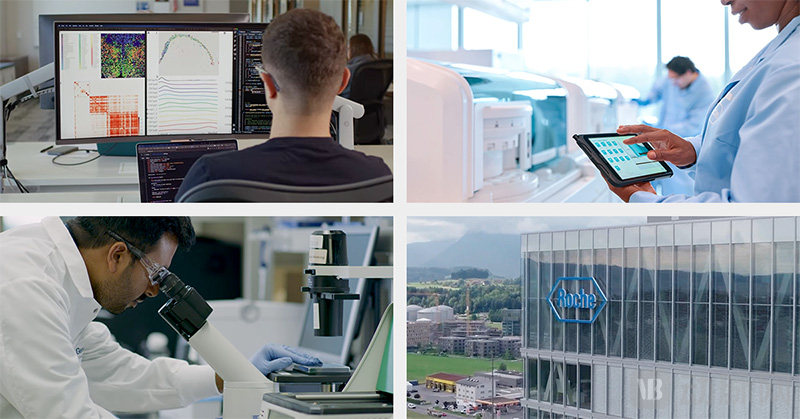
NVIDIA Collaborates with Roche to Create the Largest GPU Deployment in the Pharmaceutical Industry (Image courtesy of NVIDIA)
Roche's Chief Digital and Technology Officer Wafaa Mamilli highly praised this advancement, stating that it will enable Roche to gain deep insights simultaneously in both pharmaceuticals and diagnostics.
It is worth mentioning that Roche is not simply cramming GPUs into data centers. Its strategy is to transform accelerated computing and AI from isolated pilot projects into core operational capabilities that run through the entire chain of pharmaceuticals, diagnostics, and manufacturing.
AI's breakthroughs in the life sciences field rely heavily on high-quality, large-scale data. NVIDIA is collaborating with top research institutions worldwide to build and open a series of unprecedented biological datasets and open models.
NVIDIA Collaborates with Google DeepMind, EMBL, and Others to Release the World's Largest Protein Complex Dataset, Adding 1.7 Million High-Confidence Predicted Protein Complex Structures to the AlphaFold Database
Basecamp Research's "Trillion Gene Atlas" – launched in collaboration with Anthropic, Ultima Genomics, and PacBio – aims to expand insights into genetic diversity by 100 times. Basecamp Research's BaseData dataset is already 10 times larger than the combined total of all public databases and will now expand by another 100 times to train more powerful biological foundation models.
At the model level, NVIDIA provides open model weights and recipes through the Nemotron open model family. Unlike reliance on closed-source, expensive general-purpose large models, Nemotron enables medical institutions and health technology companies to securely fine-tune and deploy customized digital health agents (Agent) on their own infrastructure based on private data, thereby firmly maintaining data control.
In recent years, NVIDIA has gradually delved into specific aspects of healthcare, creating an end-to-end domain-specific platform that transforms foundational capabilities into direct productivity.
NVIDIA's dedicated platform for the biology field, BioNeMo, can accelerate genomics and virtual cell research, and is playing a role in multiple cutting-edge directions.
In the scenario of accelerating drug discovery, AI has become the core of Genentech's "Lab Closed-loop" strategy, a subsidiary of Roche. Under this strategy, experiments, data, and AI form an iterative closed loop to jointly tackle the most challenging scientific problems. Currently, nearly 90% of Genentech's eligible lead compound projects have integrated AI.
With the help of AI deployment, Genentech's efficiency has been greatly improved. The design speed of a degradative molecule for oncology has increased by 25%; the delivery time of another "backup molecule," developed in parallel to reduce R&D risks, has been significantly shortened from over two years to seven months.
With the help of NVIDIA Blackwell and the NVIDIA BioNeMo platform running on its AI factory, Roche is able to train and fine-tune biological and molecular foundational models, integrate proprietary datasets, and expand AI-driven laboratory automation, thereby exploring a broader biological and chemical space at a faster pace.
The Parabricks tool integrated into BioNeMo can increase the processing speed of genomic data by 10 times. Basecamp Research is leveraging this capability to handle trillion-level genetic data, reducing analysis that would have taken over 20 years to less than two years.
Tahoe has built the world's largest single-cell dataset (Tahoe-100M) containing 100 million cells, and plans to use the DGX B200 system to scale it up to 1 billion cells, aiming to create AI models capable of simulating real cell behavior, thereby reducing expensive and time-consuming "wet lab experiments."
In addition, PerturbAI released the largest in vivo CRISPR functional genomics atlas, utilizing CUDA-X to accelerate the analysis of nearly 8 million brain cell data, exploring gene functions almost in real-time to uncover new mechanisms of neurodegenerative diseases.
NVIDIA also unveiled its first domain-specific physical AI platform and toolkit for medical robots at this year's GTC, aiming to provide the "intelligent brain" and a highly realistic "training ground" for the next generation of surgical robots. This also signifies that, as applications deepen, the scope of AI in the medical field is expanding from on-screen data analysis to precise physical interactions in the real world.
This set of physical AI tools consists of the following four parts.
Open-H is the world's largest open medical robotics dataset, containing over 700 hours of real surgical videos, providing valuable real-world diversity for training general robotic systems.
Cosmos-H is a family of physics-based synthetic data generation models. It can generate highly realistic surgical simulation videos on a large scale based on text instructions or reference videos, for infinite expansion of training data and safe evaluation of different robotic operation strategies.
GROOT-H is a vision-language-action foundational model. It can understand natural language instructions such as "Pass me the surgical clamp" and generate corresponding robot action sequences, which is key to enabling robots to possess the ability to understand and execute complex tasks.
Finally, there is the Rheo developer blueprint, which is used to create high-fidelity digital twins of hospital environments, enabling the development and testing of automated processes and robots in a safe and controlled virtual setting.
Currently, leading global medical technology companies, including CMR Surgical and Johnson & Johnson Medical Technologies, have begun adopting this set of tools to accelerate the workflow development, synthetic data generation, and strategy evaluation of their surgical robots. Perhaps, the era of explosive growth for surgical robots is just around the corner.
Facing海量non-structured data such as clinical documents, patient inquiries, and medical research, previous AI models often fell short. NVIDIA, through its Nemotron open model family and the NeMo framework, is sparking a "smart agent" revolution in the digital health field. The core value lies in high efficiency, low cost, and data sovereignty.
Unlike reliance on closed-source, expensive general-purpose large models, Nemotron provides open model weights and recipes. This enables medical institutions and health technology companies to securely fine-tune and deploy customized digital health agents (Agents) on their own infrastructure based on private data, ensuring firm control over data ownership. For example, according to a report by Heidi Health, by adopting the Nemotron speech model to process clinical documentation, system latency was reduced by 75%, while operating expenses decreased by 64%.

Nemotron Health Agent (Image courtesy of NVIDIA)
What was little known before is that these open models are being widely used in the industry to build the next generation of medical applications.
For instance, Hippocratic AI is training an AI health assistant capable of providing real-time, low-cost health advice to patients through conversations. Sword Health is leveraging NeMo reinforcement learning to optimize its AI-driven mental health coaching model. The recently skyrocketing OpenEvidence is building intelligent agents that can synthesize vast amounts of medical literature and provide evidence-based insights by deploying Nemotron.
With the help of the Nemotron open model family and the NeMo framework, an Agent revolution is underway.
The goal of the aforementioned infrastructure and tool platforms is to systematically embed and reshape the entire value chain of healthcare. From upstream basic research (protein/gene discovery) to core drug development and production (AI-driven molecular design, digital twin factories), and finally to patient diagnosis and treatment (surgical robots, digital pathology, intelligent health agents), NVIDIA's solutions are empowering and accelerating the entire chain.
In the drug discovery process, Roche has upgraded AI from an experimental tool to a core operational capability — 90% of lead compound projects have integrated AI, reducing the delivery time for candidate drugs from two years to seven months and increasing the efficiency of degrader molecule design by 25%. Meanwhile, the opening of protein complex databases and trillion gene maps allows researchers worldwide to start from a higher point in the search for new drug targets.
In the drug manufacturing process, Roche uses Omniverse to create a digital twin for its new GLP-1 production base in North Carolina. AI is also applied in regulatory documentation, quality assurance, and production scheduling. Given Roche's massive scale, even minor efficiency improvements can create ripples throughout the global supply chain.
In the clinical diagnosis process, accelerated computing and Parabricks enable Roche to scan a large number of images to detect subtle disease patterns, while NeMo Guardrails can be used to ensure the safety and reliability of AI in medical scenarios.
In the surgical robotics sector, CMR Surgical contributed nearly 500 hours of surgical video for the pre-training of GR00T-H. Johnson & Johnson Medical Technologies utilized the Cosmos foundational model and anatomical simulations to generate training data for its MONARCH urology platform, while PeritasAI trained humanoid robots to introduce embodied intelligence into the operating room.
In the patient service segment, Heidi Health’s 75% reduction in delays and 64% decrease in operational expenses demonstrate the commercial viability of open models. Companies like Hippocratic AI, Sword Health, and OpenEvidence are building intelligent health agents for patients.
NVIDIA is transforming AI from an auxiliary tool into a core engine driving the transformation of the healthcare industry through its deep "infrastructure-tools-value chain" layout. A future with faster, more precise, and more personalized healthcare could soon move from vision to reality.