

Top 10 Diabetes Companies in 2019: Novo Nordisk and Eli Lilly Lead as GLP-1 Therapies Emerge as Market Favorites

Merck Group
Pharmaceutical R&D Developer
Novo Nordisk
Insulin Developer and Manufacturer
Eli Lilly
Global Pharmaceutical R&D and Production Company

MSD
Pharmaceutical R&D and Manufacturer
According to the latest report from NAVADHI Market Research, the global diabetes drug market is projected to reach $56.18 billion by 2023.
In mid-2019, major players in the diabetes sector released their annual reports for fiscal year 2018. Based on the revenue performance of their diabetes businesses, the top 10 global pharmaceutical companies in diabetes care became clearly evident.
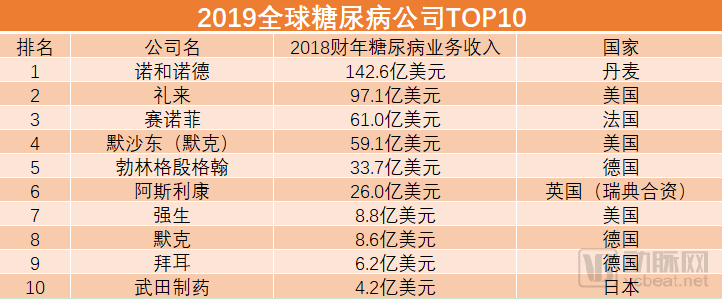
In 2018, the combined sales revenue of the top 10 global antidiabetic drugs reached $28.5 billion, with leading products dominated by insulin, dipeptidyl peptidase-4 (DPP-4) inhibitors, and glucagon-like peptide-1 (GLP-1) receptor agonists. Metformin, widely used in clinical practice, was excluded from the list due to its low price following patent expiration. Meanwhile, the emerging sodium-glucose cotransporter-2 (SGLT2) inhibitors are expected to enter the list next year, driven by their rapid growth rate.
Furthermore, insulin, the primary class of medications for diabetes, is facing a stalemate characterized by both internal and external challenges. This situation stems from the expiration of patents on multiple products and intensifying competition driven by the rapid development of biosimilar technologies. The market shares of several blockbuster insulin drugs are being gradually eroded; for instance, Sanofi’s insulin glargine, as well as Novo Nordisk’s insulin aspart, insulin detemir, and human insulin, have all experienced declines in market performance.
Furthermore, with no clear new developments in oral insulin in the second half of 2019, market expectations for insulin gradually declined in the face of the aggressive rise of GLP-1 receptor agonists and SGLT2 inhibitors.
Currently, the diabetes market remains dominated by a few major players, with Novo Nordisk, Sanofi, Eli Lilly, and MSD collectively accounting for 72% of the market share.
Among the perennial contenders for leadership in the diabetes market, Novo Nordisk and Eli Lilly are fiercely competing in the development of GLP-1 receptor agonists. Currently, Novo Nordisk appears to hold the upper hand, with its semaglutide undoubtedly poised to lead the trend in glucose-lowering therapies.
In contrast, established giants Sanofi and MSD have struggled somewhat due to business restructuring.
Notably, industry rising star Boehringer Ingelheim has delivered impressive sales performance through its collaboration with Eli Lilly to launch empagliflozin, and is even poised to directly challenge the monopoly held by the “Big Four” in diabetes care, thereby ascending to the ranks of the oligopoly.
The future of the diabetes market remains uncertain and is worth watching.
Novo Nordisk is currently a healthcare company, widely recognized in the industry as a diabetes giant and the world’s largest insulin manufacturer. The company has long been dedicated to the research, development, manufacturing, and sales of pharmaceutical products on a global scale.
In 2018, Novo Nordisk, a seasoned and resilient leader in the diabetes field, leveraged the surge of GLP-1 receptor agonists and its extensive insulin pipeline to secure the top-selling diabetes drug and widen its gap with competitors, marking a period of remarkable success.
The advantages of GLP-1 receptor agonists lie in their ability to provide additional cardiovascular benefits while lowering blood glucose, as well as reducing food intake and delaying gastric emptying, which facilitates weight control. Furthermore, the incidence of hypoglycemic events is significantly lower compared with insulin therapy.
The half-life of endogenous GLP-1 in the human body is very short. Although early modified GLP-1 receptor agonists showed some improvement in half-life, their dosing intervals remained short, and their clinical advantages in glycemic control were not significant enough. However, with the market launch of Novo Nordisk’s liraglutide and Eli Lilly’s long-acting GLP-1 receptor agonist dulaglutide in 2014, GLP-1 receptor agonists experienced rapid growth.
Liraglutide replaced insulin aspart as Novo Nordisk’s flagship product, generating $4.63 billion in revenue in 2018 and becoming a veritable blockbuster drug.
To further consolidate its dominant market position, Novo Nordisk has launched an oral formulation of semaglutide, addressing the management of diabetes as a chronic condition and offering improved patient adherence. With the anticipated future approvals for weight management and cardiovascular indications, semaglutide is poised to become Novo Nordisk’s primary growth driver.
Its large-scale series of clinical trials, PIONEER 1–10, sequentially demonstrated superiority over empagliflozin (the best-selling SGLT2 inhibitor) and sitagliptin (the best-selling DPP-4 inhibitor), and showed efficacy comparable to liraglutide (the best-selling GLP-1 receptor agonist). The drug exhibited superior glycemic control and weight loss effects compared to existing marketed agents, delivering significant clinical benefits to patients with type 2 diabetes receiving basal insulin therapy.
Novo Nordisk's semaglutide will undoubtedly lead the new trend in glucose-lowering drugs.
Eli Lilly and Novo Nordisk have long vied for the top position in the diabetes sector.
In 2018, Eli Lilly’s long-acting GLP-1 receptor agonist dulaglutide delivered impressive performance, making the rapid growth of GLP-1 receptor agonists the most striking feature of today’s diabetes market, as well as the intense, back-and-forth competition between Novo Nordisk and Eli Lilly and Company.
According to Eli Lilly’s financial reports, revenue from dulaglutide has maintained rapid annual growth, gradually narrowing the market gap with Novo Nordisk’s liraglutide and at one point showing a trend that “it was poised to surpass liraglutide’s leading position within two years.”
However, Novo Nordisk had long prepared for this challenge. Its blockbuster product, semaglutide, outperformed Eli Lilly’s dulaglutide in both glycemic control and weight loss efficacy, causing the latter to lose its title as “the best diabetes drug in history.”
However, Eli Lilly’s other strategic initiatives in diabetes care are expected to help it regain its footing.
Since its approval by the FDA in 2012, SGLT-2 inhibitors have emerged as a major trend in diabetes drug development in recent years, with the market demonstrating an overall upward trajectory. Notably, empagliflozin, developed through the collaboration between Eli Lilly and Boehringer Ingelheim, has delivered impressive performance and is highly anticipated by the industry.
The Battle for Leadership Between Eli Lilly and Novo Nordisk Will Remain a Protracted Struggle in the Future
Sanofi’s dominance in the diabetes sector was built primarily on its insulin glargine product, Lantus. However, with the launch of Eli Lilly’s insulin glargine biosimilar, sales of Sanofi’s Lantus began to decline rapidly, reaching €4.622 billion in 2017, a 19% decrease from 2016. To maintain its market position, Sanofi developed Toujeo, a new formulation of insulin glargine, which generated €816 million in sales in 2017.
In 2019, Sanofi suffered a “Waterloo”: first, the patent expiration of its flagship product, insulin glargine; second, Soliqua (insulin + GLP-1), a blockbuster drug on which high hopes were pinned in R&D, significantly underperformed compared to Novo Nordisk’s semaglutide.
Furthermore, Sanofi and its partner Lexicon announced that the U.S. Food and Drug Administration (FDA) rejected the marketing application for sotagliflozin (brand name Zynquista), a dual SGLT1/2 inhibitor indicated for the treatment of type 1 diabetes in adults, in March 2019, although the specific reasons were not disclosed. It was reported that an FDA advisory panel failed to reach a consensus in January of this year on the core issue of whether the drug’s benefits outweighed its risks. Affected by this news, Sanofi’s diabetes business revenue experienced a decline.
Whether Sanofi can make a comeback remains to be seen, depending on its performance in 2020.
Compared with Novo Nordisk, Eli Lilly, and Sanofi, MSD’s product pipeline in the diabetes field is relatively limited, with its flagship diabetes products being sitagliptin and its combination formulation with metformin.
In October 2006, the U.S. FDA approved sitagliptin, either as monotherapy or in combination with metformin or thiazolidinediones, to improve glycemic control in patients with type 2 diabetes. Sitagliptin’s sales surpassed $1 billion within its third year on the market; however, with the impending expiration of its patent and the emergence of novel GLP-1 receptor agonists, sales of sitagliptin began to decline in 2017.
However, MSD has achieved remarkable success in oncology immunotherapy, which may explain why it appears to have little bandwidth to address the patent expiration of sitagliptin, with no standout products in its R&D pipeline to follow up.
Boehringer Ingelheim’s most prominent commercial activity in 2019 was the collaborative development of empagliflozin with Eli Lilly. Empagliflozin is currently the only oral antidiabetic drug proven to deliver significant benefits in glycemic control, cardioprotection, renal protection, and weight reduction. It is projected to achieve $3.5 billion in sales by 2024, securing its place among the top three antidiabetic medications.
As a rising star in the diabetes market, Boehringer Ingelheim has seen its sales soar with the launch of empagliflozin. Industry insiders have even predicted that Boehringer Ingelheim is poised to surpass Sanofi in the coming years and secure a spot among the top three diabetes companies.
Similar to empagliflozin, co-developed by Eli Lilly and Boehringer Ingelheim, AstraZeneca’s diabetes drug Farxiga has also demonstrated impressive market performance.
British pharmaceutical giant AstraZeneca presented exploratory analysis data from the landmark cardiovascular outcomes trial (CVOT) DECLARE-TIMI 58 for its SGLT2 inhibitor glucose-lowering drug Farxiga (Andatang; generic name: dapagliflozin) at the 79th Scientific Sessions of the American Diabetes Association (ADA 2019) held in San Francisco in 2019.
It is reported that this study is the largest cardiovascular outcomes trial (CVOT) of SGLT2 inhibitors conducted to date, involving more than 17,000 patients across 33 countries worldwide. The results showed that, compared with placebo, dapagliflozin significantly reduced the risk of kidney disease progression or renal death in patients with type 2 diabetes.
In terms of global market deployment, AstraZeneca’s dapagliflozin has successfully obtained approval in Japan, meaning that patients with type 1 diabetes who are treated with insulin alone but cannot adequately control their blood glucose levels now have a new oral treatment option.
Unlike other giants that have actively expanded their diabetes businesses, Johnson & Johnson sold its diabetes unit, LifeScan, for RMB 13.5 billion in 2018 to Platinum Equity. LifeScan is a subsidiary of Johnson & Johnson specializing in the production of blood glucose monitoring products, and has launched a series of blood glucose meters and test strips under the brand names OneTouch Ultra, OneTouch SureStep, OneTouch UltraSmart, and OneTouch Verio.
In fact, Johnson & Johnson had long been planning to divest its diabetes business. In addition to the intensive divestitures of its diabetes and sterilization/disinfection businesses, the company has simultaneously made aggressive acquisitions in surgical, orthopedic, and ophthalmic segments, making its strategic restructuring increasingly clear.
Nevertheless, Johnson & Johnson’s diabetes drug continued to demonstrate outstanding performance. In 2018, the Phase III CREDENCE clinical trial of Johnson & Johnson’s glucose-lowering agent Invokana (canagliflozin), which assessed renal outcomes, was terminated early due to its particularly significant efficacy. This medication may become the first new drug in 15 years capable of slowing the progression of kidney disease in patients with type 2 diabetes.
In addition, Johnson & Johnson’s breakthrough glucose-lowering drug canagliflozin was approved in China in September 2017 under the brand name Invokana. In 2018, Xi’an Janssen and Merck Serono entered into a marketing collaboration agreement to officially launch Invokana in the Chinese market. Under the agreement, the two companies will collaborate closely on the further development, distribution, promotion, market access, and sales of Invokana, with Merck holding exclusive promotional rights for the product in the Chinese market.
Merck’s most notable initiative in the diabetes field in 2018 was its partnership with Johnson & Johnson’s subsidiary, Xian Janssen Pharmaceutical Ltd. (Xian Janssen), to officially launch Invokana (canagliflozin tablets), a new medication for type 2 diabetes, in mainland China.
Yikean is a sodium-glucose cotransporter 2 (SGLT2) inhibitor with an innovative mechanism of action. Approved in September 2017, it is indicated, in conjunction with diet and exercise, to improve glycemic control in adults with type 2 diabetes mellitus when used in combination with metformin alone or with metformin and a sulfonylurea, in cases where glycemic control is not adequately achieved with metformin alone or with metformin and a sulfonylurea.
Yikean is the first type 2 diabetes treatment drug launched by Xi’an Janssen. Based on the cooperation agreement signed by both parties, Xi’an Janssen has granted Merck the exclusive rights to promote Yikean in mainland China. The two companies will also collaborate closely on the subsequent development, distribution, promotion, market access, and sales of Yikean.
It is reported that Invokana (canagliflozin tablets) has been marketed in many countries and regions, including the United States, Canada, Mexico, and Europe.
Bayer’s most renowned product in the Chinese market is acarbose. Reportedly, acarbose is the leading oral medication for diabetes in China. According to publicly available data cited from Menet, the expenditure on acarbose in public medical institutions reached RMB 7.42 billion in 2017, with a growth rate exceeding 18%. The combined market size, including the retail sector, is estimated to be approximately RMB 8.5 billion.
Recently, Huadong Medicine announced that its wholly-owned subsidiary, Zhongmei Huadong, received the "Approval for Supplementary Drug Application" issued by the National Medical Products Administration. The acarbose tablets (50mg) produced by Zhongmei Huadong became the first domestically produced generic drug to pass the consistency evaluation of quality and efficacy in China.
Public data indicates that the multinational company Bayer holds nearly a 60% share of the acarbose market. However, Hangzhou Zhongmei Huadong Pharmaceutical, which has already passed the consistency evaluation, also holds a significant market position, with its market share exceeding 30%. Due to the retail price difference between domestically produced drugs and original research products from foreign companies, the gap in prescription volume is significantly smaller than the gap in market share. Following the consistency evaluation, state-owned pharmaceutical enterprises are expected to substantially expand their market share, thereby replacing original research products from foreign companies.
Over the next one to two years, market share is likely to shift between state-owned enterprises and originator companies. Luye Pharma, which currently holds approximately 9% of the market, is also actively advancing its market development. However, given the limited number of competitors for this product, future market competition is not expected to be overly intense.
Takeda Pharmaceutical’s most renowned diabetes-related product is undoubtedly Trelagliptin, a once-weekly dipeptidyl peptidase-4 (DPP-4) inhibitor that controls blood glucose levels through selective and sustained inhibition of DPP-4.
In 2015, Takeda Pharmaceutical’s trelagliptin was approved by Japan’s Ministry of Health, Labour and Welfare (MHLW), becoming the world’s first once-weekly antidiabetic drug. However, it is reported that Takeda has no plans to market trelagliptin globally. Furthermore, Datamonitor Healthcare predicts that sales of this inhibitor in Japan will grow steadily, peaking in 2023.
Takeda’s original voglibose also holds a place in the Chinese market. Acarbose and voglibose have long dominated China’s antidiabetic drug market. Voglibose, marketed as Besen by Takeda Pharmaceutical, was launched in Japan in 1994 and entered the Chinese market in 1999. Due to its lower incidence of gastrointestinal side effects, voglibose experienced rapid growth after its market entry.
Since voglibose is produced via semi-fermentation combined with chemical synthesis or fully chemical synthesis, its manufacturing process is simpler than that of acarbose, resulting in a more fragmented competitive landscape. According to sample hospital terminal data, Takeda Pharmaceutical’s BeiXin holds a market share of 54.7%, Jiangsu Chenpai accounts for approximately 30.7%, and Chensin Pharmaceutical and Zhejiang Zhenyuan hold 5.5% and 4.1%, respectively.
This article is compiled based on the VCBeat Special Report Pro, “Top 10 Diabetes Companies of 2019: Novo Nordisk and Eli Lilly Lead the Pack, GLP-1 Emerges as the New Market Favorite.” The ranking of diabetes companies will be continuously updated. For more insights into the corporate developments of major players in the diabetes sector, please scan the QR code below to read further!

More unicorn rankings, more investment and financing news, more in-depth analyses of leading companies’ businesses, and more comprehensive industrial consulting insights—all on VCBeat.Special Topic Pro! Scan the QR code below to read!
