

Cell Study Reveals 3D Structure of Chemokine Receptor CCR7 and Identifies Promising Compounds for Treating Common Cancers

Roche
Oncology Drug Research, Development, and Manufacturing

Paul Scherrer Institute
The Paul Scherrer Institute (PSI) is Switzerland’s largest research institution for natural and engineering sciences, conducting cutting-edge research in three main areas: matter and materials, energy and the environment, and human health. PSI develops, builds, and operates complex large-scale research facilities. Each year, more than 2,400 scientists from Switzerland and around the world come to PSI to conduct experiments using our unique facilities—experiments that cannot be performed anywhere else. PSI is committed to nurturing the next generation. Accordingly, approximately one-quarter of our staff consists of apprentices, graduate students, or postdoctoral researchers. For school students, PSI offers the iLab school laboratory.
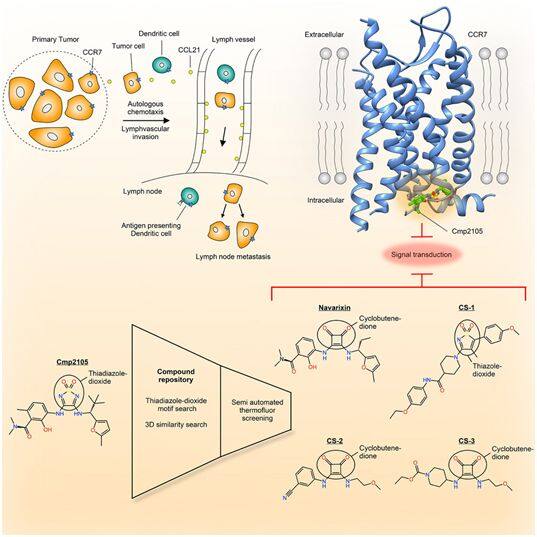
When cancer cells spread throughout the body, secondary tumors known as metastases can form. These secondary tumors are responsible for approximately 90% of cancer-related deaths. A major pathway for the dissemination of cancer cells is through the lymphatic system, which, like the vascular system, extends throughout the entire body and interconnects lymph nodes. As white blood cells migrate via the lymphatic system to coordinate defense against pathogens, the chemokine receptor 7 (CCR7), a specific membrane protein, plays a crucial role. Located in the cell membrane, CCR7 receives external signals and transmits them into the cell interior. In collaboration with Roche, researchers at the Paul Scherrer Institute have, for the first time, elucidated the structure of CCR7, laying the foundation for the development of drugs that can inhibit the metastasis of certain common cancers.
In the cells of all vertebrates, 20 different chemokine receptors can interact with more than 40 signaling proteins known as chemokines. Each of these signaling proteins is specific to a particular receptor. In turn, when a signaling protein binds to its receptor, it triggers intracellular processes that lead to a specific cellular response directed against the signal carried by that signaling protein.
CCR7 is one of the receptors that regulate cell migration within the body. Once appropriate signaling proteins in the extracellular environment bind to it, a cascade reaction within the cell directs the cell to move toward the highest concentration of these signaling proteins. Cells follow the chemokine gradient, much like hounds tracking a scent. For instance, white blood cells, as crucial components of the immune system, continuously migrate to the lymph nodes.
Cancer cells can also exploit CCR7, hijacking this cell receptor for their own purposes. Appropriate signaling proteins guide them out of the tumor and into the lymphatic system. Furthermore, they disseminate throughout the body and ultimately form metastases in other tissues. These metastaticTumorSignificantly increases the risk of patient mortality.
To improve the survival rates of cancer patients, inhibiting this process of cancer cell metastasis holds significant medical importance. This is why researchers at the Paul Scherrer Institute used X-ray crystallography at the institute’s Swiss Light Source (SLS) to elucidate the structure of the CCR7 receptor.
This structure formed the basis for collaboration with Roche to identify suitable active agents. Steffen Brünle, co-first author of the paper, explained, “Appropriate active agent molecules can prevent signaling proteins from binding to this receptor and triggering intracellular responses.” Determining the structure of this receptor posed a significant challenge. Jörg Standfuss, co-corresponding author of the paper and co-head of the Time-Resolved Crystallography research group at the Paul Scherrer Institute, stated, “The difficulty in this regard lies primarily in cultivating suitable crystals in a manner that allows us to study them using X-ray crystallographic diffraction techniques.” To accelerate the research process, Roche developed its own novel protein modification technology module, known as crystallization chaperones.
Leveraging information on the precise structure of this receptor, they identified five potential drug-like molecules that block the receptor, such as Navarixin, which prevents signals carried by signaling proteins from being transmitted into cells. Navarixin is a multi-target antagonist. These five compounds may serve as candidate drugs for potential cancer therapies.Brünle stated, “Our experiments demonstrate that this artificial molecule within the cells binds to this receptor. This prevents the initiation of the cascade reaction that leads to cell migration.” (Bioon.com)
References:
1.Kathrin Jaeger et al. Structural Basis for Allosteric Ligand Recognition in the Human CC Chemokine Receptor 7. Cell, 2019, doi:10.1016/j.cell.2019.07.028.
2.Preventing tumor metastasis
https://medicalxpress.com/news/2019-08-tumor-metastasis.html